


Listen to the article
Canada and India to Fast-Track Trade Deal After Two-Year Diplomatic Freeze
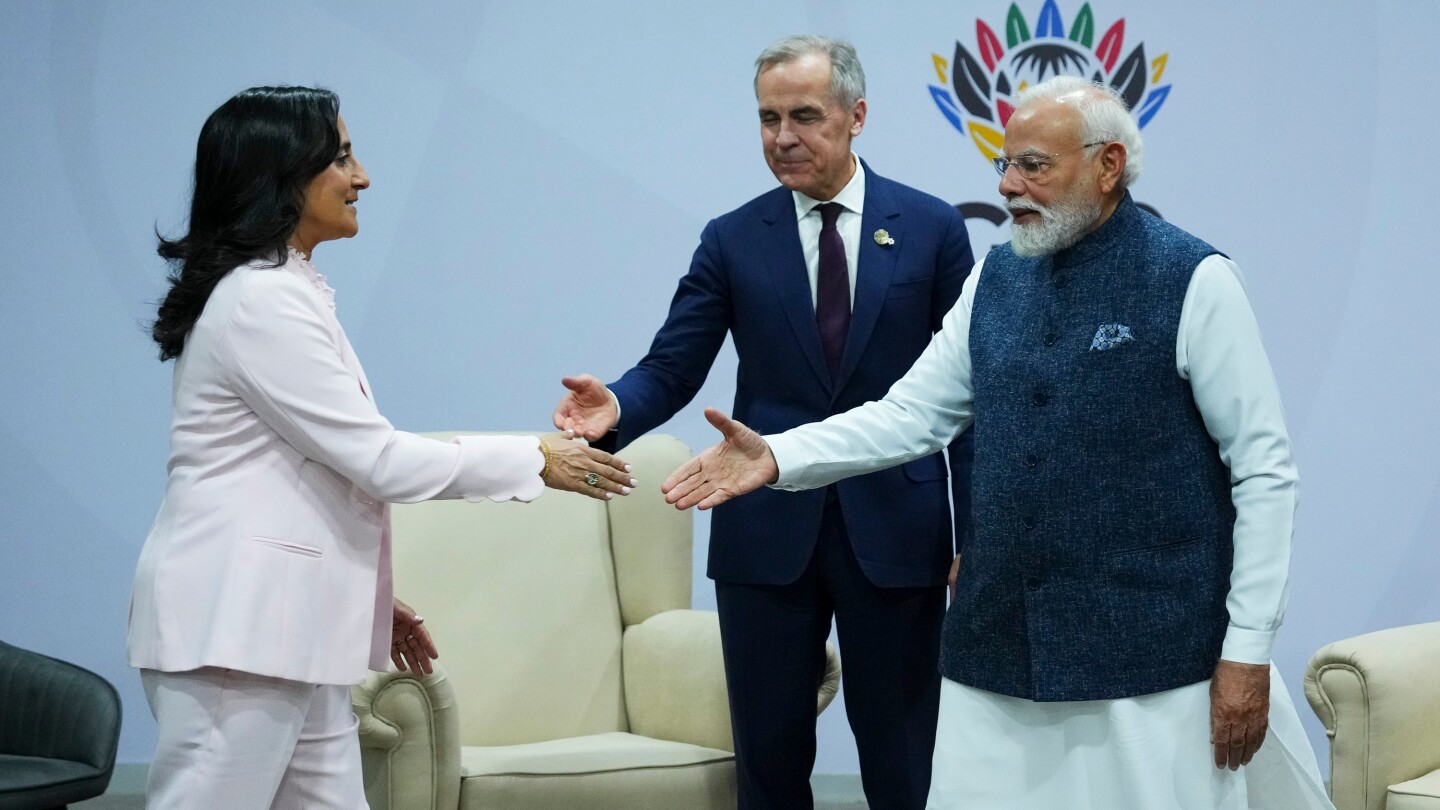
Canadian Foreign Minister Anita Anand announced Monday that Canada and India will move swiftly to advance a new trade agreement, marking a significant diplomatic reset after two years of strained relations between the nations.
The renewed trade push follows a productive meeting between Canadian Prime Minister Mark Carney and Indian Prime Minister Narendra Modi at the Group of 20 summit in South Africa over the weekend. Both leaders agreed to restart trade talks that had been suspended amid serious diplomatic tensions.
“The leaders were adamant that this work proceed as quickly as possible so that timing is going to be expeditious,” Anand told The Associated Press in a telephone interview. She confirmed that Prime Minister Carney plans to visit India in early 2024 to further strengthen bilateral ties.
Relations between the two countries deteriorated dramatically in 2023 when Canadian authorities publicly accused the Indian government of involvement in the assassination of Hardeep Singh Nijjar, a Sikh activist who was gunned down outside a temple in Surrey, British Columbia. Nijjar, 45, a Canadian citizen who owned a plumbing business, was a prominent advocate for an independent Sikh homeland.
The murder case remains active, with four Indian nationals currently awaiting trial in Canada on charges related to Nijjar’s killing.
The diplomatic thaw began taking shape in June when Carney extended an invitation to Modi to attend the G7 summit in Alberta. Relations further improved in August when both countries agreed to restore their top diplomatic representatives.
“This is a step by step process. And in the last six months, significant steps have been taken,” Anand explained.
The renewed focus on India aligns with Canada’s broader economic strategy to diversify its trade relationships beyond the United States. Anand highlighted Carney’s ambitious goal to double non-U.S. trade over the next decade—a critical objective for a nation where more than 75% of exports currently go to the United States.
“This is a completely new approach to foreign policy that is responsive to the global economic environment in which we find ourselves,” Anand said. “There is a new government, a new foreign policy, a new prime minister and a new world order where countries are becoming more protectionist and this is a moment for Canada as a trading nation.”
The stakes are particularly high given that the United States-Mexico-Canada Agreement (USMCA) is scheduled for review in 2026. While this agreement currently exempts most Canadian exports from U.S. tariffs, the uncertainty surrounding future trade relations with the U.S. has accelerated Canada’s push to strengthen economic ties elsewhere.
Both Canada and India have set an ambitious target to double bilateral trade to US$50 billion by 2030. Anand noted that Canada currently stands as India’s seventh largest trade partner for goods and services and ranks among the largest foreign investors in the world’s most populous country.
Canada’s diplomatic reset extends beyond India. Last month, Carney and Chinese President Xi Jinping met at the Asia-Pacific summit, taking preliminary steps toward repairing long-damaged relations with Beijing.
Meanwhile, trade discussions with the United States have faced complications after President Donald Trump ended talks with the Carney administration. The breakdown followed an anti-tariff advertisement run by Ontario’s provincial government that reportedly angered Trump, who had previously made controversial comments suggesting Canada should become “the 51st U.S. state.”
Despite these challenges, Anand emphasized Canada’s readiness to return to the negotiating table with the U.S. “We are operating under the fact that the United States has fundamentally changed all of its trading relationships,” she said. “We look forward to getting back to the table.”
As global trade patterns continue to shift amid rising protectionism, Canada’s strategic pivot toward strengthening ties with India represents a critical component of its broader effort to secure economic stability through diversified international partnerships.
Fact Checker
Verify the accuracy of this article using The Disinformation Commission analysis and real-time sources.

14 Comments
A successful trade deal could boost investment and activity in mining, energy, and other key sectors that both countries are eager to develop. However, the details will be crucial in determining the real-world impact.
Restarting trade talks between Canada and India is a positive step, but the two-year diplomatic freeze will cast a shadow over the negotiations. Building trust and overcoming past tensions will be essential for securing a durable agreement.
Exactly. Any trade deal will need to address the underlying issues that led to the breakdown in relations, otherwise it may be difficult to implement and maintain in the long run.
Interesting to see Canada and India trying to revive their trade ties after a diplomatic freeze. It will be important for both countries to work through any lingering tensions and find common ground to advance their economic relationship.
Agreed. Reopening trade talks could provide economic benefits for both countries, but they’ll need to tread carefully given the recent history of strained relations.
The fast-tracking of a Canada-India trade agreement is an intriguing development, but both countries will need to balance economic interests with political realities. Careful diplomacy and compromise will be the key to unlocking the full potential of this partnership.
A fast-tracked trade deal between Canada and India could open up new opportunities for mining and commodities companies in both countries. However, it will be crucial to ensure the agreement addresses concerns on both sides.
That’s a good point. Any trade deal will need to carefully balance the interests of various industries and stakeholders to be successful long-term.
While the leaders’ commitment to expedite a trade deal is laudable, the devil will be in the details. Ensuring the agreement is fair and beneficial for both countries’ economies, including the mining and commodities sectors, will be crucial.
While expediting a new trade pact is ambitious, the leaders will have to be cautious not to overlook important details that could undermine the deal down the line. Building trust and mutual understanding will be key.
Streamlining trade procedures between Canada and India is a worthy goal, but the countries will need to work through thorny issues like intellectual property, regulatory standards, and market access. Careful compromise will be essential.
You’re right, those are all critical areas that will require extensive negotiations. Balancing the interests of various industries and stakeholders on both sides will be a significant challenge.
The renewed push for a Canada-India trade agreement is an encouraging sign, but the diplomatic tensions of the past will linger. Careful diplomacy and compromise from both sides will be essential to making tangible progress.
Absolutely. Any trade negotiations between Canada and India will require deft handling to navigate the complex geopolitical landscape and ensure the agreement is mutually beneficial.