


Listen to the article
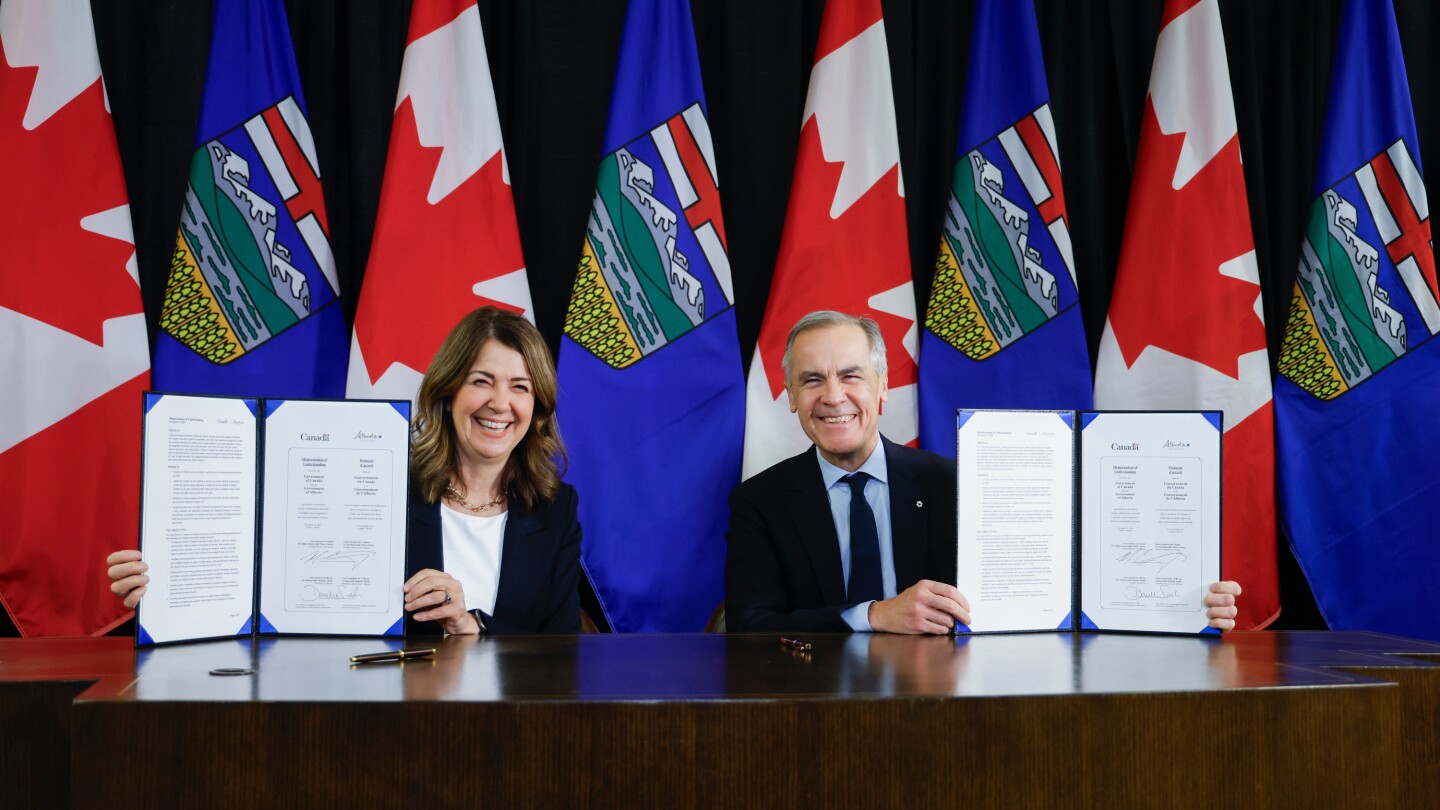
Canadian Prime Minister Mark Carney and Alberta Premier Danielle Smith have signed a memorandum of understanding to pursue a new pipeline project that would transport oil to Canada’s Pacific Coast, potentially opening lucrative Asian markets for Canadian crude exports.
The agreement, announced Thursday in Toronto, aims to reduce Canada’s heavy dependence on the United States as its primary oil customer. The deal includes provisions to adjust an existing oil tanker ban along parts of the British Columbia coast to accommodate the proposed pipeline.
“Over 95% of all our energy exports went to the States. This tight interdependence – once a strength – is now a weakness,” Carney said during the announcement. The Prime Minister has set an ambitious target of doubling Canada’s non-U.S. exports within the next decade, citing growing concerns about American tariffs chilling investment in Canada.
The announcement has already triggered political fallout within Carney’s Liberal government. Steven Guilbeault, who served as minister of culture and previously as environment minister, resigned from cabinet immediately following the announcement, though he will remain a Liberal Member of Parliament.
In his resignation statement, Guilbeault, a career environmentalist before entering politics, expressed strong opposition to the agreement, highlighting concerns about the pipeline potentially crossing the ecologically sensitive Great Bear Rainforest and increasing risks of oil tanker spills along British Columbia’s coast.
Premier Smith framed the agreement as a crucial step toward energy independence, stating it could facilitate the export of more than one million barrels of oil per day primarily to Asian markets. “Our province and our country are no longer dependent on just one customer to buy our most valuable resource,” Smith said.
Northern Alberta’s oil sands represent one of the world’s largest oil reserves, with approximately 164 billion barrels of proven reserves. However, limited pipeline capacity has forced producers to sell to U.S. refineries at significant discounts compared to global market prices.
Carney characterized the memorandum as “the start of a process” rather than a finalized project. “We have created some of the necessary conditions for this to happen but there is a lot more work to do,” he noted, adding that the pipeline would not proceed without private sector investment.
The agreement faces substantial hurdles, particularly from British Columbia’s government and coastal First Nations communities. British Columbia Premier David Eby expressed skepticism about the project’s viability, describing it as a “distraction” lacking corporate backing, financial resources, and support from coastal indigenous communities.
“What this is about is the fact that this project has no company that’s advancing it. It’s got no money. It’s got no coastal First Nations support,” Eby said, while acknowledging the federal government’s authority to impose the pipeline if it chose to do so.
Coastal First Nations President Marilyn Slett issued a stronger rebuke: “We have zero interest in co-ownership or economic benefits of a project that has the potential to destroy our way of life and everything we have built on the coast.”
This isn’t Canada’s first attempt to diversify its oil export markets. In 2016, then-Prime Minister Justin Trudeau rejected the Northern Gateway pipeline project that would have transported 525,000 barrels of oil daily through the Great Bear Rainforest to British Columbia’s northwest coast. That pipeline was primarily intended to deliver oil to China and other Asian markets.
In the same year, Trudeau did approve another controversial pipeline from Alberta to British Columbia’s coast, but the federal government ultimately had to purchase and complete the project due to opposition from environmental and indigenous groups.
The new agreement pairs the pipeline project with a proposed carbon capture initiative, with government officials emphasizing that both projects must be developed simultaneously. Under the terms of the deal, Ottawa and Alberta will work with companies to identify new emissions-reduction projects by April 1, with implementation slated to begin in 2027.
Fact Checker
Verify the accuracy of this article using The Disinformation Commission analysis and real-time sources.

14 Comments
Diversifying energy export markets is a smart move for Canada, but the environmental implications of this pipeline project can’t be overlooked. A balanced approach is needed.
Expanding Canada’s energy export markets is an interesting move, but the environmental concerns around this pipeline can’t be ignored. A balanced approach that considers all stakeholders will be key.
This pipeline deal could be a game-changer for Canada’s energy exports and help diversify its customer base. Reducing dependency on the US market makes economic sense, though the environmental concerns will need to be carefully addressed.
The resignation of the environment minister highlights the political tensions around this decision. A balanced approach considering economic and environmental priorities will be crucial.
Canada seems to be taking a pragmatic approach to diversifying its energy export markets. But the environmental impacts of this pipeline will need to be thoroughly assessed and mitigated.
Expanding Canada’s energy export markets beyond the US makes sense, but the environmental impact assessment will be crucial. Curious to see how the government addresses the concerns of environmental advocates.
This pipeline deal highlights the ongoing tension between economic and environmental concerns in the energy sector. Curious to see how the government navigates these complex tradeoffs.
The resignation of the environment minister suggests there are significant environmental risks that need to be addressed. A transparent and inclusive process will be crucial.
This pipeline deal represents an important strategic shift for Canada’s energy exports. But the environmental risks and political tensions surrounding it will need to be carefully managed.
The resignation of the environment minister is a significant development that underscores the complexity of this issue. Transparent stakeholder engagement will be crucial going forward.
Reducing dependency on the US market is a sensible goal, but the environmental impacts of this pipeline project will need to be thoroughly assessed. Curious to see how the government navigates these tradeoffs.
Interesting move to open up new Asian markets for Canadian oil. I wonder how this will impact global energy trade dynamics and prices. The devil will be in the details on the environmental regulations.
The political fallout within the government suggests this is a complex issue with competing priorities. Careful stakeholder engagement will be key to navigating this transition.
Reducing dependency on the US market is a sensible move, but the environmental risks of this pipeline project need to be carefully considered. Curious to see how the government balances these competing priorities.