


Listen to the article
Asian markets climbed Tuesday as investors embraced rising hopes for U.S. interest rate cuts, with the tech sector showing mixed reactions to recent AI developments.
Most Asian indices posted gains, mirroring Monday’s rally on Wall Street where the S&P 500 jumped 1.5% to 6,705.12 in one of its strongest performances since summer. The tech-heavy Nasdaq composite surged 2.7% to 22,872.01, while the Dow Jones Industrial Average rose a more modest 0.4% to 46,448.27.
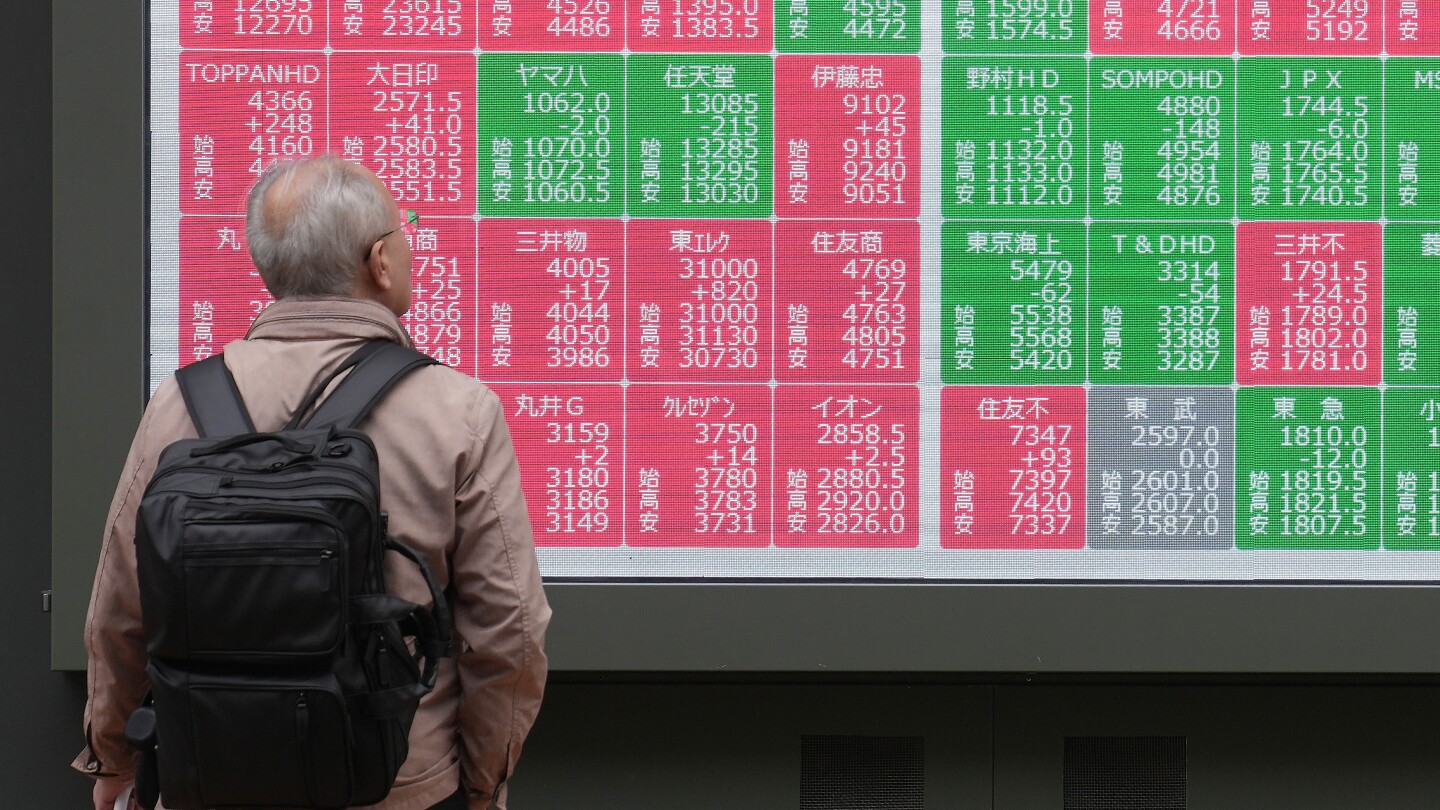
Tokyo’s Nikkei 225 remained nearly flat at 48,628.85 after reopening from a holiday, weighed down by a 10.3% plunge in SoftBank shares. Investors appear concerned that the technology investment giant’s substantial stakes in OpenAI could be threatened by Google’s newly launched Gemini artificial intelligence model, which has received widespread praise in the tech community.
Chinese markets showed resilience, with the Shanghai Composite index climbing 0.9% to 3,872.45 and Hong Kong’s Hang Seng rising 0.4% to 25,821.47. E-commerce behemoth Alibaba gained 1.6% ahead of its earnings report scheduled for release later Tuesday. The company’s performance will be closely watched as an indicator of consumer spending and economic health in China.
South Korea’s Kospi edged up 0.3% to 3,859.12, while Taiwan’s Taiex showed stronger momentum with a 1.5% jump. Australia’s S&P/ASX managed to recover from early losses to close 0.1% higher at 8,537.00.
Market optimism has been fueled by increasing expectations that the Federal Reserve will implement another interest rate cut at its December meeting. Traders are currently pricing in an 85% probability of such a move, up significantly from 71% on Friday and less than 50% just a week ago, according to CME Group data.
However, several critical economic tests remain this week that could influence the Fed’s decision. Tuesday brings the release of U.S. wholesale inflation figures for September, with economists expecting a year-over-year increase of 2.6%, matching August’s reading. Any higher-than-anticipated figure could undermine the case for another rate cut, as some Fed officials have already expressed reluctance due to inflation remaining stubbornly above their 2% target.
The market’s recent performance has been characterized by sharp volatility, with wild swings not just between trading days but even within single sessions. This turbulence stems from uncertainty surrounding Fed policy and concerns about excessive investment in artificial intelligence potentially creating a market bubble.
Despite these anxieties, the S&P 500 remains within striking distance of its all-time high, sitting just 2.7% below the record set last month. This resilience comes despite the significant market test in April when President Donald Trump announced his “Liberation Day” tariffs.
In the tech sector, companies involved in the AI boom saw significant gains, with Google parent Alphabet rallying 6.3% on the strength of its Gemini AI model. Nvidia, the chipmaker at the center of the AI hardware revolution, rose 2.1%.
U.S. markets will observe shortened trading hours this week due to Thursday’s Thanksgiving holiday, followed by the critical Black Friday and Cyber Monday shopping period that will provide important signals about consumer spending.
In the commodities market, oil prices retreated Tuesday with U.S. benchmark crude falling 25 cents to $58.59 per barrel, while Brent crude, the international standard, declined 30 cents to $62.42 per barrel.
Currency markets showed the dollar weakening slightly against the yen, trading at 156.70 Japanese yen compared to 156.91 yen. The euro held relatively steady at $1.1517. Meanwhile, Bitcoin continued its recent slide, falling 1.1% to $88,100, a significant decline from its near $125,000 level last month.
Fact Checker
Verify the accuracy of this article using The Disinformation Commission analysis and real-time sources.

16 Comments
Interesting to see Asian markets bounce back after the tech rally on Wall Street. I wonder how the AI developments will impact SoftBank and other AI-focused companies going forward.
Google’s new Gemini AI model seems to have shaken up the tech sector. It will be worth watching how companies like SoftBank adapt and respond to the competitive landscape.
The energy sector will also be a key focus area, as the transition to renewable sources and the geopolitical dynamics surrounding fossil fuels continue to shape the industry. Diversification and adaptability will be crucial for companies and investors alike.
The energy landscape is undergoing a transformative shift, and companies that can navigate these changes effectively will be well-positioned to capitalize on the emerging opportunities.
The mixed performance across Asian markets highlights the complexities of the global economic landscape. Factors like geopolitics, trade policies, and technological advancements will all play a role in shaping the future.
The global economy is a constantly evolving system, and investors will need to stay vigilant and adaptable to navigate the challenges and opportunities that arise.
The prospect of potential Fed rate cuts is driving optimism in the markets, but it will be important to monitor how this plays out in the long run. Cautious optimism seems warranted at this stage.
The Fed’s policy decisions will undoubtedly have a significant impact on global markets. Investors will be closely watching for any signs of a shift in the central bank’s stance.
The mixed reactions to the AI developments in the tech sector highlight the complexity of the industry. It will be interesting to see how companies navigate these evolving technologies and their implications.
The AI landscape is rapidly changing, and companies like SoftBank will need to stay agile and adaptable to maintain their competitive edge. This is an area worth monitoring closely.
The potential impact of the Fed’s interest rate decisions on the mining and commodities sectors will be an important consideration for investors. Careful analysis of market trends and policy changes will be crucial.
The mining and commodities industries are closely linked to macroeconomic factors, so any shifts in monetary policy could have significant ripple effects that investors will need to monitor closely.
The performance of the Nasdaq and S&P 500 suggest that investor sentiment remains cautiously optimistic, despite the challenges facing the tech sector. It will be crucial to see if this momentum can be sustained.
The strength of the tech sector will be a key indicator of the broader market’s direction. Investors will be closely watching for any signs of volatility or shifts in the coming weeks and months.
The resilience of Chinese markets is encouraging, especially with Alibaba’s upcoming earnings report. Consumer spending will be a crucial indicator of economic health in the region.
Alibaba’s performance could provide valuable insights into the state of the Chinese economy. I’m curious to see how the e-commerce giant has fared amidst the broader market conditions.