


Listen to the article
Asian markets showed resilience on Tuesday, with most indices advancing despite pressure from rising global bond yields that weighed on U.S. stocks a day earlier.
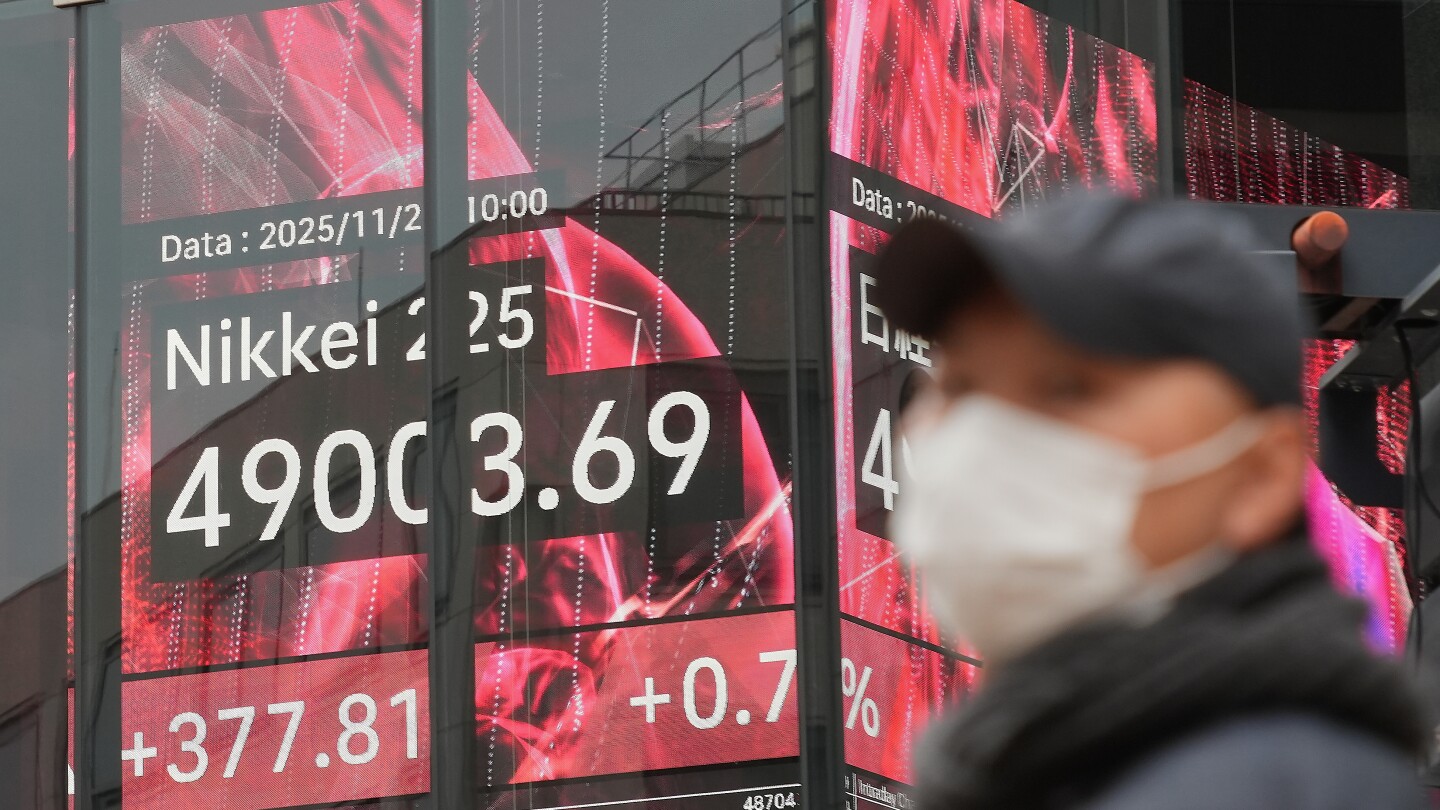
Japan’s Nikkei 225 gained 0.5% to close at 49,534.36, with financial shares leading the rally after Bank of Japan Governor Kazuo Ueda hinted at a possible interest rate hike later this month. The comments triggered ripples through global markets, as Japan’s benchmark interest rate has remained near zero for years in a bid to stimulate economic growth. Now, with inflation persisting above the central bank’s 2% target, monetary tightening appears increasingly likely.
“The prospect of the Bank of Japan resuming its hiking cycle sooner than previously thought has sent tremors through global bond and equity markets this week,” noted Thomas Mathews of Capital Markets. “But we suspect they could nonetheless weather further tightening.”
Across the region, Hong Kong’s Hang Seng jumped 0.7% to 26,209.07, while mainland China’s Shanghai Composite index slipped 0.3% to 3,902.78. South Korea’s Kospi was a standout performer, surging 1.5% to 3,977.85, powered by strong gains in technology shares. Samsung Electronics climbed 2.8% while chip manufacturer SK Hynix leaped 3.4%, reflecting the ongoing strength in the semiconductor sector.
Taiwan’s Taiex climbed 1%, Australia’s S&P/ASX 200 added 0.2% to 8,582.80, while India’s Sensex edged marginally lower by 0.1%.
This Asian resilience contrasted with Monday’s performance on Wall Street, where the S&P 500 slipped 0.5% to 6,812.63, breaking a five-day winning streak. The Dow Jones Industrial Average fell 0.9% to 47,289.33, while the tech-heavy Nasdaq composite dipped 0.4% to 23,275.92.
Last week’s U.S. market rally had been fueled largely by growing expectations that the Federal Reserve will cut its main interest rate next week to support a slowing job market. Manufacturing data continues to show pressure, with the Institute for Supply Management’s survey indicating that the majority of manufacturers remain focused on managing headcount rather than expanding their workforce. Several manufacturers reported that tariffs continue to complicate business operations.
“Conditions are more trying than during the coronavirus pandemic in terms of supply chain uncertainty,” one manufacturer told the ISM.
The cryptocurrency market has experienced significant volatility, with Bitcoin trading around $86,650 early Tuesday, a dramatic decline from its October peak of approximately $125,000. The digital currency has shed about 6% of its value in just 24 hours, dragging down crypto-related stocks. Coinbase Global fell 4.8%, while Robinhood Markets lost 4.1% in Monday’s trading.
A bright spot in the technology sector came from Synopsys, which rose 4.9% after announcing that Nvidia is investing $2 billion in its stock as part of an expanded partnership. Nvidia, which has emerged as Wall Street’s most influential stock, overcame early losses to close 1.6% higher.
The market’s reaction to the holiday shopping season has been mixed. Consumer spending during the Black Friday and Cyber Monday period reportedly exceeded expectations, despite ongoing uncertainty about the U.S. economic outlook. Williams-Sonoma climbed 1.3% on the news, while electronics retailer Best Buy fell 2.6%.
In Europe, France’s CAC 40 slipped 0.3% on Monday, weighed down by Airbus’s 5.8% decline. The European aerospace giant reported that most of its fleet of 6,000 A320 passenger jets had received software updates following a weekend glitch that could have affected flight controls. The issue caused minor disruptions for travelers as airlines worked to implement the updates.
Oil markets remained stable in early Tuesday trading, with U.S. benchmark crude oil gaining 2 cents to $59.34 per barrel, while Brent crude, the international standard, shed 4 cents to $63.13 per barrel.
In currency markets, the dollar strengthened slightly to 155.61 Japanese yen from 155.41 yen, while the euro inched up to $1.1612 from $1.1608.
Fact Checker
Verify the accuracy of this article using The Disinformation Commission analysis and real-time sources.

10 Comments
The Bank of Japan’s potential rate hike is a significant development that seems to be causing some volatility. It will be interesting to see how this affects commodity prices and mining stocks, especially in light of the broader regional market performance. Curious to see how this story evolves.
Absolutely, the BOJ’s policy shift could have wide-ranging implications, both for the Japanese market and beyond. The interplay between interest rates, commodity prices, and mining equities will be an important dynamic to monitor going forward.
Interesting to see Asian markets bouncing back after the Wall Street dip. Seems the prospect of BOJ tightening is causing some volatility, but good to hear analysts expect the markets to weather it. Curious to see how this plays out and if there’s any impact on mining/commodity stocks.
You raise a good point. The BOJ’s potential policy shift could certainly influence commodity prices and related equities in the region. It will be worth monitoring how this develops.
Encouraging to see the resilience in Asian markets, especially with Japan’s financial sector rallying on the BOJ’s signals. The global bond and equity impacts highlight how interconnected these markets are. Curious to see if this leads to any shifts in the mining/commodities landscape.
Absolutely, the ripple effects of monetary policy changes can be far-reaching. It will be interesting to see if this spurs any changes or opportunities in the mining and commodities space across Asia.
The strength in South Korea’s tech sector is noteworthy, especially with the broader regional gains. Rising bond yields could put some pressure on mining stocks, but the overall resilience is encouraging. I’ll be watching closely to see how this affects commodity prices and related equities.
Good point. The tech sector’s performance could be a bright spot, even if mining faces some headwinds from higher rates. It will be crucial to monitor how this dynamic plays out in the coming weeks and months.
Intriguing to see the divergence between China’s mainland index and the gains elsewhere. Curious what’s driving that, and whether it could impact commodity plays like copper, lithium, or uranium that are often linked to Chinese demand. Overall, a complex picture emerging in Asian markets.
Agreed, the Chinese market’s relative underperformance is worth digging into further. The demand dynamics for key commodities will be an important factor to watch, given China’s pivotal role in those global markets.