


Listen to the article
A rare Fabergé egg crafted for Russia’s imperial family is expected to fetch more than £20 million ($26.4 million) at auction this week, highlighting the enduring appeal of these exquisite historical treasures.
The Winter Egg, one of only seven imperial Fabergé eggs still in private hands, will go under the hammer at Christie’s London headquarters on Tuesday. This exceptional piece represents the pinnacle of pre-revolutionary Russian decorative arts and craftsmanship.
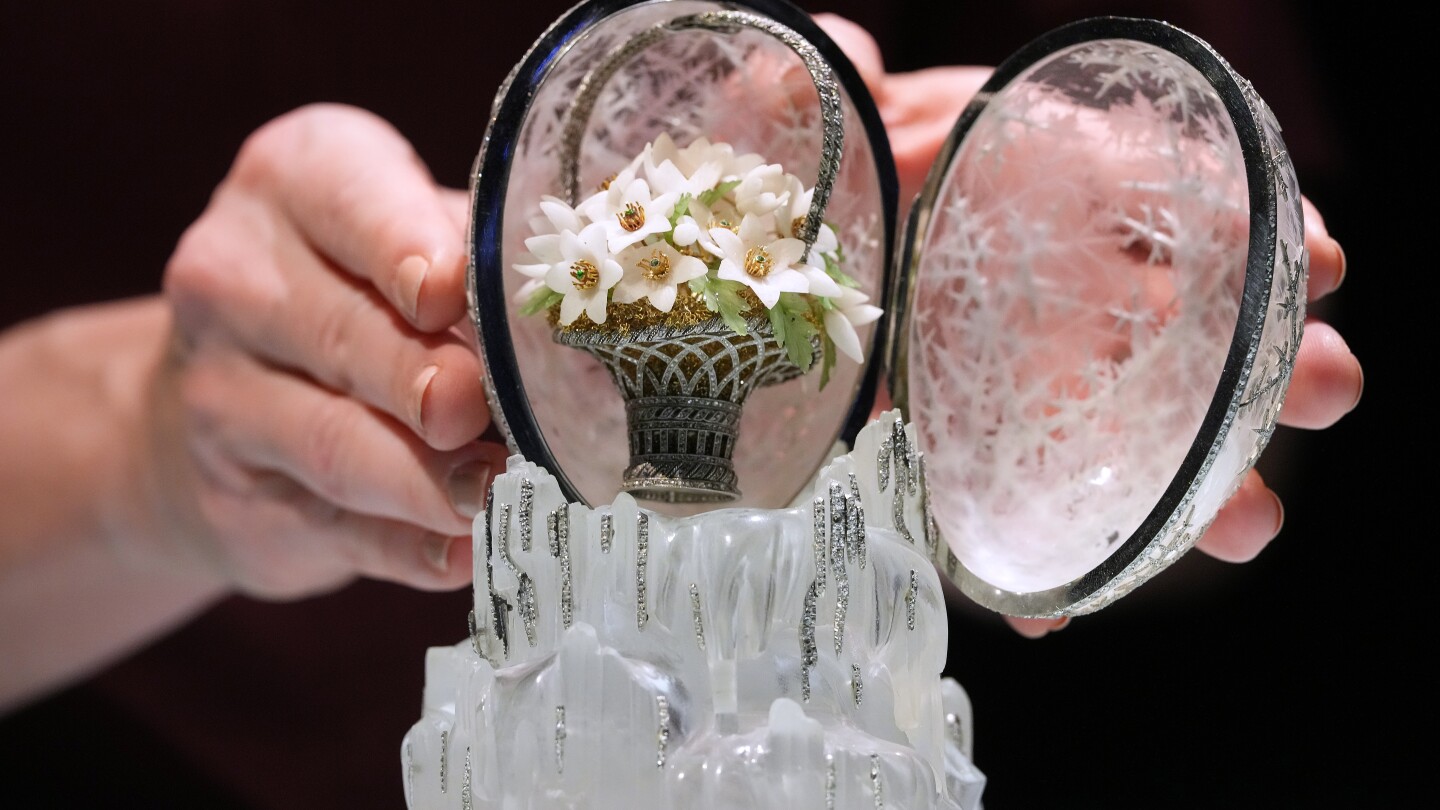
Standing just 4 inches (10 centimeters) tall, the egg showcases remarkable artistry. Crafted from meticulously carved rock crystal, it features an intricate snowflake pattern created with platinum and adorned with 4,500 tiny diamonds. True to Fabergé’s tradition of surprises, the egg opens to reveal a removable basket of jeweled quartz flowers symbolizing the arrival of spring—a stark contrast to the winter motif of the exterior.
“It’s like a luxurious Kinder Surprise chocolate,” said Margo Oganesian, head of Christie’s Russian art department, who described the piece as the “Mona Lisa” of decorative arts.
The Winter Egg carries particular significance as one of only two imperial eggs designed by a woman. Alma Pihl created it in 1913 after Czar Nicholas II commissioned it as an Easter gift for his mother, Dowager Empress Maria Feodorovna. Pihl’s other creation is currently owned by Britain’s royal family.
The tradition of imperial Fabergé eggs began with Czar Alexander III, who first presented one to his wife for Easter. His son, Nicholas II, continued the practice, extending it to include both his wife and mother. Between 1885 and 1917, Peter Carl Fabergé and his company produced more than 50 unique eggs for the Russian imperial family, each containing a hidden surprise.
This tradition came to an abrupt end with the 1917 Russian Revolution, which toppled the Romanov dynasty after 300 years of rule. Nicholas II and his family were executed in 1918, marking a tragic conclusion to the imperial era.
The fate of the Winter Egg reflects the tumultuous history of post-revolutionary Russia. During the 1920s, as the Soviet government faced economic challenges, many imperial treasures were sold to raise funds. A London dealer acquired the Winter Egg for just £450 during this period.
The egg subsequently changed hands several times and was considered lost for approximately two decades until it resurfaced at a Christie’s auction in 1994, selling for more than 7 million Swiss francs (equivalent to $5.6 million at the time). It was sold again in 2002 for $9.6 million.
Experts anticipate the upcoming sale could eclipse the current record for a Fabergé egg—$18.5 million paid at a Christie’s auction in 2007 for an egg created for the Rothschild banking family. This steady appreciation reflects both the egg’s artistic merit and its historical significance as a tangible connection to pre-revolutionary Russian aristocracy.
Of the original imperial Fabergé eggs, 43 are known to have survived. The vast majority are housed in museums, including Moscow’s Kremlin Armoury and the Fabergé Museum in St. Petersburg, making privately owned examples exceptionally rare and coveted by collectors.
The auction comes amid renewed interest in Russian imperial artifacts and growing appreciation for masterpieces of decorative arts. The Winter Egg’s combination of exquisite craftsmanship, historical provenance, and extreme rarity position it as one of the most significant decorative art objects to appear on the market in recent years.
The sale offers a rare opportunity for museums, institutions, and private collectors to acquire an artifact that embodies both artistic excellence and a pivotal moment in Russian history—the final years of imperial rule before revolution forever changed the country’s trajectory.
Fact Checker
Verify the accuracy of this article using The Disinformation Commission analysis and real-time sources.

27 Comments
Interesting update on A crystal Fabergé egg crafted for Russian royalty is expected to sell for more than $26 million. Curious how the grades will trend next quarter.
Good point. Watching costs and grades closely.
Production mix shifting toward Business might help margins if metals stay firm.
Good point. Watching costs and grades closely.
Good point. Watching costs and grades closely.
I like the balance sheet here—less leverage than peers.
Good point. Watching costs and grades closely.
Good point. Watching costs and grades closely.
Nice to see insider buying—usually a good signal in this space.
Good point. Watching costs and grades closely.
Nice to see insider buying—usually a good signal in this space.
Exploration results look promising, but permitting will be the key risk.
Good point. Watching costs and grades closely.
If AISC keeps dropping, this becomes investable for me.
The cost guidance is better than expected. If they deliver, the stock could rerate.
Nice to see insider buying—usually a good signal in this space.
Good point. Watching costs and grades closely.
Exploration results look promising, but permitting will be the key risk.
Good point. Watching costs and grades closely.
Good point. Watching costs and grades closely.
Interesting update on A crystal Fabergé egg crafted for Russian royalty is expected to sell for more than $26 million. Curious how the grades will trend next quarter.
Good point. Watching costs and grades closely.
Good point. Watching costs and grades closely.
Uranium names keep pushing higher—supply still tight into 2026.
Good point. Watching costs and grades closely.
Good point. Watching costs and grades closely.
Nice to see insider buying—usually a good signal in this space.