


Listen to the article
In a groundbreaking conservation milestone, a Sumatran orangutan has been documented using a human-made canopy bridge to cross a public road for the first time, Indonesian conservationists announced Monday. The historic crossing marks a significant advancement in efforts to protect one of the world’s most critically endangered primates.
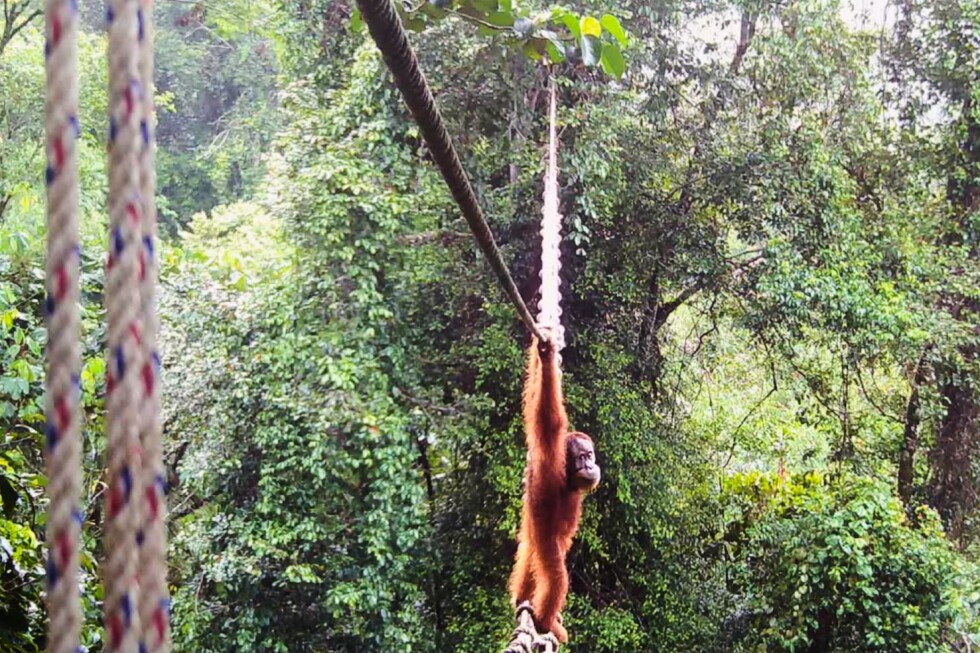
Motion-sensitive cameras captured the cautious journey as a young orangutan approached the forest edge, carefully gripped the rope bridge, and ventured out over the roadway below. Midway across, the animal paused momentarily to look down at the road before completing its crossing—a moment conservationists had anxiously awaited for two years.
“This was the moment we had been waiting for,” said Erwin Alamsyah Siregar, executive director of Tangguh Hutan Khatulistiwa (TaHuKah), an Indonesian conservation organization. “We are very grateful that the canopy here provides benefits for orangutan conservation efforts.”
The bridge spans the Lagan–Pagindar road in Sumatra’s Pakpak Bharat district, a critical transportation route connecting remote villages to essential services including schools, healthcare facilities, and government offices. However, the road’s construction has come at an environmental cost, bisecting prime orangutan habitat and dividing an estimated 350 orangutans into two isolated populations—one in the Siranggas Wildlife Reserve and the other in the Sikulaping Protection Forest.
The situation worsened in 2024 when road upgrades widened gaps in the forest canopy, eliminating natural crossings for the tree-dwelling animals. “Development was necessary for people,” Siregar acknowledged. “But without intervention, it would have left orangutans trapped on either side.”
Responding to this challenge, TaHuKah partnered with the Sumatran Orangutan Society (SOS) and government agencies to implement a straightforward but effective solution: rope bridges suspended between trees that allow arboreal animals to traverse safely above traffic. The project involved installing five specially designed canopy bridges capable of supporting the substantial weight of orangutans—the world’s largest tree-dwelling mammals.
Each bridge is equipped with camera traps and undergoes regular monitoring to prevent forest encroachment. Before the orangutan’s successful crossing, the bridges had already proven valuable for smaller wildlife, with cameras recording crossings by squirrels, langur monkeys, macaques, and eventually gibbons—developments that conservationists viewed as promising indicators.
The orangutan’s approach to using the bridge reflected the species’ cautious nature. For months, the animal built nests near the bridge, lingered at its edges, and tested the ropes before finally making a complete crossing.
“They observe,” Siregar explained. “They don’t rush. They watch, they try, they retreat. Only when they’re certain it’s safe do they move.”
While similar bridges have been used by orangutans to cross rivers or private industrial forest roads, conservationists note that public roadways present far greater challenges due to noise, traffic, and unpredictability. This makes the successful crossing particularly significant for conservation efforts.
The canopy bridge project addresses a critical threat to orangutan survival: habitat fragmentation. When populations become isolated, they face increased risks of inbreeding, genetic weakness, and eventual collapse. By restoring connectivity between forest fragments, the bridges offer hope for maintaining genetic diversity and population health.
The stakes could hardly be higher for these great apes. Once widespread throughout southern Asia, orangutans now survive only on the islands of Sumatra and Borneo. Current estimates suggest fewer than 14,000 Sumatran orangutans remain in the wild, alongside approximately 800 Tapanuli orangutans (the most endangered great ape species) and about 104,700 Bornean orangutans.
Habitat loss driven by palm oil plantations, logging, mining, and infrastructure development continues to threaten these remaining populations. Conflicts with humans have also increased as orangutans are forced into closer proximity with agricultural areas and settlements.
“These bridges allow orangutans to move, to mix, to maintain healthy populations,” Siregar emphasized. “It reduces the risk of extinction.”
The success of this initial crossing offers a model for wildlife-friendly infrastructure development across Southeast Asia, where rapid economic growth often conflicts with biodiversity conservation. As regional governments balance development needs with environmental protection, simple innovations like canopy bridges demonstrate that coexistence solutions are both feasible and effective.
Fact Checker
Verify the accuracy of this article using The Disinformation Commission analysis and real-time sources.

12 Comments
What an incredible sight to see an orangutan using the canopy bridge! This is a huge win for conservation efforts. I hope this sets a precedent for more of these types of structures to be built to protect endangered species.
Definitely, this is a hugely promising step forward. Carefully designed infrastructure like this can go a long way in mitigating human-wildlife conflict. I’m glad the local community is supportive of this project.
This is really exciting news for orangutan conservation. It’s great to see the animals using the canopy bridge and safely crossing the road. Protecting these critically endangered primates is so important.
I agree, this is a fantastic development. The bridge seems to be working well to balance the needs of both the orangutans and the local community. Kudos to the conservationists for making this happen.
As an investor in mining and natural resource companies, I’m curious to see how initiatives like this canopy bridge could impact operations in areas with endangered wildlife. Responsible development is key, and solutions that balance business and conservation needs are essential.
That’s a good point. Mining and other resource extraction companies will need to carefully consider the environmental impact of their projects and look for innovative ways to coexist with local wildlife. Collaborating with conservation groups could lead to some creative solutions.
This is a really positive development for orangutan conservation. Seeing the animals confidently using the canopy bridge is a testament to the hard work of the conservationists. I hope this inspires more projects like this around the world.
Incredible to see these endangered orangutans adapting to human infrastructure. The canopy bridge seems like a great solution to help them safely cross the road and access their habitat. I’m glad the conservation efforts are paying off.
Absolutely, this is a huge milestone for orangutan conservation. Building these bridges is such a clever way to protect the animals while also maintaining critical transport links.
This is really encouraging news for orangutan conservation. Seeing them using the canopy bridge shows that well-designed infrastructure can effectively protect endangered species while also meeting the needs of local communities. I hope more of these types of projects are implemented.
While it’s great to see the orangutans using the canopy bridge, I wonder what the long-term implications will be. Will this type of solution scale effectively, or are there potential drawbacks that need to be considered?
That’s a fair point. Maintaining and monitoring these bridges over time will be crucial. It’s an innovative approach, but the impacts on the orangutans’ behavior and overall population will need to be closely studied.