


Listen to the article
Violent Attacks in Southwest Colombia Raise Security Concerns Ahead of Presidential Election
A series of coordinated attacks has rocked Colombia’s southwestern region, heightening security concerns as the country approaches its May presidential election where crime and safety are expected to be key voter issues.
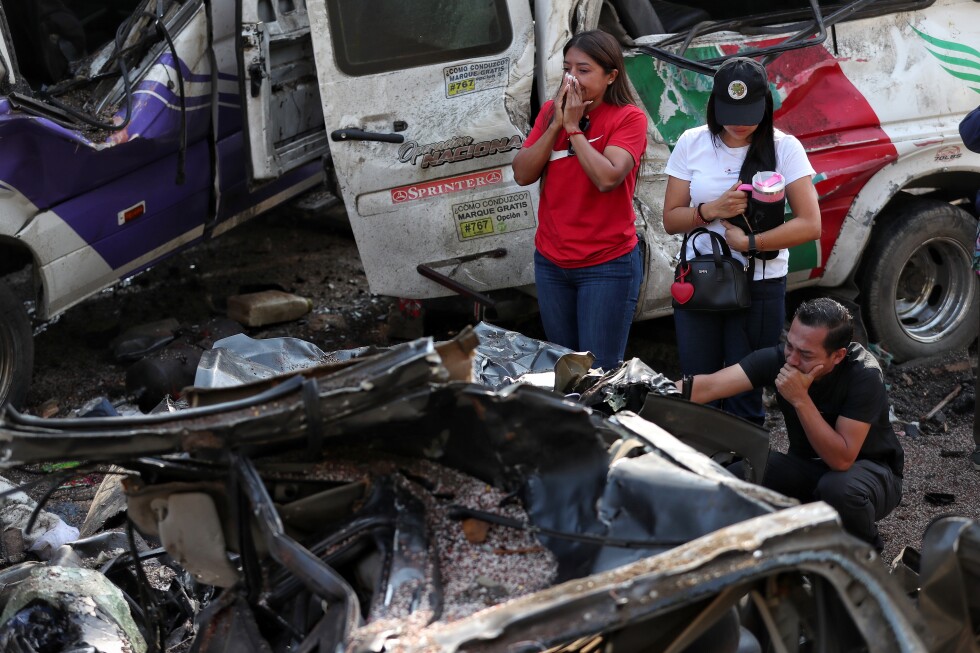
Since Friday, rebel groups have executed 26 attacks using explosives and drones, according to Colombia’s defense ministry. The most devastating incident occurred Saturday on the Pan-American Highway between Cali and Popayan, where an explosion killed 21 people.
Authorities have attributed the deadly highway attack to the FARC-EMC, a dissident faction led by Nestor Vera, commonly known as Iván Mordisco. Mordisco was formerly a member of the Revolutionary Armed Forces of Colombia (FARC) who rejected the landmark 2016 peace agreement with the Colombian government.
“The government’s peace policy has been naïve,” said Javier Garay, a political science professor at Colombia’s Externado University. “They thought that if they had a condescending attitude towards these groups they would receive a positive response.”
Colombia’s southwestern region has long been contested territory, with illegal armed groups fighting for control of lucrative illicit activities including drug trafficking and illegal gold mining. The area is particularly valuable for its coca leaf cultivation, the raw material for cocaine production.
Under President Gustavo Petro, himself a former guerrilla fighter, the government has pursued a strategy known as “total peace,” offering ceasefires to various rebel groups to promote negotiations. Critics argue this approach has backfired, allowing these groups to regroup, rearm, and strengthen their territorial control.
The FARC-EMC entered peace talks with the Colombian government in late 2023, but Mordisco’s faction abandoned negotiations in April 2024 and resumed hostilities. According to Elizabeth Dickinson, a Colombia analyst at the International Crisis Group, Mordisco’s group maintains significant strength in the provinces of Cauca and Valle del Cauca.
“The latest attacks in southwest Colombia are one way for the group to show that it can sustain its asymmetrical war against the government,” Dickinson explained.
For the past two years, the FARC-EMC has employed increasingly sophisticated tactics, including drone attacks and car bombs, particularly in response to Colombian military operations in the Micay Canyon, a remote area dominated by coca fields under the group’s control.
Sergio Guzmán, a political risk analyst based in Bogotá, suggests that Mordisco’s group may be attempting to demonstrate its capabilities and establish credibility with Colombia’s next government. “Part of what they are doing is establishing leverage towards the future,” Guzmán said.
The timing of these attacks is particularly significant with Colombia’s presidential election scheduled for May 31. The contest features 14 candidates, including Iván Cepeda from President Petro’s party, who has pledged to continue the “total peace” approach. Conservative contenders like Abelardo de la Espriella and Paloma Valencia advocate for more aggressive military pressure on rebel groups before resuming any peace negotiations.
In a nationally televised address Monday night, President Petro claimed his administration has made progress fighting drug trafficking and reducing coca cultivation. However, he also suggested the recent attacks could be part of a conspiracy to influence the election, requesting investigations into whether explosives used in Saturday’s attacks originated from Ecuador, which recently engaged in a trade dispute with Colombia over border security issues.
“They want to sabotage our elections so that the extreme right wins,” Petro stated without specifying who “they” might be.
The escalating violence recalls darker periods in Colombia’s history, including the assassination of a presidential candidate last year. Political observers note that both sides of the political spectrum will likely leverage these attacks to support their positions.
“Government supporters will use the attacks as an opportunity to say that this is exactly why we need to reach urgent agreements with these groups,” Guzmán noted. “Detractors will say this is why we need to more aggressively attack them.”
As Colombia approaches its election, these security challenges underscore the complex reality facing the next administration. The southwestern region’s strategic importance for illicit economies ensures it will remain contested territory, while the effectiveness of peace negotiations versus military confrontation continues to divide the nation’s political discourse.
Fact Checker
Verify the accuracy of this article using The Disinformation Commission analysis and real-time sources.

6 Comments
While the peace process was an important step, it’s clear that more needs to be done to dismantle and disarm these dissident rebel factions. I hope the next president will make this a top priority to protect Colombian citizens.
Deeply concerning to see these attacks in Colombia just ahead of the presidential election. Security and stability are critical issues that will be on voters’ minds. I hope the authorities are able to get a handle on the situation and restore a sense of safety.
Dissident rebel groups like the FARC-EMC pose a real threat to Colombia’s democratic process. The government’s peace efforts have clearly fallen short, and strong leadership will be needed to address these security challenges.
You’re right, the government’s approach seems to have been too naive. Striking the right balance between negotiation and firm action against these groups will be crucial in the next administration.
These attacks are a tragic reminder of the ongoing instability and violence that has plagued parts of Colombia for decades. Voters will be looking for a presidential candidate who can restore a sense of safety and security across the country.
Horrifying to see the loss of life in these latest attacks. My heart goes out to the victims and their families. Securing peace and stability in Colombia needs to be the top focus for the next administration.