


Listen to the article
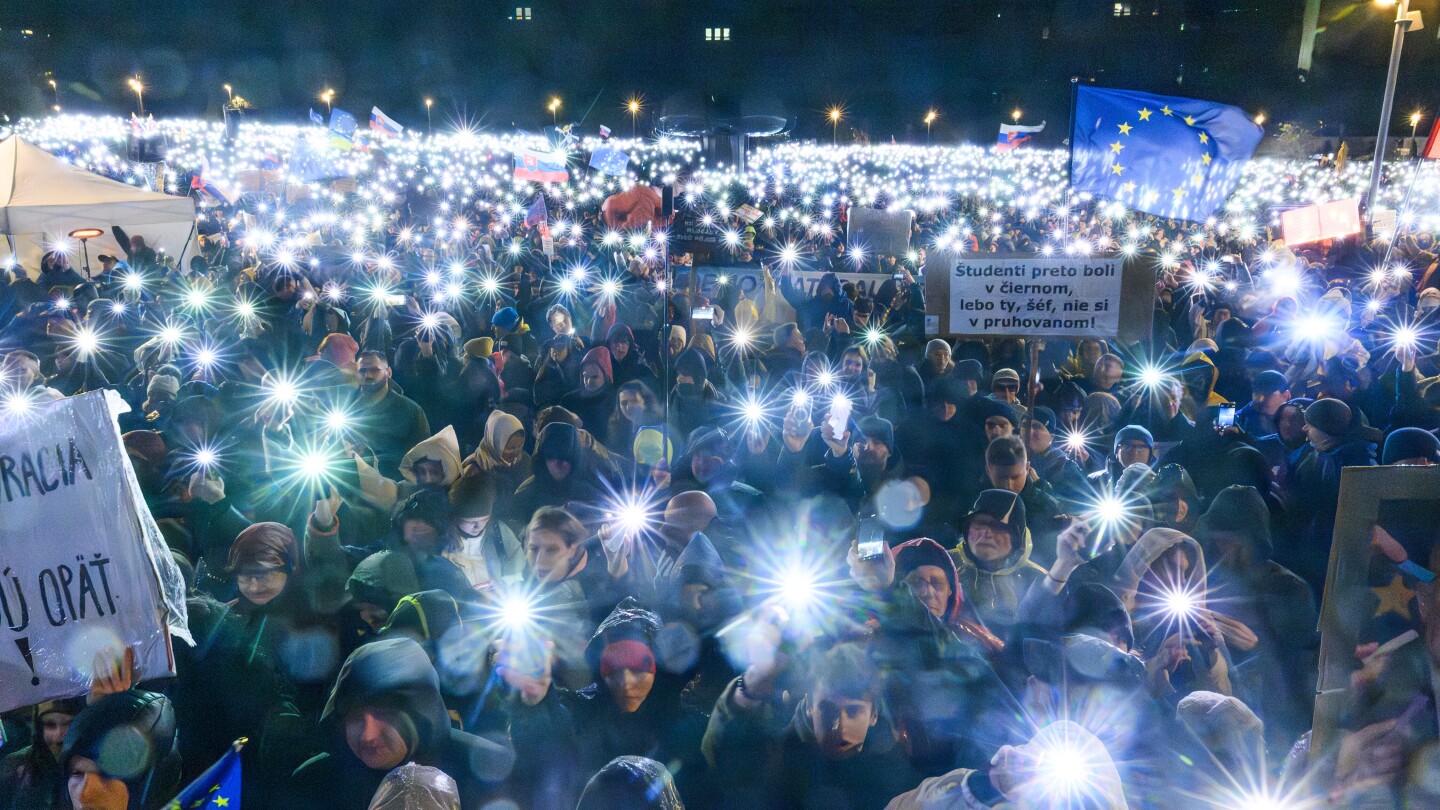
Tens of thousands of Slovakians flooded the streets on Monday to protest against Prime Minister Robert Fico’s government, expressing outrage over his pro-Russian stance and recent controversial policies. The demonstrations, which spread across dozens of communities throughout the country, coincided with the anniversary of the 1989 Velvet Revolution that peacefully ended communist rule in former Czechoslovakia.
In Bratislava’s Freedom Square, despite heavy rain, protesters gathered in large numbers, their voices united in chants of “We have enough of Fico,” “We want a change,” and “Resign.” Many demonstrators carried signs featuring the iconic words of former Czechoslovak and Czech President Václav Havel: “Truth and love must prevail over lies and hatred,” which became the rallying cry of the Velvet Revolution.
The protests gained additional significance after Fico’s government recently canceled the national holiday commemorating the Velvet Revolution, claiming it was part of necessary austerity measures. This decision was widely viewed as an attempt to diminish the historical importance of Slovakia’s democratic transition.
Michal Šimečka, leader of the opposition Progressive Slovakia party, directly challenged this justification at the rally. “It has nothing to do with economy or savings,” Šimečka told the crowd. “Robert Fico just wants to tell us that the holiday of freedom is useless, that freedom is useless. We value freedom and we will not let it be taken away from us.”
Fico’s third term as prime minister, which began after his populist SMER-SD party won elections in September 2023, has been marked by increasing controversy. His administration has taken several steps that critics say align with Russian interests and undermine Slovakia’s Western alliances. Public discontent reached a new peak after Fico recently told students in Poprad that if they disagreed with his pro-Russian views, they should “go fight for Ukraine.”
The prime minister’s stance on the Russia-Ukraine conflict has proven especially divisive in Slovak society. Since Russia launched its full-scale invasion of Ukraine in February 2022, Fico has met with Russian President Vladimir Putin three times. Upon returning to power last year, he immediately canceled all of Slovakia’s bilateral military support for Ukraine, marking a significant shift from his predecessor’s policy.
Fico has also repeatedly challenged European Union positions on Ukraine, creating tension between Slovakia and its EU partners. This approach has raised concerns both domestically and internationally about Slovakia’s geopolitical orientation and its commitment to European values.
Monday’s demonstrations reflect a deeply polarized political landscape in Slovakia. Fico, who previously served as prime minister from 2006 to 2010 and 2012 to 2018, has long been a divisive figure in Slovak politics. His previous tenure ended amid massive anti-corruption protests following the murder of investigative journalist Ján Kuciak and his fiancée in 2018.
The current wave of protests indicates growing concern among many Slovakians about the country’s democratic trajectory. Civil society organizations have warned about the erosion of democratic norms and freedom of expression under Fico’s leadership.
Political analysts note that the demonstrations represent more than just opposition to specific policies; they signal deep anxiety about Slovakia’s future direction as a member of the European Union and NATO. While Fico maintains significant support among rural voters and those concerned about economic issues, the urban population has largely opposed his governance approach.
As Slovakia approaches the 35th anniversary of the Velvet Revolution next year, the country finds itself at a crossroads, with competing visions for its future. The protests underline that the legacy of 1989 remains a powerful symbol in Slovak political discourse and that many citizens are determined to defend the democratic values established in that pivotal historical moment.
Fact Checker
Verify the accuracy of this article using The Disinformation Commission analysis and real-time sources.

4 Comments
It’s notable that these protests are happening on the anniversary of the Velvet Revolution. Slovaks are clearly eager to preserve the democratic gains made back then and are pushing back against efforts to erode those freedoms. This could have wider ramifications for the country’s economy and industries.
Fico’s government canceling the Velvet Revolution holiday is a concerning move. Demonstrations across Slovakia show citizens value their democratic freedoms and are willing to voice dissent. I wonder how this political turmoil could affect mining and related industries in the country.
Interesting to see public protests over a populist leader’s policies in Slovakia. Seems like the government’s decision to cancel the Velvet Revolution holiday was seen as an attack on the country’s democratic transition. Curious to see how this unfolds.
Protests on the anniversary of the Velvet Revolution are a powerful symbol. Slovakians are clearly concerned about their leader’s pro-Russian stance and efforts to downplay the country’s democratic history. This bears watching as it could impact the mining and energy sectors.