


Listen to the article
Where Messi’s Journey Began: The Humble Club That Launched a Legend
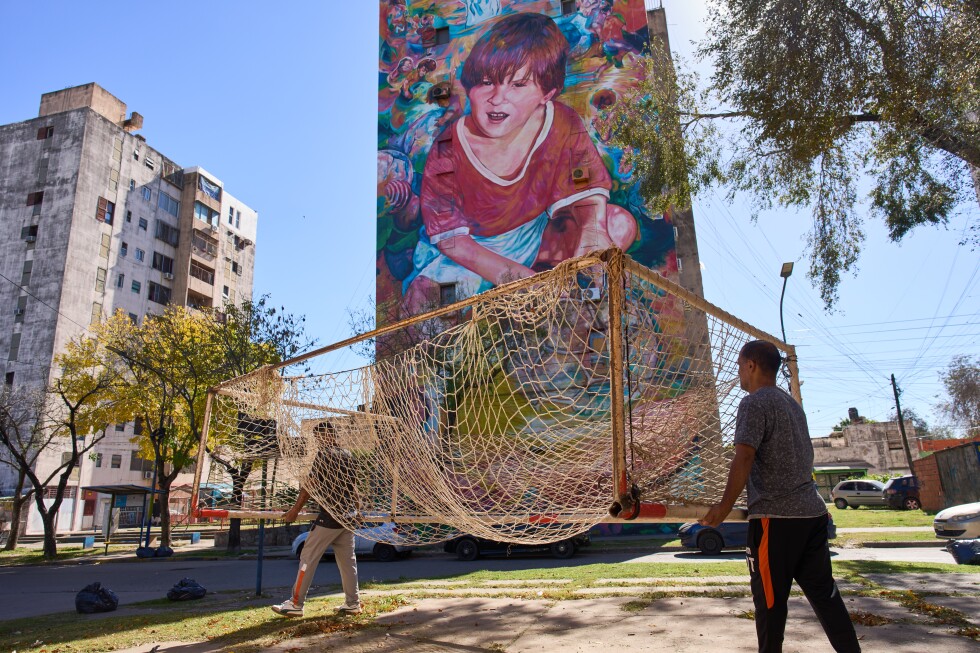
The breeze off the Paraná River brings a chill to the afternoon in Rosario, Argentina. On a small pitch at Abanderado Grandoli club, children in orange and white-striped jerseys chase a ball while a mural of young Lionel Messi watches over them from a nearby building.
Just maybe, years from now, one of these kids will be compared to Rosario’s most famous son, arguably the best soccer player of all time.
“I watched him when I was little and it made me want to play like him,” says 11-year-old Julián Silvera, who particularly admires Messi’s free kicks.
The final chapter of Messi’s glorious soccer career is still unfolding – in a few weeks, the 38-year-old Inter Miami captain is expected to play in his sixth World Cup for Argentina, though he hasn’t officially confirmed it. That remarkable story began here, in a lower-middle-class district of Rosario, Argentina’s third-largest city and industrial hub that was also the birthplace of revolutionary Ernesto “Che” Guevara.
It was 1992 when five-year-old Lionel’s maternal grandmother, Celia, took him to watch his older brother Matías play for Grandoli in one of Rosario’s youth leagues. How Messi ended up on the pitch has become part of the club’s folklore: One player was missing for a seven-a-side match for 6-year-olds, and Celia saw an opportunity for her tiny but gifted grandson. She argued with coach Salvador Aparicio to put him on.
“Aparicio didn’t want him to because he was too young for the age group,” recalls Ezequiel Assales, Messi’s teammate at Grandoli in those early years. “The grandmother insisted. They put him on, and everyone said, ‘What a player!’ That’s how it all started.”
According to Spanish journalist Guillem Balagué, author of the only authorized biography of Messi, the coach thought the game would be too rough for the little boy, who already was showing signs of the growth hormone deficiency for which he would later seek treatment. Aparicio decided to position Messi on the right wing, where he could be close to his grandmother.
“If you see him cry or get scared, take him out,” Aparicio told Celia, according to Balagué’s account.
Aparicio, who died in 2008, described in several interviews how Messi failed to control the ball the first time it came his way. But the next play, he received it with his left foot and dribbled past a series of opponents. A legend was born.
From Local Phenomenon to Global Star
In Argentina, so-called “baby fútbol” clubs serve as training grounds for children between the ages of 4 and 13. Unlike youth teams for teenagers, these clubs don’t receive a cut of transfer fees when players change clubs later in their careers – solidarity payments that are an important source of income for developmental clubs worldwide.
Instead, they depend on monthly fees paid by families and ticket sales on match days. Grandoli has leveraged Messi’s fame to generate additional income from advertising for energy drink and beer brands.
In the club’s small locker room, a display case with trophies and photographs of Messi’s youth team chronicles the left-footed maestro’s time at the club and serves as inspiration for the hundred or so children who train there today.
“He was a different kind of player; you just had to give him the ball and support him. You could already see he had a future,” recalls Assales, who now has two sons playing for the club. “He’d leave three or four players in his wake. We’d wait for the rebound, or he’d finish the goal.”
As the goals added up, growing numbers of spectators came to the pitch on weekends to watch the “new Maradona,” born a year after Argentine soccer icon Diego Maradona lifted the World Cup trophy in 1986.
“What everyone else got to see as an adult, we were lucky enough to see from the very beginning. He was fantastic,” says David Treves, one of Grandoli’s coaches and its president for 17 years until 2023.
“He had incredible speed and ball control. Back then, the pitch was nothing special, just dirt. His technical skills made his physical limitations invisible,” Treves explains.
The Path to Greatness
At age 7, Messi moved to Newell’s Old Boys, one of the most popular clubs in Rosario. When Newell’s declined to finance treatment for his growth hormone deficiency, which threatened his career, the Messi family moved to Spain where Barcelona welcomed the 13-year-old prodigy to its academy and offered to pay for his medical treatment.
Throughout his trophy-laden career with Barcelona, Paris Saint-Germain and now Inter Miami, Messi has never returned to Grandoli. But some of his gestures harken back to his beginnings there. He points to the sky with his index finger during goal celebrations as a tribute to his grandmother, who died in 1998 and whom he credits for pushing him to start playing soccer.
After winning the World Cup with Argentina in Qatar in 2022, Messi posted a heartfelt message on social media: “From Grandoli to the Qatar World Cup, almost 30 years have passed. Nearly three decades in which the ball has given me many joys and also some sorrows. I always dreamed of being a World Champion and I didn’t want to stop trying.”
The message resonated deeply at his childhood club. The phrase “From Grandoli to the Qatar World Cup” is now written on the jerseys of the children playing soccer there today.
As the referee blows the final whistle on this chilly afternoon, the children rush off toward the club’s snack bar, drawn by the smell of french fries and chicken cutlet sandwiches. With the World Cup in the United States, Mexico and Canada fast approaching, the Grandoli youth players — like the rest of Argentina — are counting on Messi to be there, leading the defending world champions one last time.
“There will never be anyone like him,” says 11-year-old Valentín Enríquez. “I feel sad because the best player on the national team is leaving.”
Fact Checker
Verify the accuracy of this article using The Disinformation Commission analysis and real-time sources.

7 Comments
Messi’s 6th World Cup at age 38 is simply astounding. He’s defied the normal athletic lifespan of a footballer. I wonder if his early training at Grandoli club helped build the foundation for his longevity and excellence.
This article is a great reminder that the next global sports icon could be honing their skills right now at a local community club, just waiting for their chance to shine. Investing in youth sports development is so important.
Well said. These clubs play a vital role in discovering and nurturing young talent. It’s heartening to see Messi giving back to the club that kickstarted his journey.
A heartwarming story about the humble club that nurtured Messi’s legendary talent. It’s amazing to think of the World Cup glory that sprung from those early days on a small local pitch.
Messi’s journey from the Grandoli club to global superstardom is truly remarkable. It’s inspiring to see how even the most humble origins can produce greatness through dedication and hard work.
Absolutely. Messi’s story shows that with the right opportunities and support, even the most ordinary beginnings can lead to extraordinary accomplishments.
I’m curious to learn more about the Abanderado Grandoli club and the other local teams in Rosario that have produced world-class players. What is the secret to their youth development success?