


Listen to the article
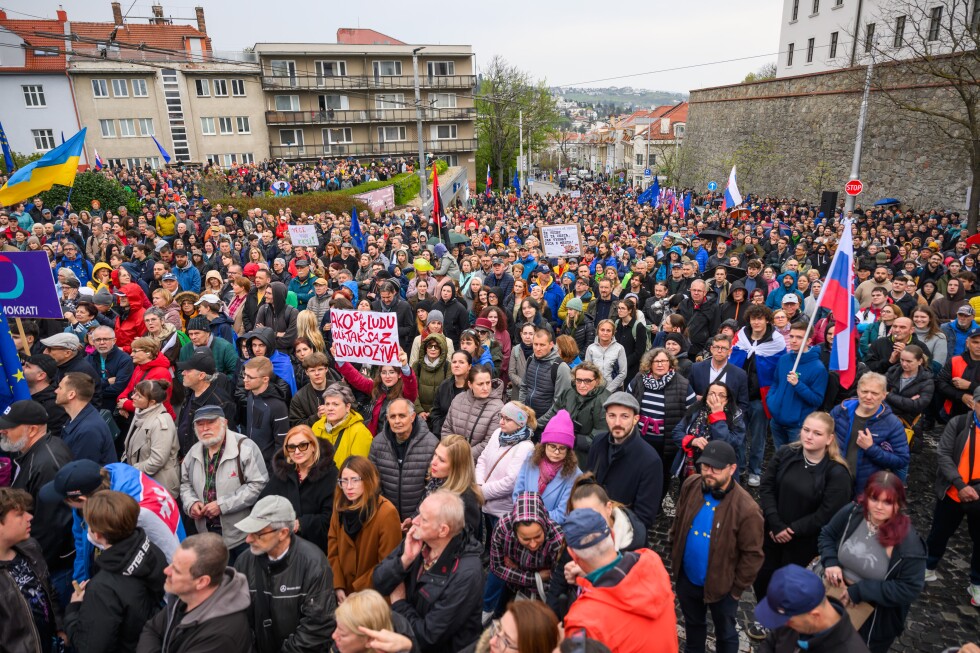
Thousands gathered in Bratislava and other cities across Slovakia on Tuesday to protest Prime Minister Robert Fico’s controversial plan to eliminate mail-in voting for Slovaks living abroad. The demonstrations, organized by four opposition parties, reflected growing concerns about democratic backsliding in the country.
The rally outside Parliament in the capital opened with applause for neighboring Hungary’s weekend election results, where voters ousted long-serving populist leader Viktor Orbán in favor of pro-European candidate Péter Magyar. The reference wasn’t coincidental – critics have long accused Fico of modeling his governance style after Orbán’s increasingly authoritarian approach.
“What is at stake is democracy, like it was in Hungary’s election,” Michal Šimečka, leader of the opposition Progressive Slovakia party, told demonstrators in Bratislava. As the crowd chanted “Shame, shame,” Šimečka argued that the proposed legislation would effectively disenfranchise tens of thousands of Slovak citizens living overseas.
Under the current system, nearly 59,000 Slovaks living abroad voted by mail in the 2023 parliamentary election. The proposed change would force expatriate citizens to vote only at Slovak embassies, which would significantly limit participation due to travel distances in many countries. Opposition parties view the move as deliberately targeting voters who overwhelmingly support pro-Western parties. In the last election, Fico’s Smer (Direction) party received only 6.1% of expatriate votes, while opposition groups garnered over 80%.
While Fico defends the proposal as necessary to “prevent fraud and manipulations,” critics see it as part of a broader pattern of democratic erosion since his return to power in October 2023. The prime minister, who previously led Slovakia from 2006-2010 and 2012-2018, has pursued policies that have alarmed both domestic critics and EU partners.
“It’s clear they are doing it because they are afraid,” Šimečka told the crowd. “They are afraid of people, they are afraid of elections, they are afraid of losing.”
Tuesday’s demonstrations spread beyond Slovakia’s borders, with rallies also taking place in Brussels and Prague, underscoring the international dimensions of the controversy. Within Slovakia, protests occurred in the cities of Košice and Banská Bystrica alongside the main demonstration in Bratislava.
The current protests represent the latest in a series of demonstrations against Fico’s policies since his return to office. His government has pursued controversial reforms of public broadcasting, shown sympathy toward Russia despite its invasion of Ukraine, and proposed changes to the criminal code that critics say would weaken anti-corruption efforts.
Slovakia, a nation of 5.4 million people, has experienced political turbulence in recent years. Fico himself resigned in 2018 following massive protests after the murder of investigative journalist Ján Kuciak and his fiancée. The killings, linked to corruption Kuciak was investigating, sparked a political earthquake that temporarily pushed Fico’s party from power.
His return to office last year has heightened polarization in Slovak politics. While his supporters view him as a defender of Slovak sovereignty against external influences, opponents fear the erosion of democratic institutions and Slovakia’s westward orientation established since the fall of communism.
With the next parliamentary elections not scheduled until 2027, the opposition appears concerned about preserving democratic guardrails in the interim. The proposed electoral change will be debated during the current parliamentary session, where Fico’s coalition holds a majority.
The proposed elimination of mail-in voting comes at a time of increased scrutiny of electoral systems worldwide, with debates about voting access and integrity playing out across many democracies.
Fact Checker
Verify the accuracy of this article using The Disinformation Commission analysis and real-time sources.

8 Comments
The reference to Hungary’s election results is an interesting parallel. Both countries have seen concerning trends of democratic backsliding under populist leaders. I’m curious to see if the Slovak public can mobilize to defend their democratic institutions like the Hungarians did.
That’s a good point. The contrast between Hungary and Slovakia’s political trajectories is quite striking. Hopefully the Slovaks can follow Hungary’s lead in voting for a pro-European, democratic alternative.
This proposed voting change seems clearly designed to consolidate the ruling party’s power by making it harder for expatriate Slovaks to participate. I hope the protesters can pressure the government to reconsider and maintain the current mail-in voting system.
Restricting access to voting is a common tactic used by populist, authoritarian-leaning leaders to cling to power. I’m glad to see the Slovak people taking to the streets to defend their democratic rights.
You’re absolutely right. Preserving free and fair elections is essential for a healthy democracy. I hope the Slovak government listens to the protesters and abandons this undemocratic proposal.
This is a troubling development that bears close watching. The stakes are high, as the erosion of democratic norms and institutions in Slovakia could have ripple effects across the region. I’m curious to see how this situation unfolds.
This is a concerning development for democracy in Slovakia. Eliminating mail-in voting for citizens living abroad seems like an effort to restrict their political participation. I hope the protesters are successful in pushing back against this proposal.
You’re right, this is a worrying step backwards for Slovak democracy. Disenfranchising expatriate citizens is unacceptable in a free society.