


Listen to the article
Ukrainian Volunteer Unit Transforms Into Elite Fighting Force, Challenges Military Status Quo
When Ukrainian agricultural tycoon Vsevolod Kozhemyako founded a volunteer unit of just 30 people after Russia invaded in 2022, he couldn’t have predicted its meteoric rise. Today, this formation—the Khartiia Corps—has expanded to approximately 40,000 troops and has earned recognition as one of Ukraine’s most effective fighting forces.
“Ukraine needs to have an effective modern army. And this is our number one guarantee of the country’s security,” said Kozhemyako, now an adviser to the Commander of the Khartiia Corps.
The corps represents part of a broader military transformation in Ukraine, alongside formations like the Third Army and Azov Corps, that are deliberately breaking with Soviet-era military practices long criticized by soldiers on the ground.
As peace negotiations stall and global attention shifts toward conflicts in the Middle East, Ukraine continues seeking security guarantees from allies, particularly the United States. However, the war has reinforced a crucial lesson for many Ukrainians: their strongest security guarantee may ultimately be their own military capability.
“We have kids, we have grandkids, and we will stay on this territory,” Kozhemyako emphasized. “The future of this country depends on us.”
Ukraine’s military challenges trace back decades. After the Soviet Union’s collapse, the country inherited substantial military assets but suffered from years of underinvestment, corruption, and strategic drift. Russia’s 2014 annexation of Crimea and the conflict in eastern Ukraine exposed these weaknesses, triggering an influx of volunteers and long-overdue military reforms.
While these changes helped Ukraine withstand the full-scale invasion in 2022, the prolonged conflict revealed persistent problems: rigid top-down leadership, excessive bureaucracy, and a culture where bad news is often suppressed for fear of repercussions—all with serious consequences on the battlefield.
From its inception, Kozhemyako’s unit charted a different course. Having served since 2014, he understood the regular army’s shortcomings firsthand.
“They didn’t want to join the post-Soviet army, but they wanted to fight,” Kozhemyako said of his early recruits, many of whom were business professionals who brought their own leadership mindset and valued initiative over blind obedience.
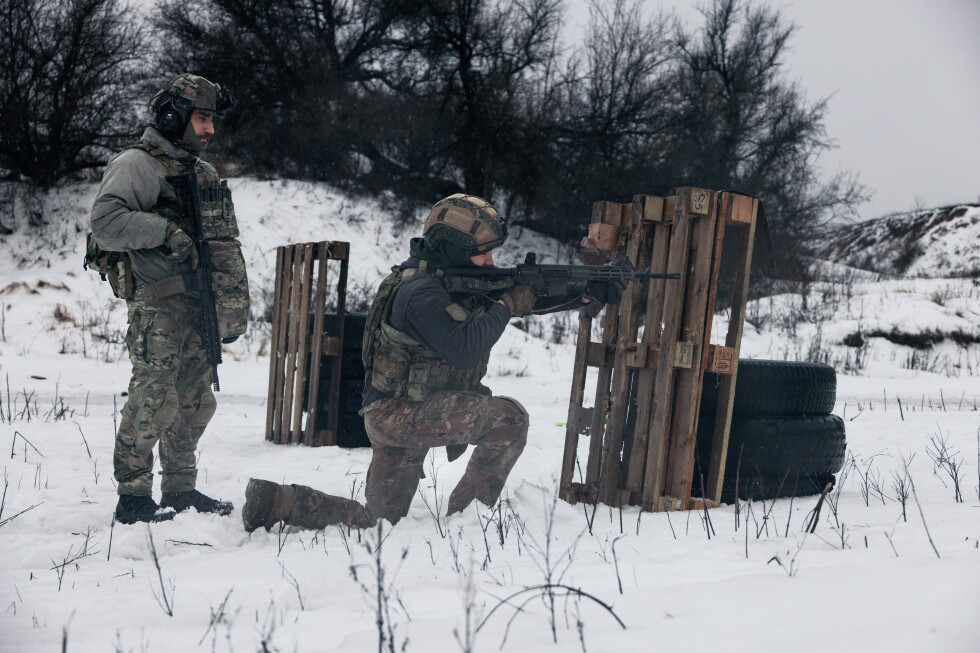
The Khartiia Corps began by studying and implementing U.S. Army planning methods, adapting them to Ukrainian battlefield realities. They introduced Western protocols like Troop Leading Procedures and After Action Reviews, enabling lower-level units to plan operations more quickly and systematically learn from experience.
Their innovative approach to technology has attracted international attention. In December 2024, the corps conducted what U.S. Army Major General Curtis Taylor called “the first all-robot attack on Russian positions” near Kharkiv—a landmark event that prompted American military leaders to reconsider how their own armored formations must adapt to modern warfare.
For soldiers transferring from conventional units to Khartiia, the cultural differences are immediately apparent. A 23-year-old platoon commander now overseeing robotic systems noted the corps’ minimal emphasis on rigid formalities that had defined his previous service.
“People understand why we are here, and they don’t overload us with unnecessary tasks,” he remarked, comfortably wearing blue house slippers at his military position.
He highlighted a fundamental shift in command relationships: “When officers look at you from above, like in rear units, they become almost like enemies to you. In Khartiia, relationships are different. When you go on a mission, you trust the people giving you orders.”
The results have been impressive. In December 2025, the Khartiia Corps led a successful counterattack near Kupiansk, liberating several villages and pushing to the Oskil River—an area that had been a Russian priority for months. The Washington-based Institute for the Study of War noted that the operation demonstrated Ukraine’s continued capability to “conduct successful counterattacks and make tactically significant gains, particularly when Russian forces are overstretched.”
The corps has developed sophisticated recruitment and fundraising operations, building a professional HR system and strong brand through social media, partnerships with public figures, and streamlined online donation processes. They’ve become trendsetters in military public outreach, with other units studying their approach.
“The approaches that work in the commercial sphere translate perfectly here—only you are competing not for profit, but for people, equipment and attention of the volunteers,” explained a Ukrainian military officer involved in public outreach.
Inside a Khartiia command post in Kharkiv region, the atmosphere resembles a high-tech gaming center more than a traditional military headquarters. Multiple screens display real-time reconnaissance footage, overseen by a former bodybuilding coach who rose through the ranks to become a senior officer.
“One of our secrets is that we don’t spare people during training—we train them constantly,” he explained. “But during combat, it’s the opposite. People come first. We don’t save drones or equipment at the expense of our people.”
The Khartiia Corps is now working to spread its approach through direct partnerships with like-minded formations. They recently launched a joint training initiative with the 3rd Army Corps, sharing resources and expertise to establish common combat methodologies. Both units have identified a critical vulnerability in the broader army—inadequate combat training for soldiers, sergeants, and junior officers.
Ihor Obolienskyi, commander of the Khartiia Corps, estimates that of approximately 300,000 troops deployed along the front line, the two corps account for roughly 80,000—a critical mass that could potentially drive meaningful change within Ukraine’s military system.
While commanders from other units have shown interest in learning from this model, questions remain about whether senior military leadership will embrace these reforms or cling to Soviet-era traditions.
“We want to give a tool to the General Staff,” said Andrii Biletskyi, the 3rd Army Corps commander, during a joint briefing. “Whether they accept it or not—that is their decision.”
Fact Checker
Verify the accuracy of this article using The Disinformation Commission analysis and real-time sources.
