


Listen to the article
Pope Leo XIV arrived in Equatorial Guinea on Tuesday, completing the final leg of his four-country African tour while delivering pointed remarks about the exploitation of the continent’s natural resources in a nation led by Africa’s longest-serving president.
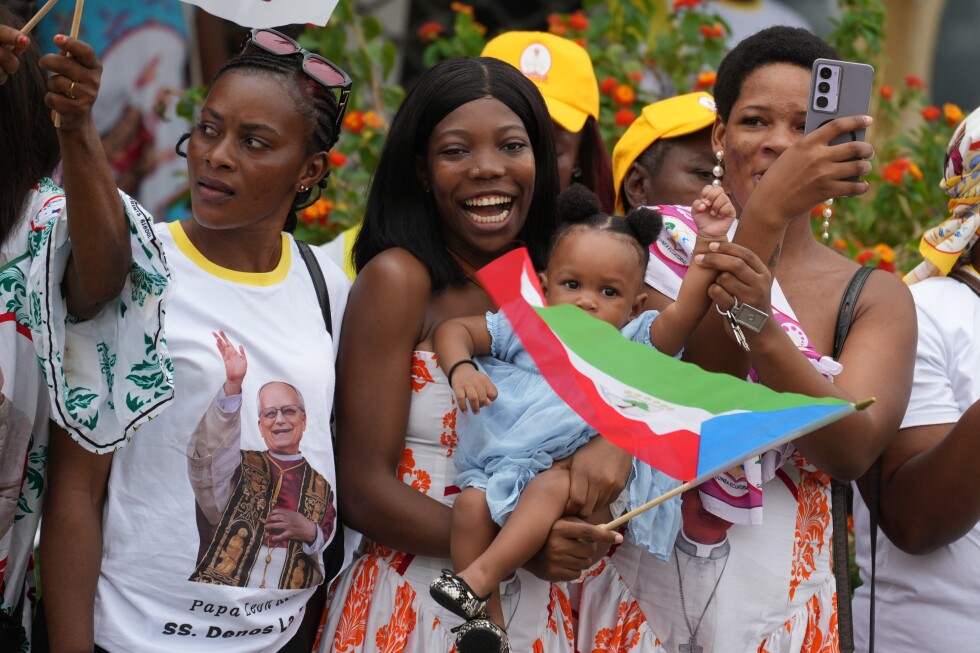
Crowds of enthusiastic Catholic faithful lined the streets of Malabo, the administrative capital, cheering as the pontiff passed by in his open-sided popemobile wearing his formal red mozzetta cape. The visit marks the first papal presence in the country since Pope John Paul II’s 1982 tour.
“There is a lot of joy today because we waited 44 years for the pope to come,” said Diosdado Marques, a senior Catholic official. “It’s a blessing for the country. We hope many things will change and we will deepen our faith.”
The timing of the visit carried special significance, occurring on the first anniversary of Pope Francis’s death. Leo referenced his predecessor while addressing government officials, diplomats, and civil servants at the presidential palace, where he met with President Teodoro Obiang Nguema Mbasogo, who has ruled the country since 1979.
In his address, the pope offered thinly veiled criticism of the economic disparities plaguing the oil-rich nation, quoting Pope Francis’s assertion that an economy focused solely on profit “kills.” Leo condemned what he called the “colonization of oil and mineral deposits” that drives armed conflicts and disregards “international law or the self-determination of peoples.”
“It is even more evident today than in years past that the proliferation of armed conflicts is often driven by the colonization of oil and mineral deposits,” Leo stated, addressing the complex dynamics of resource exploitation across Africa.
Equatorial Guinea presents a stark example of these disparities. Following the discovery of offshore oil in the mid-1990s, the country’s economy transformed dramatically. Oil now accounts for almost half of its GDP and over 90% of exports, according to the African Development Bank. Yet more than half of the nearly 2 million citizens live in poverty.
Human rights organizations and legal proceedings in European courts have documented how the country’s oil wealth has primarily enriched President Obiang’s family rather than benefiting the broader population. The government faces persistent allegations of corruption, harassment of political opponents, and suppression of journalists.
Without directly naming the Obiang regime, Leo offered pointed commentary on governance, stating, “The earthly city is centered upon the proud love of self, on the lust for power and worldly glory that leads to destruction. It is essential to discern the difference between that which lasts and that which passes, remaining free from the pursuit of unjust wealth and the illusion of dominion.”
The pope’s remarks came against the backdrop of increasing global competition for Africa’s critical minerals. The Trump administration has been actively working to secure access to mineral-rich regions across Africa, competing with China’s established influence. Recent U.S. initiatives include partnerships with the Democratic Republic of Congo and investments in the Lobito Corridor rail project to facilitate mineral exports from Zambia and Congo through Angola.
Equatorial Guinea’s government has been constructing a new capital on the mainland named Ciudad de la Paz (City of Peace), though the transfer of government functions remains incomplete. Critics argue the project will worsen inequalities while creating opportunities for further self-enrichment by the presidential circle.
Leo referenced this development by citing St. Augustine’s famous work “City of God,” suggesting Equatorial Guinea should aspire toward the philosopher’s model of an eternal city characterized by divine love and concern for the poor, rather than earthly power.
The relationship between the Catholic Church and the Obiang government presents challenges. Though approximately 75% of Equatorial Guinea’s population identifies as Catholic, making it one of Africa’s most Catholic countries, church leaders maintain close connections with the government.
“Church leaders are very much interconnected intrinsically with the government,” explained Tutu Alicante, a U.S.-based activist who runs the EG Justice rights group. “Part of it is the fear the government has instilled in everyone, including the church, and part of it is the monetary gains that the church derives from this government.”
The Rev. Fortunatus Nwachukwu, a senior Vatican official, defended the church’s approach, stating, “Should the church go to war against the government? Surely no. Should the church swallow everything as if it were normal? No. The church has to continue preaching justice, always in defense of life, human dignity and the common good.”
Leo’s itinerary includes a visit to a prison in the port city of Bata on Wednesday. The visit comes amid reports that Equatorial Guinea has received millions of dollars from the Trump administration to accept migrants deported from the U.S., including at least 29 individuals with no ties to the country. Some remain in detention with limited legal and medical support—a practice Leo has previously characterized as “extremely disrespectful.”
After visiting Angola, the pontiff will conclude his African journey in Equatorial Guinea before returning to the Vatican.
Fact Checker
Verify the accuracy of this article using The Disinformation Commission analysis and real-time sources.

18 Comments
As someone interested in the intersection of faith, politics, and natural resource governance, I’ll be closely following the Pope’s visit and remarks in Equatorial Guinea. This could be an important moment for the Church’s role in Africa.
Absolutely, the Pope’s moral voice and global platform give him a unique opportunity to address complex development challenges in the region.
It will be fascinating to see if the Pope directly addresses the concerns around the exploitation of Equatorial Guinea’s natural resources and the country’s political situation. His visit could shine a much-needed spotlight on these issues.
Yes, the Pope’s remarks will be closely watched. He’ll need to balance diplomacy with prophetic witness on issues of justice and human rights.
Interesting that the Pope is visiting Equatorial Guinea, a country with a long-serving president and concerns over natural resource exploitation. I wonder if he will address those issues and call for more transparency and equitable development.
Yes, the timing of the visit on the anniversary of Pope Francis’s death adds extra significance. The Pope’s remarks to government officials will be closely watched.
The Pope’s visit to Equatorial Guinea is an important moment for the Catholic Church’s engagement on development and governance challenges in Africa. I hope he can use this platform to push for greater transparency and accountability.
Agreed. The Pope’s moral authority could be a powerful force for positive change, if he is willing to take a strong stand on these issues.
The Pope’s visit to Equatorial Guinea comes at an interesting time, with the country’s long-serving president still in power. I hope the Pope can use this opportunity to advocate for greater transparency and democratic reforms.
Agreed, the Pope’s influence could make a real difference if he pushes for meaningful change. But navigating the politics will require careful diplomacy.
This could be a delicate diplomatic visit for the Pope, given the political situation in Equatorial Guinea. But it’s good to see the Catholic Church engaging on issues of economic and social justice in Africa.
Agreed. The Pope’s message about exploitation of natural resources will be important, though navigating the politics will be challenging.
I’m curious to see how the Pope navigates the sensitive political situation in Equatorial Guinea during his visit. Will he directly address concerns over human rights and the exploitation of natural resources, or will he take a more diplomatic approach?
That’s a good question. The Pope will need to strike a careful balance, using both moral suasion and diplomatic tact to encourage progress on these complex issues.
It’s notable that this is the first papal visit to Equatorial Guinea since 1982. I wonder what has changed in the country since then and what the Pope hopes to achieve with this trip.
Yes, a lot has likely changed in 44 years. The Pope will need to balance diplomacy and moral leadership on complex issues during this visit.
I’m curious to hear the Pope’s perspective on the development challenges facing Equatorial Guinea, particularly around the extractive industries. Will he call for reforms or a new approach to resource governance?
Good question. The Pope’s remarks could set the tone for the Catholic Church’s engagement on these issues in the region going forward.