


Listen to the article
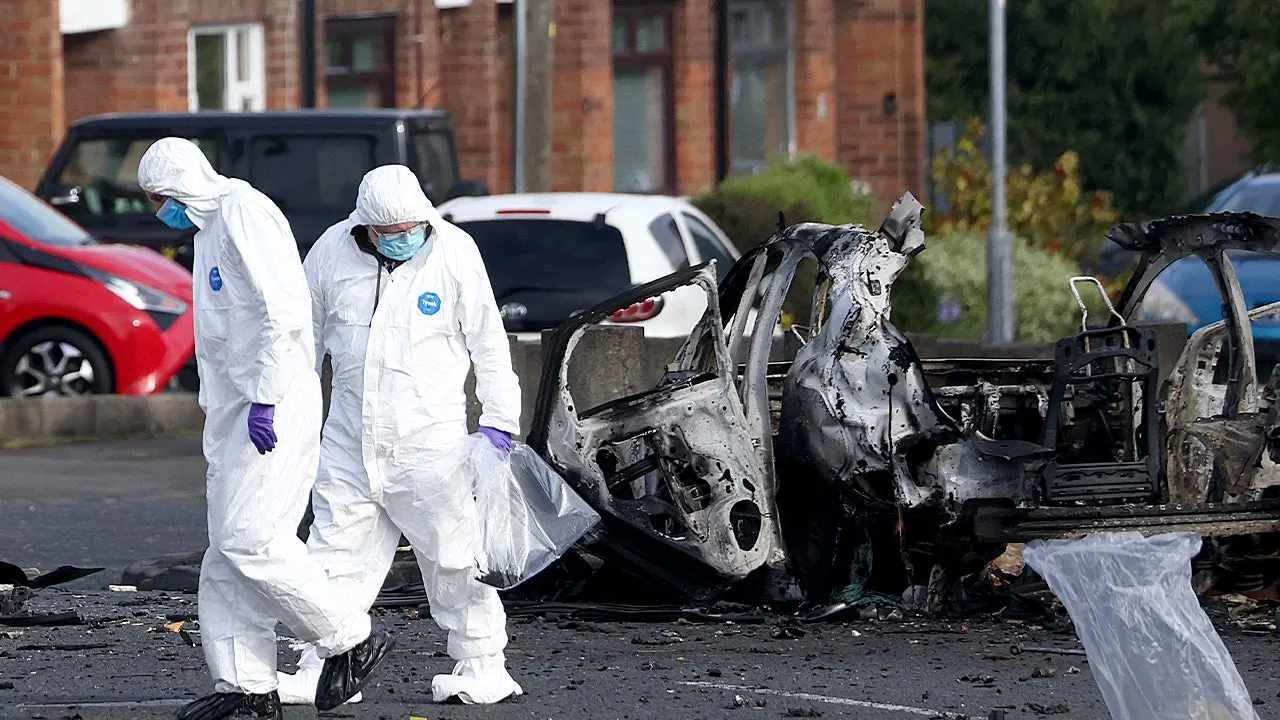
A dangerous dissident group, the New IRA, claimed responsibility for a car bomb attack outside a Belfast police station on Tuesday, while simultaneously issuing threats of future violence against law enforcement officers. The group, which allegedly has ties to Iran and Hezbollah, warned it would target police officers at their homes.
The explosion occurred at the Police Service of Northern Ireland station in Dunmurry, prompting authorities to increase patrols across the region. In connection with the bombing, police arrested a 66-year-old man under terrorism laws, according to Reuters.
In a statement attributed to the “leadership of the IRA,” the militant group revealed the bomb was intended to kill officers leaving the station. The statement contained explicit threats that anyone cooperating with police “will be severely dealt with.”
Intelligence reports from 2020 suggest concerning international connections. According to The Times, citing information from an MI5 informant, the New IRA has established links with Lebanon-based Hezbollah and Iran’s Islamic Revolutionary Guard Corps (IRGC). The report noted that individuals associated with the New IRA signed a book of condolences following the 2020 killing of Iranian General Qassem Soleimani in a U.S. drone strike in Baghdad, raising alarms about possible external support, including weapons and financing.
“The New IRA–Hezbollah link is a useful data point in a much larger pattern: the operationalization of the so-called axis of resistance,” said Andrew Badger, a former Defense Department intelligence officer, in comments to Fox News Digital. He explained that this connection represents part of a broader global network involving Russia, Iran, China, North Korea, and various non-state actors who share logistics and tradecraft.
The Dunmurry bombing follows a similar attempted car bomb attack on another police station outside Belfast just weeks ago, indicating an escalation in militant activity. The New IRA is one of several groups that oppose the 1998 Good Friday Agreement, which brought relative peace to Northern Ireland after decades of sectarian conflict known as “The Troubles.” These dissident republican groups seek to end British rule in Northern Ireland and establish a united Ireland.
The organization has been responsible for numerous attacks in recent years specifically targeting police and security forces. Security experts warn that these incidents are becoming more sophisticated as militant groups share tactics and expertise.
“The real challenge for local Irish police and security services is that these groups now compound each other’s learning,” Badger noted. “A tactic battle-tested in one theater can be in the hands of a dissident cell in another within months, and Western counter-terror structures simply aren’t wired to track that kind of cross-pollination.”
This evolution of tactics represents a new phase in global terrorism networks. “A Lebanese Shia militia training a hard-left Irish republican faction would have looked exotic 10 years ago,” Badger added. “Today, it is consistent with a wider pipeline including Russian sabotage cells using local criminal proxies in Europe and Iranian-directed assassination plots on U.K. and U.S. soil.”
Security analysts point to a troubling convergence in methods across these diverse militant groups. Despite their different geographic origins and stated goals, they appear to be adopting similar operational approaches. “The playbook of these actors — proxies, dual-use logistics, weapons-and-finance pipelines, exploitation of grievance movements in the target country — appear to be converging,” Badger explained.
The bombing comes at a sensitive time for Northern Ireland, which has maintained relative but fragile peace since the Good Friday Agreement was signed more than two decades ago. The region still grapples with sectarian tensions, and security forces remain vigilant against the ongoing threat posed by dissident groups like the New IRA.
Local authorities have urged the public to remain alert and report any suspicious activities as they continue to investigate the bombing and assess the credibility of further threats against police personnel.
Fact Checker
Verify the accuracy of this article using The Disinformation Commission analysis and real-time sources.

8 Comments
This attack is deeply concerning, especially the alleged links to Iran and Hezbollah. Militant groups like the New IRA pose a serious threat to peace and security in the region. I hope authorities can quickly apprehend those responsible and disrupt any international connections.
Yes, the transnational nature of this threat is worrying. Coordinated action between security services will be crucial to counter these extremist networks.
The use of car bombs and threats against police officers is an alarming escalation of violence. I’m curious to learn more about the group’s motivations and how they may be receiving support from foreign actors like Iran and Hezbollah.
Agreed, the international linkages are a significant concern that require further investigation. Disrupting the flow of resources and expertise to these militant groups should be a top priority.
This incident underscores the fragile security situation in Northern Ireland and the ongoing risks posed by dissident republican groups. I hope the authorities can quickly identify and apprehend those responsible before they strike again.
While the details are still emerging, this attack is a sobering reminder of the persistent challenges facing Northern Ireland’s peace process. Maintaining vigilance and strengthening cross-border cooperation will be vital to addressing the threat posed by groups like the New IRA.
The targeting of police stations is a disturbing tactic that demonstrates the New IRA’s intent to sow fear and undermine public confidence. Curbing the group’s access to weapons and explosives will be crucial to mitigating the threat.
Absolutely. Cutting off the New IRA’s supply lines and financial networks will be key to disrupting their operations. Close cooperation between law enforcement and intelligence agencies will be essential.