


Listen to the article
French President Macron: EU Defense Push Complements NATO, Not Replacing It
European Union efforts to strengthen its defense capabilities are not meant to create an alternative to NATO but rather to respond to long-standing American requests for Europe to take greater responsibility for its own security, French President Emmanuel Macron said Saturday in Athens.
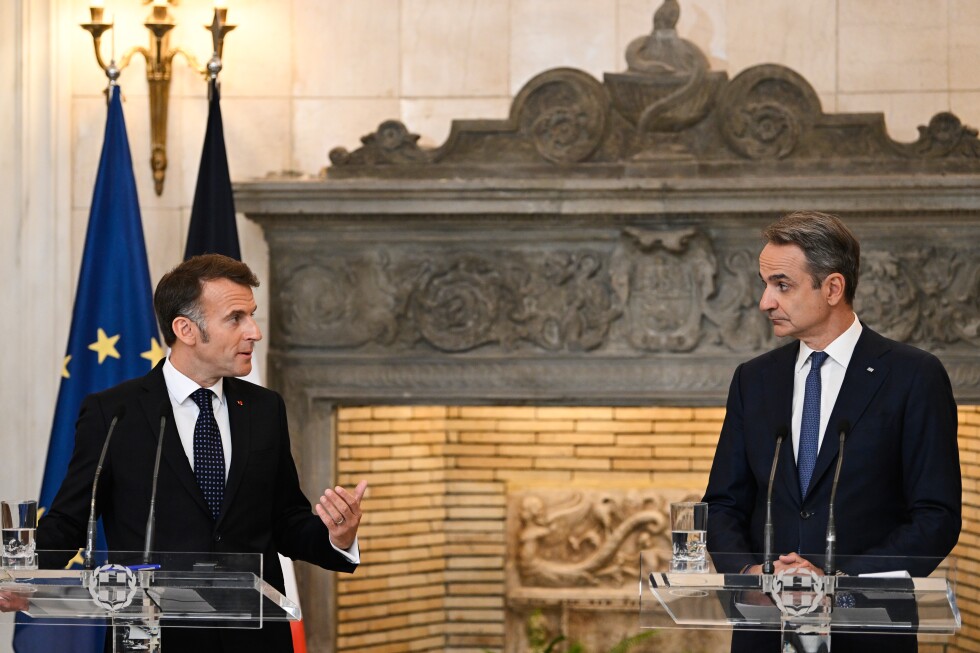
During a joint appearance with Greek Prime Minister Kyriakos Mitsotakis, Macron emphasized that Europeans must reduce their dependence on outside powers. “The lesson we must draw is, let us no longer be dependent,” Macron stated. “We Europeans must strengthen this European pillar of NATO, we must strengthen this Europe of defense — not against anyone, not as an alternative to anything.”
Mitsotakis agreed, noting that the United States should welcome the EU’s increased focus on self-reliance in defense matters. He described Washington’s demands for greater European defense spending as “justified” and said European nations should embrace this direction.
Macron’s visit to Greece followed his attendance at an informal European Union leaders’ summit in Cyprus. The trip highlighted the ongoing defense partnership between France and Greece, formalized in a 2021 agreement worth 3 billion euros. This deal included Greece’s purchase of 24 Rafale fighter jets and four advanced frigates, including the Kimon, which both leaders visited during Macron’s stay.
The French-Greek defense agreement includes a mutual assistance clause that Macron described as “inviolable” and “not up for debate.” He emphasized the importance of this commitment: “So there are no question marks, no doubts to be entertained — and all our potential, or real, enemies need to be very clear about that.”
Greece’s military modernization comes against the backdrop of historically tense relations with neighboring Turkey. The country has significantly upgraded its defense capabilities in recent years, with France emerging as a key supplier. Among the systems Greece has acquired is the French MICA anti-air-missile system, versatile enough to be deployed on aircraft, land vehicles, and warships.
Both leaders presented their bilateral cooperation as a model for other EU member states to follow. Mitsotakis called for European nations to move beyond “national egotism” that protects domestic industries and instead pursue more cross-border mergers to achieve economies of scale in defense manufacturing.
Macron reinforced this point, stressing the need for European industry to innovate and create products that appeal to consumers while supporting the EU’s defense objectives. “All of us Europeans — the Franco-Greek relationship is a prime example — need to buy more European products, produce more European goods, and innovate more within Europe,” he said.
The leaders also referenced Article 42.7, the EU’s mutual defense clause, which Macron insisted was not “just empty words.” He cited both countries’ swift deployment of warships to assist Cyprus after a Shahed drone struck a British base on the island during the recent conflict involving Iran.
Addressing ongoing tensions in the Middle East, Macron cautioned against creating panic about potential fuel shortages resulting from disruptions in the Strait of Hormuz, through which approximately one-fifth of the world’s oil and gas passes. He assured that fuel supplies remain “under control” and that no shortages are anticipated, though he acknowledged that restoring normal operations in the strait would take time.
Mitsotakis, representing Greece’s significant shipping interests, emphasized that any diplomatic solution must guarantee “complete and unimpeded freedom of navigation” through the strait without imposing tolls on ships, as was standard practice before recent hostilities.
The meeting underscores growing European determination to strengthen defensive capabilities while maintaining the transatlantic alliance that has been central to Western security for over seven decades.
Fact Checker
Verify the accuracy of this article using The Disinformation Commission analysis and real-time sources.

16 Comments
The call for Europe to be less dependent on external powers is understandable, given the geopolitical shifts in recent years. However, NATO remains a crucial alliance, so any EU defense initiatives should complement rather than compete with it. Finding the right balance will be key.
Macron’s emphasis on ‘not against anyone’ is an important nuance. The EU defense push is about increasing European capabilities, not creating an antagonistic force against NATO or the US.
Increased European defense spending and integration is a positive step, but it must be done in a way that reinforces NATO rather than replaces it. The transatlantic alliance remains crucial for European and global security, so any EU initiatives should be designed to enhance rather than undermine it.
The leaders’ emphasis on Europe reducing its ‘dependence on outside powers’ is understandable, but NATO should remain the foundation of European defense. Careful coordination between the EU and NATO will be essential going forward.
The leaders’ emphasis on the EU defense push as a complement to NATO, not a replacement, is a sensible approach. Reducing European dependence on outside powers is understandable, but not at the expense of the transatlantic alliance that has anchored Western security for decades.
I agree that the US should welcome increased European defense spending and capabilities, as long as it’s done in a way that strengthens NATO rather than undermines it. Careful coordination between the EU and alliance partners will be key.
While the desire for greater European strategic autonomy is understandable, maintaining a strong NATO alliance must remain a priority. The leaders’ focus on complementarity rather than replacement is reassuring and important for preserving Western security architecture.
Macron’s point about the EU defense push not being ‘against anyone’ is a crucial nuance. The goal should be to strengthen European capabilities in a way that enhances rather than undermines the transatlantic partnership.
Interesting perspective from the French and Greek leaders. Strengthening European defense capabilities as a complement to NATO, not a replacement, seems like a pragmatic approach. It’s crucial for Europe to be able to take more responsibility for its own security while maintaining coordination with NATO partners.
I agree that reducing European dependence on outside powers is an important goal. Building up a stronger European pillar within NATO makes sense, rather than trying to create a wholly separate defense structure.
Increased European defense spending and capabilities could benefit NATO as a whole, by reducing the burden on the US and strengthening the alliance. It’s a complex issue, but the leaders seem to be striking the right tone of cooperation rather than confrontation.
The US has long called for greater European defense contributions, so it’s good to see European leaders embracing this direction. Striking the right balance between EU and NATO efforts will be crucial going forward.
Macron’s point about ‘no longer being dependent’ on external powers resonates. The EU should absolutely strengthen its own defense capabilities, but in a way that enhances rather than undermines NATO. Maintaining a strong transatlantic partnership is critical for European and global security.
I’m encouraged to see the French and Greek leaders on the same page about the EU defense push not being an alternative to NATO. Complementarity and coordination will be key as Europe seeks greater strategic autonomy.
While the European defense push is understandable, maintaining strong NATO ties is critical. The alliance has been the bedrock of Western security for decades, so it’s reassuring to see the French and Greek leaders emphasize complementarity rather than replacement.
Reducing European dependence on outside powers is a worthy goal, but it needs to be done in a way that strengthens the overall transatlantic security architecture. Careful coordination between the EU and NATO will be essential.