


Listen to the article
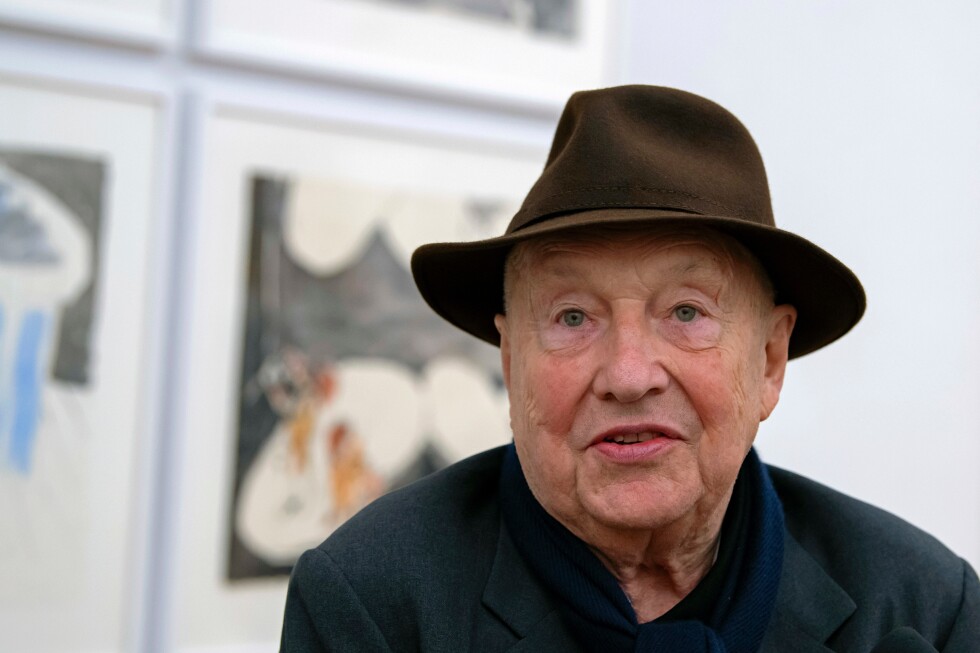
Georg Baselitz, Pioneering German Artist Known for Inverted Paintings, Dies at 88
Georg Baselitz, an acclaimed German artist who challenged artistic conventions by famously painting images upside down, has died peacefully at age 88, the Thaddaeus Ropac Gallery announced Thursday.
Born Hans-Georg Kern on January 23, 1938, in Nazi-era Germany, Baselitz emerged as a towering figure in the neo-Expressionist movement despite—or perhaps because of—growing up amid the devastation of World War II. “I was born into a destroyed order, into a destroyed landscape, into a destroyed people, into a destroyed society,” he once reflected to German news agency dpa.
In 1957, as political pressure mounted in communist East Germany, the young artist fled to the West. He later adopted his artistic name from Deutschbaselitz, the eastern Saxony village where he was born, creating a new identity that would become synonymous with artistic rebellion.
Baselitz established himself as a provocateur early in his career. His first exhibition in 1963 caused immediate controversy when authorities confiscated at least two paintings they deemed pornographic. This confrontational approach would become a hallmark of his artistic journey, with “contradiction” serving as his personal motto.
The artist’s breakthrough came in the 1960s with his “Hero” series, depicting broken figures in tattered uniforms with disproportionate body parts—giant hands, small heads—staggering toward viewers. These golden-hued paintings, inspired by Russian civil war novels, portrayed a wounded post-war psyche. “Der Hirte” (The Shepherd) from 1966 brought him international recognition.
But it was in 1969 that Baselitz made his most distinctive artistic statement with “Der Wald auf dem Kopf” (The Forest on its Head), his first “inverted” painting. This upside-down approach became his signature style, challenging viewers to engage with his work beyond conventional representation.
“Georg Baselitz did not just turn his paintings upside down; he also turned our thinking routines upside down,” German President Frank-Walter Steinmeier said in tribute. “Having experienced the destruction and suffering of the Second World War as a child, the collapse of all order forced him to question everything around him.”
Despite his works hanging in prestigious museums worldwide and fetching millions at auction—in 2017, stolen Baselitz pieces valued at approximately 2.5 million euros were recovered by German police—the artist maintained a thoughtful ambivalence about his own artistic identity.
“Typical painting has never appealed to me,” Baselitz said in a recent video, appearing in a paint-smudged jacket. “I actually wanted to be more of a black-and-white painter, and above all, I didn’t want to work spatially, perspectively, with shadows and light and such things that arise with the imitation of nature.”
Interestingly, despite being celebrated for his bold use of color, Baselitz claimed he never viewed himself as a colorist. “Throughout my life, I was not aware that I was a painter of color, even though I am constantly told that I have such wonderful colors,” he remarked.
In his later years, Baselitz continued to challenge artistic and social norms. His 2023 “Naked Masters” exhibition at Vienna’s Kunsthistorisches Museum confronted themes of nudity—including paintings of himself and his wife Elke—displayed alongside classical nude paintings from the museum’s permanent collection.
The Thaddaeus Ropac Gallery, which represented Baselitz, described him as “a titan of contemporary painting, sculpture, drawing and printmaking” and “one of the most important artists of our time,” noting his profound influence on fellow artists and the international art world.
At the time of his death, the Giorgio Cini Foundation in Venice was preparing an exhibition of his “Golden Heroes” works, scheduled to run from May 6 to September 27.
Baselitz is survived by his wife Elke and their sons, Daniel Blau and Anton Kern. His passing marks the end of an artistic career that spanned more than six decades and consistently challenged viewers to see the world—quite literally—from a different angle.
Fact Checker
Verify the accuracy of this article using The Disinformation Commission analysis and real-time sources.

22 Comments
Production mix shifting toward World might help margins if metals stay firm.
Exploration results look promising, but permitting will be the key risk.
If AISC keeps dropping, this becomes investable for me.
Good point. Watching costs and grades closely.
Production mix shifting toward World might help margins if metals stay firm.
Good point. Watching costs and grades closely.
Good point. Watching costs and grades closely.
Production mix shifting toward World might help margins if metals stay firm.
If AISC keeps dropping, this becomes investable for me.
Silver leverage is strong here; beta cuts both ways though.
Good point. Watching costs and grades closely.
Nice to see insider buying—usually a good signal in this space.
Good point. Watching costs and grades closely.
Good point. Watching costs and grades closely.
Silver leverage is strong here; beta cuts both ways though.
Exploration results look promising, but permitting will be the key risk.
Production mix shifting toward World might help margins if metals stay firm.
Nice to see insider buying—usually a good signal in this space.
Good point. Watching costs and grades closely.
Good point. Watching costs and grades closely.
Uranium names keep pushing higher—supply still tight into 2026.
If AISC keeps dropping, this becomes investable for me.