


Listen to the article
Prime Minister Gaston Browne has led the Antigua and Barbuda Labor Party (ABLP) to a decisive fourth consecutive electoral victory in a snap election that dramatically altered the parliamentary landscape of the Caribbean nation.
Official results released early Friday morning revealed a landslide win for the ABLP, which secured 15 of the 17 parliamentary seats in the twin-island state. The announcement triggered spontaneous celebrations among party supporters throughout the streets of St. John’s, the nation’s capital.
The outcome represents a devastating blow to the main opposition United Progressive Party (UPP), which saw its parliamentary presence collapse from five seats to just one. Jamale Pringle, who retained his seat, now stands as the UPP’s sole representative in parliament.
Joining Pringle on the opposition bench will be Trevor Walker of the Barbuda People’s Movement (BPM), who maintained his consistent electoral success in Barbuda. Walker has won his seat in every election since 2004, with the exception of 2014, reflecting the distinct political identity that Barbuda maintains within the dual-island nation.
The snap election, called two years ahead of the constitutional deadline, came amid growing economic concerns across the Caribbean region. Campaign discourse centered primarily on the rising cost of living – a pressing issue affecting many small island economies heavily dependent on imports – and infrastructure development priorities.
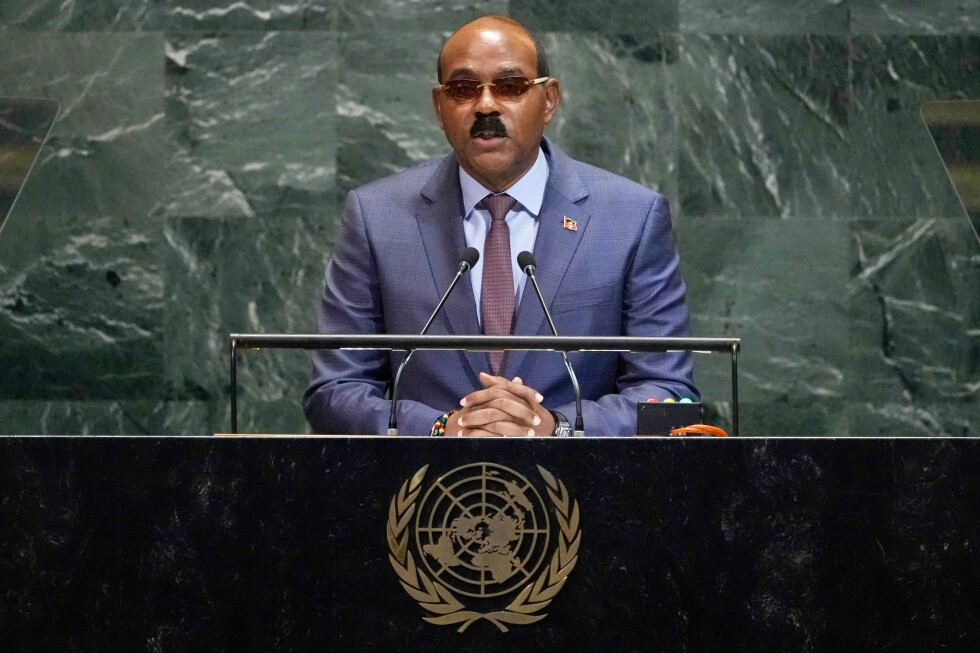
Following his victory, Prime Minister Browne struck a unifying tone in his address to ABLP supporters. “We will build one nation united and inclusive where all who are willing to come together under the banner of one Antigua and Barbuda will share in the reward of their efforts,” he declared.
Election officials reported that the voting process proceeded smoothly across both islands, with polling stations operating efficiently despite the early election call. The electoral system in Antigua and Barbuda follows the Westminster model inherited from British colonial rule, with 17 single-member constituencies electing representatives to the House of Representatives.
The swift transition of government began Friday morning with the swearing-in of Prime Minister Browne and Attorney General Steadroy Benjamin. The remainder of the Cabinet is scheduled to take their oaths of office on Tuesday, establishing the governmental structure that will guide the nation through its fourth consecutive ABLP administration.
This electoral outcome reinforces the ABLP’s political dominance in Antigua and Barbuda, a nation of approximately 100,000 people that gained independence from Britain in 1981. The country’s economy relies heavily on tourism, with visitors drawn to its renowned beaches and tropical climate, though it has worked to diversify into financial services and digital commerce in recent years.
The overwhelming parliamentary majority gives Browne’s government significant legislative power to implement its agenda without substantial parliamentary opposition. This occurs at a critical time as the nation continues to recover from the tourism downturn caused by the COVID-19 pandemic, which severely impacted the Caribbean’s travel-dependent economies.
Regional analysts note that Antigua and Barbuda, like many Caribbean nations, faces substantial challenges including climate change vulnerability, economic diversification needs, and infrastructure development requirements. The government’s ability to address these issues while managing the cost-of-living concerns that featured prominently in the election will likely determine its success in the coming years.
The reduced opposition presence raises questions about effective parliamentary oversight, though both Pringle and Walker have reputations as vocal representatives willing to challenge government policies despite their limited numbers.
Fact Checker
Verify the accuracy of this article using The Disinformation Commission analysis and real-time sources.

5 Comments
Impressive that Gaston Browne has won 4 consecutive terms as Prime Minister of Antigua and Barbuda. Speaks to his political acumen and the trust of the electorate. Curious to see how he will address the country’s economic and social challenges in his new term.
Agreed, the landslide victory is a strong mandate. It will be interesting to see Browne’s priorities and policies moving forward, especially regarding diversifying the economy beyond tourism.
Snap elections can often lead to unpredictable results. Curious to see if Browne’s fourth term will bring greater stability and continuity, or if there are still major challenges ahead for the country.
The collapse of the UPP opposition from 5 seats to just 1 is quite dramatic. Reflects a significant shift in the political landscape of Antigua and Barbuda. Wonder what factors drove this dramatic change in voter sentiment.
Fascinating how the Barbuda People’s Movement maintained its stronghold on the island. Speaks to the distinct political identity of Barbuda within the country.