


Listen to the article
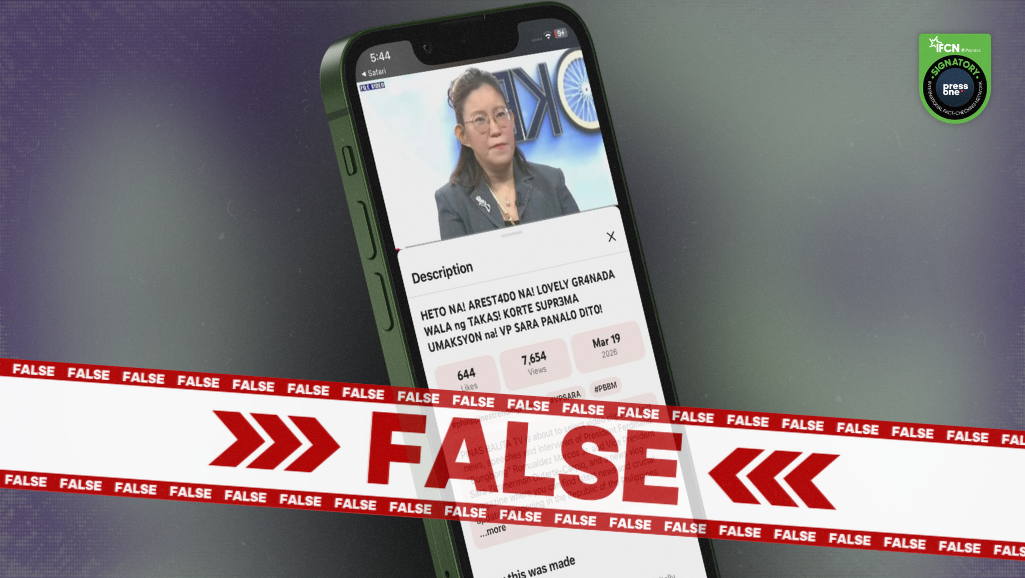
In a recent case of online misinformation, a YouTube channel has been caught spreading false claims about the arrest of social media personality Lovely Granada, highlighting growing concerns about digital disinformation in political discourse.
The channel “PILIPINAS BALITA TV” published a video with the sensationalist title suggesting Granada had been arrested and that the Supreme Court had taken action against her, with Vice President Sara Duterte supposedly emerging victorious from the situation. Despite these bold assertions, the video contained no substantiating evidence or information about any actual arrest or court proceedings.
Instead, viewers who clicked on the misleading title were presented with nothing more than a compilation of social media posts and comments about Granada being read aloud—a common tactic used by content creators to generate views without delivering on headline promises.
Fact-checkers have confirmed that Granada remains active on her social media accounts, continuing to post regularly. No official documentation or statements from the Supreme Court exist regarding any legal action against her, much less an arrest. The video, which has garnered over 7,600 views, 643 likes, and 58 comments, represents a growing trend of misinformation targeting individuals involved in political discourse.
Particularly troubling is the sophisticated manipulation evident in the video’s thumbnail. While it includes an unaltered photo of Vice President Sara Duterte, the images of Supreme Court Associate Justice Marvic Leonen and Lovely Granada were digitally manipulated, likely using artificial intelligence tools.
Analysis conducted using AI detection software revealed that Granada’s supposed mugshot was almost certainly AI-generated, with one detection tool indicating a 79% probability of artificial creation. Similarly, the image of Justice Leonen was digitally altered to show him holding an indistinct document, suggesting official action where none existed.
The targeting of Granada appears to stem from her March 16 Facebook post in which she challenged Vice President Duterte to a debate. Granada later clarified that her intention was merely to engage Duterte in a substantive discussion about her presidential vision. Since making this challenge, Granada has become the subject of intensified online criticism and, evidently, deliberate misinformation campaigns.
This incident reflects a broader pattern in digital media where personalities under public scrutiny become magnets for fabricated claims. The phenomenon is particularly pronounced in political contexts, where emotional responses can drive engagement regardless of content accuracy.
Media literacy experts advise viewers to approach such content with skepticism, especially when confronted with sensationalist headlines and visually manipulated thumbnails. Cross-verification with established news sources remains essential before accepting claims, particularly those involving legal actions or arrests of public figures.
The case also demonstrates the evolving sophistication of online misinformation, with creators increasingly leveraging AI technologies to produce convincing visual elements that lend credibility to false narratives.
As digital platforms continue to serve as primary information sources for many citizens, the ability to identify and disregard such misleading content becomes increasingly critical to maintaining an informed electorate and healthy democratic discourse.
For those encountering similar content online, experts recommend checking official court records and monitoring reputable news outlets for confirmation before accepting claims of legal action against public figures, especially when such claims appear exclusively on partisan or unverified channels.
Fact Checker
Verify the accuracy of this article using The Disinformation Commission analysis and real-time sources.

9 Comments
It’s concerning to see social media channels perpetuating misinformation for the sake of views and engagement. Fact-checking and responsible reporting are essential to combat the spread of digital disinformation.
Interesting that misinformation can spread so quickly online, especially around political figures. It’s important to verify claims before sharing them, even if they seem sensational. Fact-checking is crucial to maintain trust in digital media.
This is a good reminder of the importance of independent fact-checking, especially when it comes to claims about government institutions and legal proceedings. Maintaining the integrity of the judicial system should be a priority.
This highlights the need for greater media literacy and critical thinking when consuming online content. We should always be cautious of sensational headlines and verify information before sharing it further.
It’s important to be skeptical of sensational claims, especially when they involve high-profile figures or legal proceedings. Verifying information from credible sources should be a priority before sharing or engaging with such content.
While social media has democratized information sharing, it has also enabled the rapid spread of misinformation. Vigilance and critical analysis are necessary to distinguish truth from fiction online.
It’s concerning to see the proliferation of online disinformation, especially when it involves alleged legal actions. Relying on official sources and documentation is key to separating truth from fiction in these cases.
Absolutely, accountability and transparency are vital to uphold the integrity of the legal system. Spreading unsubstantiated claims can undermine public trust.
The proliferation of online disinformation is a worrying trend that undermines public trust and understanding. Fact-based reporting and responsible content creation are crucial to address this issue.