


Listen to the article
The diplomatic relationship between U.S. President Donald Trump and French President Emmanuel Macron has evolved dramatically since their first encounter nearly a decade ago, and the complexities of their partnership will be front and center when world leaders gather next week for the G7 summit in the French lakeside resort of Evian-les-Bains.
Their initial meeting in 2017 at a NATO summit in Brussels captured international attention with an unusually prolonged handshake that left both men with white knuckles, neither willing to be the first to release their grip. At the time, Trump was a brash businessman newly elected to the presidency, while Macron had just secured a landslide victory in France’s elections. Despite the awkward physicality of that first encounter, the meeting marked the beginning of what would become one of the more intriguing diplomatic relationships of Trump’s presidency.
In the early months of their acquaintance, Macron distinguished himself as perhaps the one European leader who appeared capable of managing Trump’s unpredictable diplomatic style. The French president extended an invitation to Trump for Bastille Day celebrations in July 2017, which included a dinner at the Eiffel Tower with their spouses. Trump returned the gesture by making Macron the guest of honor at his first White House state dinner the following year, the highest diplomatic honor the United States can bestow upon an ally.
However, the warmth of those early exchanges has cooled considerably. By the end of Trump’s first term, the bromance had visibly faded, and during his second term, the two leaders have increasingly traded public criticism over fundamental policy disagreements. Their tensions center on three major issues: tariffs, the ongoing conflict in Ukraine, and the war with Iran.
The upcoming G7 summit will bring these strains into sharp focus. Joining Trump and Macron will be leaders from Britain, Canada, Germany, Italy, and Japan. Max Bergmann, director of the Europe, Russia, and Eurasia Program at the Center for Strategic and International Studies, acknowledged the potential for awkward moments but suggested that European leaders remain professional diplomats who may view the gathering as an opportunity despite the challenges.
Kurt Volker, a former U.S. ambassador to NATO, pointed to specific friction points that have complicated the Trump-Macron dynamic. The Iran conflict has proven particularly divisive. Trump joined Israel in military action against Iran over its nuclear program in February without consulting European allies, then publicly complained when those countries declined his requests for assistance. The lack of consultation on a matter directly affecting European interests created resentment, particularly in France.
The waning American support for Ukraine under the Trump administration has further irritated French officials, who view the conflict with Russia as critically important. Macron has underscored this concern by inviting Ukrainian President Volodymyr Zelenskyy to participate in summit discussions on Tuesday.
Trade disputes have also strained relations. Macron condemned as “brutal and unfounded” new tariffs Trump imposed on steel, aluminum, and various European imports in early 2025. These economic measures have added another layer of complexity to an already challenging relationship.
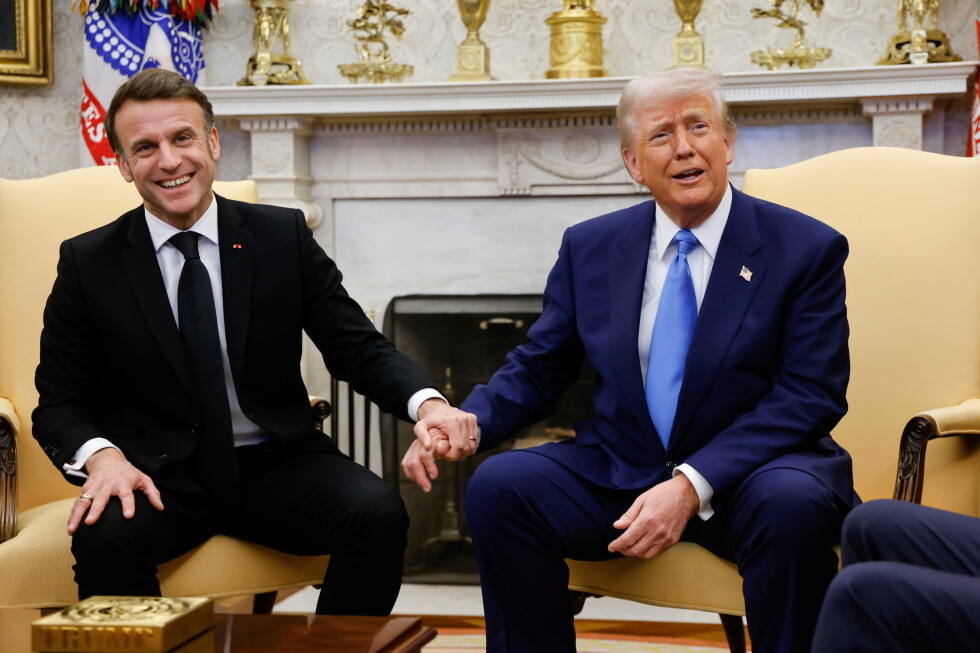
Despite these policy disagreements, the personal dynamic between the two presidents remains somewhat cordial on the surface. They continue to address each other as “my friend” in public settings. Trump attended the reopening of Notre Dame Cathedral in Paris in late 2024 at Macron’s invitation, and Macron was among the early foreign leaders to visit the Oval Office after Trump’s second term began in 2025.
Yet even these diplomatic encounters have featured revealing moments. During Macron’s White House visit, the French president publicly corrected Trump when he incorrectly suggested that Europe would recover money provided to Ukraine. With a smile, Macron touched Trump’s forearm and clarified, “We provided real money.”
Macron has grown notably more cautious in his approach to Trump. He now says he is “careful” about Trump’s statements, suggesting he no longer takes them at face value. When Trump made inappropriate comments about Brigitte Macron at a private luncheon in April, the French president responded tersely that the remarks were “neither elegant nor appropriate” and did not deserve further response.
The French president has argued that Trump’s “America first” policies have strengthened his case for enhanced European defense capabilities that would reduce reliance on the United States. In April, as Trump sent mixed signals about Washington’s commitment to NATO following the start of the Iran war, Macron delivered some of his sharpest criticism yet. “There is too much talk, and it’s going in all directions,” he said. “We all need stability, calm and a return to peace. This is not a show.”
Despite the tensions, Macron has demonstrated his commitment to maintaining channels of communication. He has often said he can reach Trump directly whenever necessary, a claim he proved during last year’s U.N. General Assembly when he called Trump after being blocked from crossing a street by the presidential motorcade.
In preparing for the summit, Macron has made accommodations for Trump’s schedule. He originally planned to begin the gathering on Sunday, which is Trump’s 80th birthday, but postponed the start by a day after learning Trump planned to celebrate with a UFC show at the White House.
As the G7 leaders prepare to convene, the Trump-Macron relationship exemplifies the broader challenges facing transatlantic relations in an era of shifting alliances and competing priorities.
Fact Checker
Verify the accuracy of this article using The Disinformation Commission analysis and real-time sources.

12 Comments
Nice to see insider buying—usually a good signal in this space.
Good point. Watching costs and grades closely.
Good point. Watching costs and grades closely.
Exploration results look promising, but permitting will be the key risk.
Good point. Watching costs and grades closely.
Nice to see insider buying—usually a good signal in this space.
Production mix shifting toward World might help margins if metals stay firm.
Good point. Watching costs and grades closely.
Good point. Watching costs and grades closely.
I like the balance sheet here—less leverage than peers.
Good point. Watching costs and grades closely.
Good point. Watching costs and grades closely.