


Listen to the article
Canadian Prime Minister Mark Carney has arrived in Europe ahead of the Group of Seven summit in France, navigating a delicate diplomatic balancing act as his country faces mounting economic pressure from the United States. The visit comes at a pivotal moment for North American trade relations, with the future of a key continental free-trade agreement hanging in the balance.
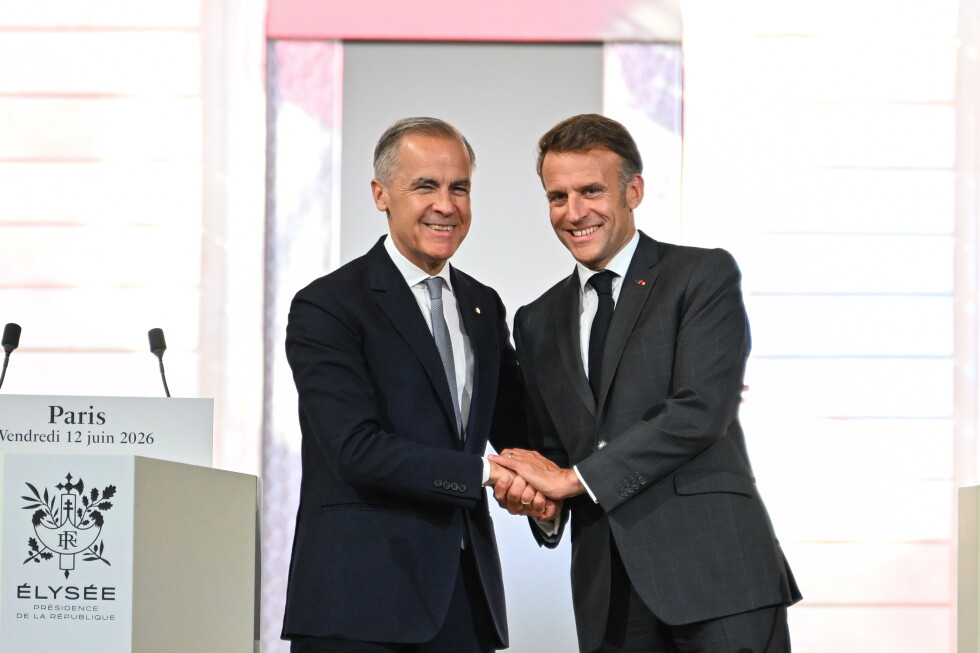
Carney met with French President Emmanuel Macron in Paris on Friday, just days before the G7 summit begins Monday in Evian-les-Bains. The timing is significant, as the gathering precedes the scheduled July 1 review of the U.S.-Mexico-Canada Agreement, known as USMCA. This trade pact, which has bound together the economies of the three nations since the early 1990s, now faces an uncertain future after President Donald Trump said this week he may not renew the deal.
During his Paris meeting, Carney avoided directly mentioning the United States but spoke about artificial intelligence and emphasized that Canada and France “are determined to act in this way to strengthen our strategic autonomy in a world dominated by hegemonic powers and hyperscalers.” Macron responded by noting the two countries “share the same view of the world.”
The comments represent a notably softer tone than the Canadian leader struck just months earlier. In January, Carney’s speech at the World Economic Forum in Davos, Switzerland, became a defining moment when he declared the global rules-based order over and condemned coercion by great powers against smaller countries. That address became a symbol of middle-power resistance and helped propel him to the prime minister’s office in March 2025.
The shift in rhetoric reflects the precarious position Canada now occupies. With 70 percent of Canadian exports destined for the United States, preserving the USMCA is critical for the country’s economic stability. Canadian historian Robert Bothwell noted that Trump represents a unique challenge for Carney because “we are more exposed to the United States” than any other nation.
Relations between the longtime allies have deteriorated sharply in recent months. Trump has launched a trade war against Canada and repeatedly suggested, to the fury of many Canadians, that the country should become the 51st U.S. state. These provocations helped create the political environment that allowed Carney to win the prime minister’s position after promising to stand up to Trump.
The strain in the relationship extends beyond rhetoric. Ontario Premier Doug Ford, who leads Canada’s most populous province, had a reception with the U.S. Chamber of Commerce in Washington abruptly canceled Monday, though one of his ministers called it “a badge of honor.” On Thursday, the opening of a major Canadian bridge across the Detroit River was delayed due to unresolved issues after Trump had previously threatened to block the project.
Trump administration officials have emphasized that only two countries, China and Canada, retaliated against American tariffs in the ongoing trade war. U.S. Trade Representative Jamieson Greer has identified Canada’s retaliatory measures as a major obstacle in ongoing negotiations.
Trump himself said again this week that the United States doesn’t need anything Canada has. In response, Carney has set an ambitious goal for Canada to double its non-U.S. exports within the next decade, arguing that Trump’s trade war is creating a chilling effect on investment.
Daniel Béland, a political science professor at McGill University in Montreal, observed that Carney appears to have moderated his approach toward the Trump administration to prevent further damage to the relationship. “There is a clear tension between what Prime Minister Carney said in his Davos speech about middle powers standing up to hegemons and his attempt to nudge the U.S. administration ‘in the right direction’ with regard to the USMCA review and trade policy more generally,” Béland said.
Carney has also downplayed Trump’s recent comments about Canadian statehood and suggested that the upcoming G7 summit will not necessarily be six countries against one, noting that different nations hold varying positions on different issues.
Canada and Mexico are seeking a 16-year renewal of the USMCA, though analysts believe annual reviews over the next decade are a more likely outcome. As part of his broader strategy to reduce dependence on the American market, Carney will travel to Ireland this weekend to meet with the Irish prime minister to explore opportunities for trade diversification.
The visit marks Carney’s ninth trip to Europe in the 15 months since he assumed office, underscoring his government’s commitment to strengthening ties beyond North America. Trump, meanwhile, is scheduled to leave for the G7 summit immediately after hosting UFC fights at the White House on Sunday to celebrate his 80th birthday.
Fact Checker
Verify the accuracy of this article using The Disinformation Commission analysis and real-time sources.

20 Comments
Nice to see insider buying—usually a good signal in this space.
Production mix shifting toward World might help margins if metals stay firm.
Nice to see insider buying—usually a good signal in this space.
Good point. Watching costs and grades closely.
The cost guidance is better than expected. If they deliver, the stock could rerate.
Good point. Watching costs and grades closely.
Nice to see insider buying—usually a good signal in this space.
Exploration results look promising, but permitting will be the key risk.
Good point. Watching costs and grades closely.
Good point. Watching costs and grades closely.
Production mix shifting toward World might help margins if metals stay firm.
If AISC keeps dropping, this becomes investable for me.
Interesting update on Ahead of G7, Canada’s Carney softens tone toward Trump with trade talks at stake. Curious how the grades will trend next quarter.
Good point. Watching costs and grades closely.
I like the balance sheet here—less leverage than peers.
Good point. Watching costs and grades closely.
Good point. Watching costs and grades closely.
Uranium names keep pushing higher—supply still tight into 2026.
Good point. Watching costs and grades closely.
The cost guidance is better than expected. If they deliver, the stock could rerate.