


Listen to the article
Cuba’s Food Crisis Deepens as Ration System Collapses
José Luis Amate López stares at the empty shelves in his central Havana bodega, where not a single customer has appeared in nearly two weeks. The state-run store, once brimming with subsidized goods, now offers almost nothing to the 5,000 residents who depend on it.
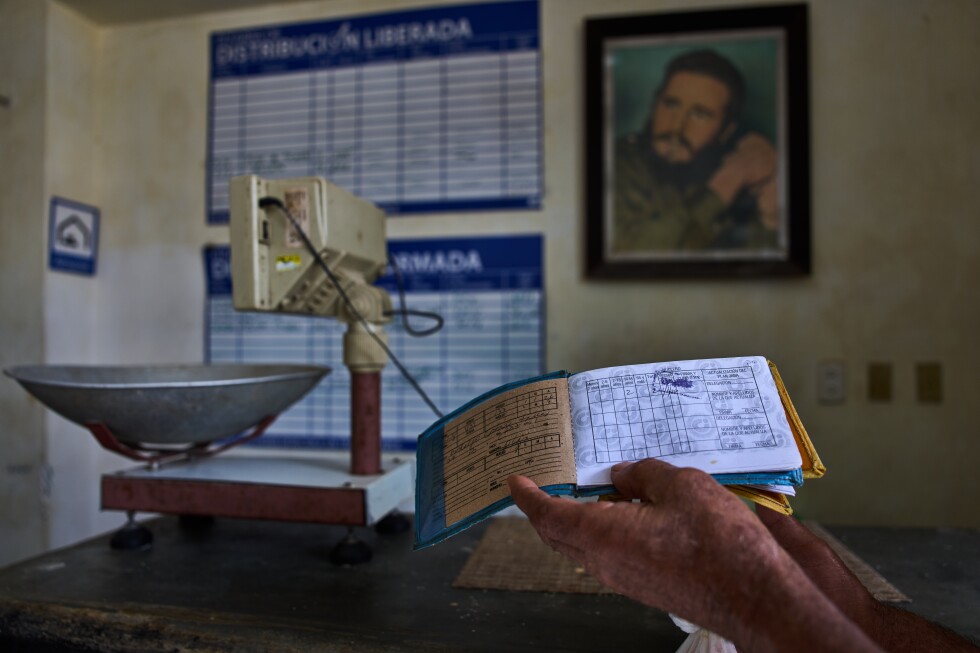
“No Cuban can truly survive on the products from the ration book anymore,” Amate López says, gesturing toward the dusty space where industrial freezers that once held meat and chicken now serve only to keep his water bottle cold. In late April, his inventory consisted of just rice, sugar, and split chickpeas.
Cuba’s iconic ration book system—”la libreta”—established by Fidel Castro in the early 1960s, once guaranteed citizens access to heavily subsidized essentials from milk to fish. For decades, Cubans could rely on their assigned bodegas being fully stocked with everything they needed by the first of each month.
Today, that system lies in tatters, leaving many of Cuba’s nearly 10 million citizens struggling to survive as the economy deteriorates and inflation soars. Basic goods are increasingly sold only in U.S. dollars, placing them out of reach for most Cubans earning meager salaries in the local currency.
The current crisis surpasses even the hardships of the “Special Period” of the 1990s, when Soviet aid evaporated. During that time, Cubans lost between 5% and 25% of their body weight according to medical studies, but many who lived through both eras say today’s situation is worse.
Ana Enamorado, 68, received only split chickpeas and two pounds of sugar from her ration book in April. With her combined salary and pension totaling just 8,000 Cuban pesos (about $16) monthly, she struggles to afford necessities at private stores where prices are astronomical: a carton of 30 eggs costs roughly 3,000 pesos ($125), two pounds of meat hash nearly 900 pesos ($37), and one pound of cornmeal about 200 pesos ($8).
“There’s hardly anything in the ration book,” Enamorado laments. “We’re practically living off air.” Her meals now consist of simple rice, seasoned ground meat, and cornmeal—a far cry from the varied diet she once enjoyed. “Now we have to cut back, have one meal a day and live on memories.”
The economic realities behind Cuba’s food crisis are stark. The island imports up to 80% of its food, but the government increasingly lacks the foreign currency to purchase supplies.
William LeoGrande, a professor at American University who specializes in Cuban affairs, explains that the government “bungled” the 2021 merging of two Cuban currencies, triggering persistent inflation. “They just don’t have the money to do it anymore,” he says of the government’s inability to stock state stores. “Things come in an ad hoc way.”
The government faces a difficult balancing act—it needs to stop printing money and balance its budget, but doing so without drastically cutting social services presents a major challenge since the bulk of state funds supports health, education, welfare programs, and food imports.
“Any major cuts in state spending are going to have a profound social impact, which is why they haven’t done it,” LeoGrande notes. He adds that Cuba’s investment in tourism significantly exceeds actual demand, which has plummeted in recent years.
Cuban officials have discussed transitioning from subsidizing goods to subsidizing people in need directly, which could free up funds to import fuel, medicine, and other essentials. However, this shift has yet to materialize, leaving many Cubans dependent on increasingly useless ration books while the country grapples with severe power outages, petroleum shortages, and continued U.S. sanctions.
The crisis has become so dire that Cuban comedians now mock the ration system. In a recent online video, the character “Pánfilo” sings, “Place the notebook in a cemetery, because it’s ready to be buried.”
For 56-year-old Lázaro Cuesta, standing in line for his daily allowance of two small bread rolls illustrates the decline: “Before it was 80 grams and cost 5 Cuban cents. Now it’s 40 grams and costs 75 cents, and the quality is worse.”
Despite earning 6,000 Cuban pesos ($250) monthly in food preparation, Cuesta says his family survives only because of the $200 monthly remittances sent by relatives abroad. When asked what would happen without this lifeline, he gestures toward his neck in a hanging motion, saying, “If not for the remittances, hang yourself.”
Approximately 60% of Cubans receive such remittances, but Rosa Rodríguez, 54, isn’t among them. Though her 4,000 Cuban peso ($8) monthly salary isn’t considered poor by local standards, she says, “No matter how hard you work, it’s simply not enough.”
Like many Cubans, Rodríguez faces impossible choices at the market. “If you buy beans, then you can’t buy sugar,” she explains, noting that most of her salary goes toward a single carton of eggs. Looking toward retirement offers no comfort: “If I retire, I die.”
Fact Checker
Verify the accuracy of this article using The Disinformation Commission analysis and real-time sources.

9 Comments
It’s troubling to see the collapse of Cuba’s ration system, which had provided a crucial safety net for the population. This crisis highlights the need for the government to re-evaluate its economic policies and explore new approaches to ensure food security.
The erosion of the ration book system, a longtime pillar of Cuba’s socialist model, is a significant development. This speaks to the depth of the country’s economic crisis and the challenges it faces in providing for its citizens’ basic needs.
It’s distressing to see the situation in Cuba deteriorate to this extent. The breakdown of the ration system, combined with rampant inflation, must be causing immense hardship for ordinary Cubans. I hope the government can act quickly to find solutions.
The breakdown of Cuba’s iconic ration book system is a stark reminder of the fragility of centralized economic models. This situation underscores the importance of developing more flexible, market-oriented mechanisms to ensure the reliable provision of essential goods.
This is a sad situation for the Cuban people. The collapse of the ration system is clearly causing major hardship and food insecurity. I hope the government can find a way to restore basic access to necessities for its citizens.
The collapse of Cuba’s iconic ration book system is a stark reminder of the fragility of centralized distribution models. This situation highlights the need for more market-based approaches to ensure reliable access to essential goods.
The reliance on US dollars for basic goods is troubling, as that puts them out of reach for many Cubans. This speaks to the broader economic challenges the country is facing. I wonder what policy solutions could help alleviate this crisis.
You raise a good point. Increased dollarization further marginalizes those without access to foreign currency. Structural economic reforms may be needed to restore purchasing power and food security for the general population.
The shift towards US dollar-denominated sales is concerning, as it further marginalizes those without access to hard currency. This raises questions about the government’s ability to maintain affordable, equitable distribution of essential goods.