


Listen to the article
The Eurovision Song Contest celebrates its 70th anniversary this year amid political tensions that threaten to overshadow the glittering musical spectacle. The competition, taking place May 12-16 in Vienna, Austria, will feature performers from 35 countries competing for Europe’s most prestigious music honor, despite several notable boycotts protesting Israel’s participation.
Born from the ashes of World War II, Eurovision was established in 1956 as an experiment in live broadcasting technology and a vehicle to promote unity across a fractured continent. What began with seven contestants has expanded to include nations from across Europe and beyond, with Israel and Australia now regular participants.
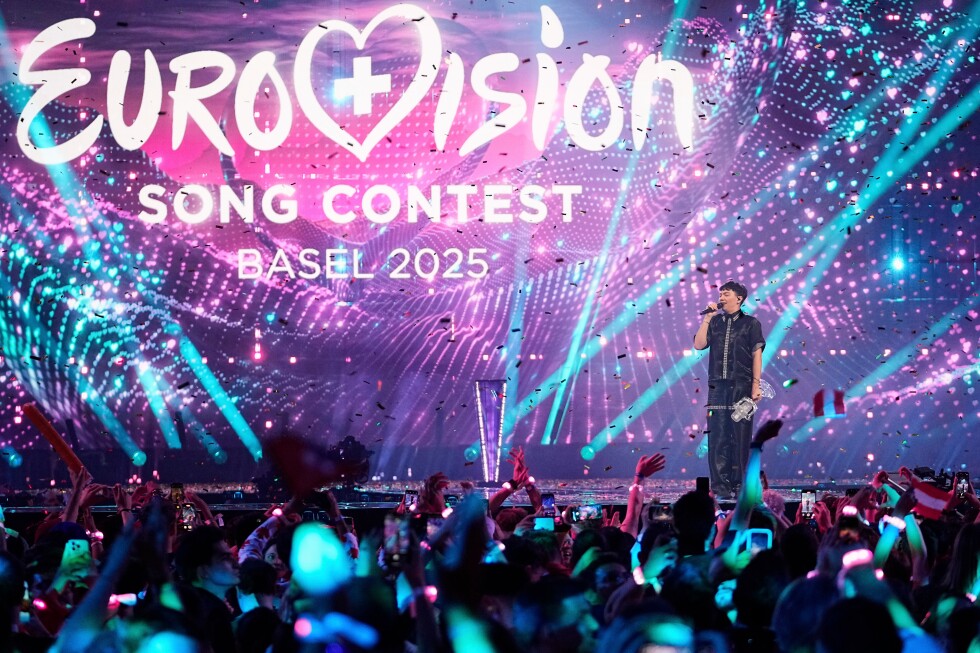
The contest has evolved into a beloved global phenomenon combining national pride, diverse musical styles, and often flamboyant performances. Organizers report last year’s event attracted 166 million viewers worldwide, while fans from 75 countries have purchased tickets for this year’s live shows in Vienna.
Throughout its seven-decade history, Eurovision has produced memorable winners ranging from Swedish pop legends ABBA with “Waterloo” in 1974 to Canadian singer Celine Dion (representing Switzerland) in 1988, Austrian drag performer Conchita Wurst in 2014, Italian rock band Måneskin in 2021, and Ukrainian folk-rap ensemble Kalush Orchestra in 2022.
Despite its “United by Music” motto, Eurovision has repeatedly become entangled in geopolitical controversies. Russia was expelled in 2022 following its full-scale invasion of Ukraine. Both the 2024 contest in Malmö, Sweden, and last year’s event in Basel, Switzerland, were marked by pro-Palestinian demonstrations calling for Israel’s removal over its military campaign in Gaza and allegations of vote manipulation.
The controversy reached a breaking point in December when five countries – Iceland, Ireland, the Netherlands, Slovenia, and Spain – withdrew from this year’s competition after organizers permitted Israel to compete. Though Bulgaria, Moldova, and Romania have returned after previous absences, the total participating nations has dropped from 37 last year to 35. Additional pro-Palestinian protests are expected during Eurovision week in Vienna.
According to Eurovision historian Dean Vuletic, “Eurovision is Europe’s biggest election,” with winners determined through a combination of national jury decisions and public votes. Finland has emerged as the bookmakers’ favorite with “Liekinheitin” (“Flamethrower”), an energetic collaboration between violinist Linda Lampenius and pop vocalist Pete Parkkonen.
Other strong contenders include 17-year-old French singer Monroe with her pop-operatic ballad “Regarde!” and Denmark’s Søren Torpegaard Lund performing the sultry “Før Vi Går Hjem” (“Before We Go Home”). Australia has sent established star Delta Goodrem with “Eclipse,” a polished mid-tempo ballad, while Greece’s Akylas has gained traction among fans with his party-rap track “Ferto” (“Bring It”).
Vuletic also highlighted Cyprus’ entry “Jalla,” a folk-influenced dance-pop song by Antigoni that has already achieved success on YouTube, describing it as “the up-tempo feelgood song that people vote for.” Israel, a four-time winner that placed second last year, is represented by crooner Noam Bettan performing “Michelle,” while San Marino’s Senhit has recruited 1980s icon Boy George for a guest appearance on her anthem “Superstar.”
Eurovision expert Paul Jordan notes the competition has transcended its reputation for “sugary pop,” now featuring a diverse range of genres from classical-influenced “popera” to electro-pop, power ballads, and folk-inspired compositions. “There’s not a lot of cheesy pop numbers,” Jordan observed. “There’s such diversity that I don’t think there is such a thing as a ‘Eurovision sound’ anymore.”
The 2026 contest is being held at the Wiener Stadthalle in Vienna – the third time Austria’s capital has hosted the event – following Austrian singer JJ’s victory last year with “Wasted Love.” The competition will be broadcast by national networks in participating countries, on Peacock in the United States, and via the Eurovision YouTube channel in certain regions.
The event structure includes two semifinals on May 12 and 14, narrowing the field to 25 finalists who will compete on May 16. Austrian singer and crystal heiress Victoria Swarovski and actor Michael Ostrowski will host the grand final. Viewers in participating nations can vote by phone or text but cannot support their own country’s act, while international audiences from non-participating countries can vote online at www.esc.vote.
In response to past vote-rigging allegations, the European Broadcasting Union has implemented stricter voting regulations, including halving the number of votes per payment to 10 and strengthening safeguards against “suspicious or coordinated voting activity.”
As Eurovision marks its 70th year, questions linger about its future. The withdrawal of seven-time champion Ireland and Spain – one of the “big five” financial contributors – represents a significant challenge at a time when public broadcasters face funding pressures and social media platforms compete for audience attention.
Nevertheless, Eurovision is looking beyond Europe, with the inaugural Eurovision Song Contest Asia scheduled for Bangkok in November. Jordan remains optimistic about the competition’s resilience, noting, “It still gets people talking. It still brings us all together. It still gets huge viewing figures, it’s still creating hits. At a time when broadcasting is changing, people still make a date with their television set on that Saturday night.”
Fact Checker
Verify the accuracy of this article using The Disinformation Commission analysis and real-time sources.

10 Comments
While political tensions may threaten to overshadow the musical aspects of Eurovision, I’m hopeful the organizers can find a way to keep the focus on the incredible talent and artistry showcased at the event. The diversity of musical styles and national pride on display is always a highlight for me.
Eurovision has become such an iconic event, transcending its origins as an experiment in broadcasting technology. It’s fascinating to see how it has evolved and expanded over the decades, reflecting the changing political and cultural landscapes of Europe. I’m looking forward to seeing how the 70th anniversary celebration unfolds.
Eurovision has such a rich history, from its origins as a broadcasting experiment to its current status as a beloved global phenomenon. It’s remarkable to see how the competition has evolved and adapted over the decades, reflecting the changing cultural and political landscape of Europe. I’m curious to see how the organizers will navigate the challenges of this year’s event.
As a fan of diverse musical styles, I’m always eager to tune in to Eurovision. The range of performers and genres represented is truly impressive. I’m particularly intrigued by the mention of notable boycotts – it will be interesting to see how that dynamic plays out and impacts the overall competition.
As someone who appreciates global music and cultural exchange, I’m excited to tune in to Eurovision 2026. The variety of performers and musical genres represented is always a highlight. I’m curious to see which acts will captivate audiences this time around.
Eurovision seems to have weathered some political tensions over the years, but its ability to foster unity and celebrate diverse musical styles is truly commendable. I wonder how the organizers will navigate the challenges of this year’s event.
That’s a good point. Navigating political tensions while maintaining the spirit of the competition will certainly be a balancing act for the organizers. I’m hopeful they can find a way to keep the focus on the music and artistry.
Wow, 70 years of Eurovision! It’s amazing how this musical spectacle has endured and evolved over the decades, bringing together talent from across Europe and beyond. I’m curious to see what unique performances will captivate audiences this year.
With 35 countries competing, Eurovision 2026 is sure to be a feast for the senses. I’m particularly intrigued by the mention of flamboyant performances – that’s always a highlight for me. Can’t wait to see what the contestants bring to the stage this year.
I agree, the flamboyant performances are always a treat at Eurovision. It’s a platform for artists to really let their creativity shine and put on a show-stopping display. I’m sure this year’s edition will be no exception.