


Listen to the article
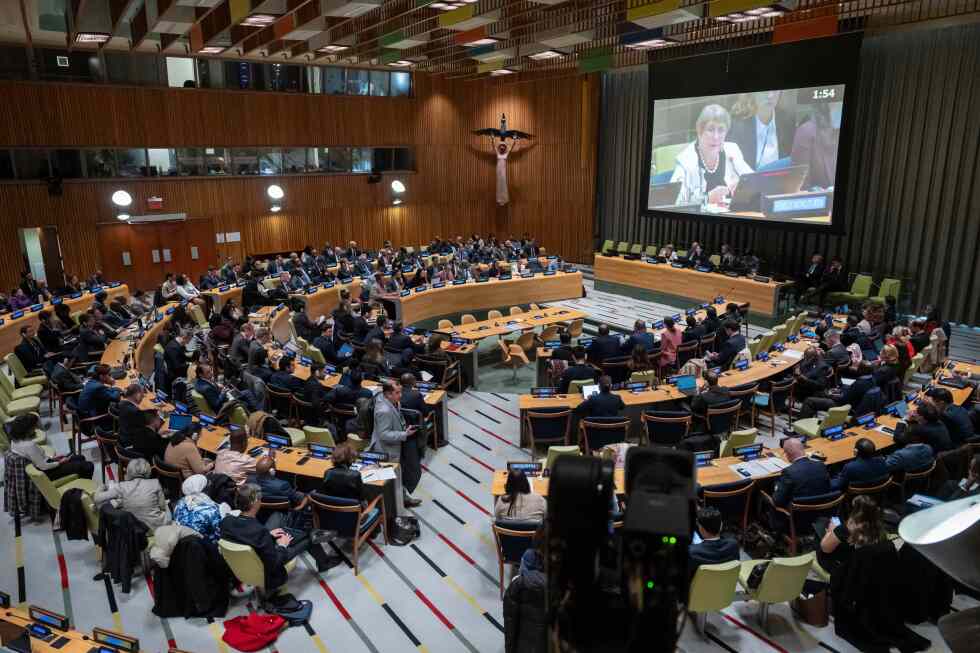
Four candidates seeking to lead the United Nations faced intense questioning about their visions for global peace, poverty reduction, and institutional reform during what General Assembly President Annalena Baerbock described as “one of the toughest job interviews in the world.”
The contenders – Chile’s Michelle Bachelet, Argentina’s Rafael Grossi, Costa Rica’s Rebeca Grynspan, and Senegal’s Macky Sall – spent hours addressing U.N. ambassadors, with no clear frontrunner emerging from the sessions. The door remains open for additional candidates to join the race to succeed current Secretary-General António Guterres when his term ends on January 1.
“This role matters,” Baerbock emphasized during the proceedings. “The secretary-general is not only the head of the U.N. and the world’s top diplomat – she or he also represents all 8 billion of us, defending the U.N. Charter and leading on peace, development, human rights.”
All candidates highlighted the organization’s founding mission of ensuring international peace and security, acknowledging the U.N.’s recent struggles to resolve conflicts in Gaza, Ukraine, Sudan, and other global hotspots due to deep international divisions. Each pledged to pursue reforms to modernize the 80-year-old institution.
Bachelet, 74, who served as Chile’s president twice and previously led the U.N.’s human rights office, emphasized crisis prevention and hands-on leadership. “I stand before you to reclaim the urgent need for dialogue,” she stated, adding that the next secretary-general must be “physically present in the field” to address problems directly.
Grossi, 65, currently serves as director-general of the International Atomic Energy Agency and brings extensive diplomatic experience. He focused on the challenge of restoring trust in the organization, noting, “There are enormous, huge doubts about our institution” amid global polarization. Grossi stressed that effective leadership and universal support are essential for the U.N. to regain its central role in solving international problems.
Grynspan, 65, a former Costa Rican vice president who now heads the U.N. trade and development agency, positioned herself as a principled leader willing to take necessary risks. “We need to take more risks – and I am ready to fail and try again,” she declared, warning that the U.N. has become “a risk-conservative organization.”
Sall, 64, who led Senegal for 12 years, emphasized his potential as a “bridge-builder” who could restore trust and reduce global tensions. “My first priority would be to contribute to restoring trust, to calm tensions, reduce fragmentation and breathe renewed hope into our collective action,” he said.
The selection process has not been without controversy. Bachelet addressed opposition from 28 Republican U.S. lawmakers who labeled her a “pro-abortion zealot” and urged Secretary of State Marco Rubio to veto her candidacy. While affirming her support for women’s rights, she pledged to respect each country’s positions on contentious issues.
Tradition dictates that the secretary-general position rotates by region, with Latin America expected to provide the next leader. Sall, the sole candidate from outside the region, noted that the U.N. Charter doesn’t prohibit candidates from any region and suggested that after Guterres, who is from Portugal, the next leader should come from the Global South. His candidacy has sparked both supportive and opposing demonstrations outside U.N. headquarters, with some critics raising corruption allegations that Sall denies.
Daniel Forti, head of U.N. affairs at the International Crisis Group, observed that all candidates “tried to walk a political tightrope” during the questioning. “It is not immediately obvious whether any candidate did enough to propel themselves ahead of the others, or to ward off potential challengers who might emerge later,” he noted.
The ultimate decision rests with the 15-member Security Council, particularly its five permanent members with veto power – the United States, Russia, China, United Kingdom, and France. The 193-member General Assembly must then approve their selection.
Minh-Thu Pham, former adviser to U.N. Secretary-General Kofi Annan and current CEO of the Starling Institute, highlighted widespread desire for a secretary-general willing to take risks and actively promote peace, noting the U.N. is often sidelined in major crises “because it hasn’t had the courage to take risks.”
The advocacy group GWL Voices, led by former Argentine foreign minister Susana Malcorra, continues to campaign for the next U.N. chief to be a woman, emphasizing that the organization “more than ever” needs fresh leadership and renewed energy.
Fact Checker
Verify the accuracy of this article using The Disinformation Commission analysis and real-time sources.

27 Comments
Silver leverage is strong here; beta cuts both ways though.
Good point. Watching costs and grades closely.
The cost guidance is better than expected. If they deliver, the stock could rerate.
Good point. Watching costs and grades closely.
Interesting update on Candidates for next UN chief spend hours selling themselves. Curious how the grades will trend next quarter.
Good point. Watching costs and grades closely.
Silver leverage is strong here; beta cuts both ways though.
Good point. Watching costs and grades closely.
Good point. Watching costs and grades closely.
Uranium names keep pushing higher—supply still tight into 2026.
Uranium names keep pushing higher—supply still tight into 2026.
Good point. Watching costs and grades closely.
Good point. Watching costs and grades closely.
Silver leverage is strong here; beta cuts both ways though.
Good point. Watching costs and grades closely.
Production mix shifting toward World might help margins if metals stay firm.
Good point. Watching costs and grades closely.
Production mix shifting toward World might help margins if metals stay firm.
Good point. Watching costs and grades closely.
Good point. Watching costs and grades closely.
Nice to see insider buying—usually a good signal in this space.
Interesting update on Candidates for next UN chief spend hours selling themselves. Curious how the grades will trend next quarter.
I like the balance sheet here—less leverage than peers.
If AISC keeps dropping, this becomes investable for me.
Good point. Watching costs and grades closely.
Exploration results look promising, but permitting will be the key risk.
Good point. Watching costs and grades closely.