


Listen to the article
In the early hours of Sunday, residents of Slavutych gathered in the city’s central square for a solemn midnight vigil commemorating the 40th anniversary of the Chernobyl nuclear disaster. Despite wartime curfews and official warnings against large gatherings during Russia’s ongoing war in Ukraine, people placed candles on a large radiation hazard symbol laid out on the ground to honor those killed in the 1986 catastrophe and the thousands who risked deadly radiation exposure in its aftermath.
The Chernobyl disaster, which occurred on April 26, 1986, exposed serious safety deficiencies and government secrecy in the former Soviet Union. Soviet authorities delayed reporting the explosion for two days, only acknowledging it after winds had carried radioactive fallout across Europe and Swedish experts raised public concerns about the radiation levels.
Approximately 600,000 people, often referred to as Chernobyl’s “liquidators,” were sent to fight the nuclear plant fire and clean up the worst contamination. Thirty workers died within months from either the explosion or acute radiation sickness. Millions in the region were exposed to dangerous radiation levels, forcing the permanent evacuation of hundreds of towns and villages across Ukraine and Belarus.
Slavutych itself was built in the aftermath of the disaster. While most evacuees were resettled across nearby districts in the Kyiv region, Soviet authorities began constructing the city in late 1986 to house workers from the Chernobyl Nuclear Power Plant and their families. The first residents moved in around 1988.
In recent years, the city has faced new challenges. It endured a brief Russian occupation during Moscow’s failed attempt to seize Kyiv in the early days of the invasion. Residents also struggled through harsh winters, particularly the most recent one, when power outages forced some to cook meals over open fires in the streets.
The anniversary ceremony attracted people of all ages, with many bringing spring tulips and daffodils. They gathered in a broad plaza framed by Soviet-era apartment blocks, where a memorial stands near posters honoring local residents killed in the current war.
Liudmyla Liubyva, 71, attended with a friend. She shared that she used to attend with her husband, who had worked at the Chernobyl plant but later developed a disability linked to radiation exposure, eventually losing his ability to walk.
“It’s important to honor those who sacrificed their health in the aftermath of the disaster,” Liubyva said. “But Russia’s war has revived fears that the danger was never fully left behind.” She referenced a Russian drone strike in 2025 that damaged the New Safe Confinement structure, the massive dome built to contain radiation from the destroyed reactor. “We all — young and old alike — must protect our land, because it is so vulnerable.”
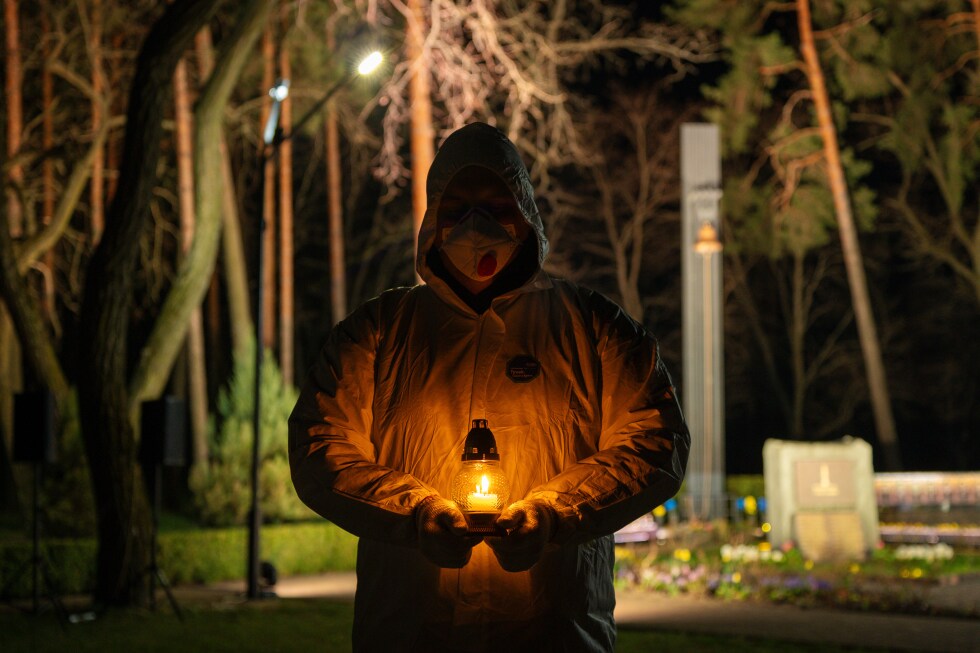
During the commemoration, soft music played as poetry about the disaster was broadcast over loudspeakers. “Years pass, generations change, but the pain of Chernobyl does not fade,” a woman’s voice recited. People dressed in white protective suits and face masks, symbolizing the liquidators, stood in silence holding candles.
Larysa Panova, 67, still vividly remembers the day of the accident that forced her to leave her hometown of Chernobyl (transliterated in Ukrainian as Chornobyl) and begin a new life in Slavutych. Though she has made the new city her home, she continues to think about the forests and rich natural environment of the place she left behind.
Before Russia’s full-scale invasion, Panova regularly traveled back to visit relatives who remained in the area or simply to spend time in the land where she grew up. However, with the war, access to the exclusion zone has become severely restricted.
“I never stop thinking of Chernobyl as my homeland,” she said. “You remember your school, your childhood, your youth — everything happened there, in Chernobyl.”
The anniversary comes as nuclear safety concerns have returned to international prominence. The damage to the protective confinement structure from last year’s drone strike highlighted the ongoing vulnerability of the site. Environmental experts warn that military operations near nuclear facilities present grave risks to public safety and ecological stability across the region.
The Chernobyl disaster remains one of the worst nuclear accidents in history, a stark reminder of both technological failure and the human cost of such catastrophes. Four decades later, its legacy continues to shape lives in Ukraine and beyond, now complicated by the added dangers of war in a region still healing from nuclear trauma.
Fact Checker
Verify the accuracy of this article using The Disinformation Commission analysis and real-time sources.

21 Comments
Interesting update on Ukrainian city gathers for midnight Chernobyl vigil 40 years later. Curious how the grades will trend next quarter.
Good point. Watching costs and grades closely.
I like the balance sheet here—less leverage than peers.
Good point. Watching costs and grades closely.
If AISC keeps dropping, this becomes investable for me.
Good point. Watching costs and grades closely.
Good point. Watching costs and grades closely.
Nice to see insider buying—usually a good signal in this space.
Uranium names keep pushing higher—supply still tight into 2026.
Interesting update on Ukrainian city gathers for midnight Chernobyl vigil 40 years later. Curious how the grades will trend next quarter.
Good point. Watching costs and grades closely.
Silver leverage is strong here; beta cuts both ways though.
If AISC keeps dropping, this becomes investable for me.
Good point. Watching costs and grades closely.
If AISC keeps dropping, this becomes investable for me.
Good point. Watching costs and grades closely.
If AISC keeps dropping, this becomes investable for me.
Good point. Watching costs and grades closely.
Production mix shifting toward World might help margins if metals stay firm.
Good point. Watching costs and grades closely.
Good point. Watching costs and grades closely.