


Listen to the article
African Runners Shatter Marathon’s Two-Hour Barrier in Historic London Race
A pair of African distance runners made sporting history Sunday by breaking one of athletics’ most formidable barriers, completing the London Marathon in under two hours—a feat once considered physically impossible.
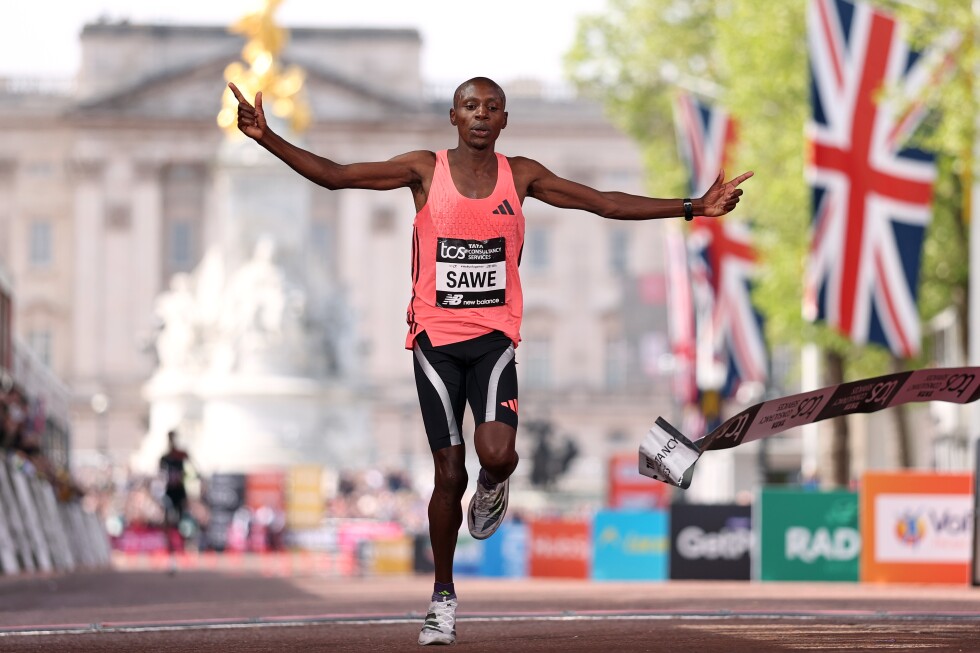
Kenya’s Sabastian Sawe won the race in a stunning 1 hour, 59 minutes and 30 seconds, obliterating the previous world record by an astonishing 65 seconds. Ethiopia’s Yomif Kejelcha, competing in his first-ever marathon, finished just 11 seconds behind at 1:59:41.
“What comes today is not for me alone, but for all of us today in London,” said Sawe, who successfully defended his London Marathon title with the record-breaking performance.
Uganda’s Jacob Kiplimo completed the historic podium, finishing third in 2:00:28—still seven seconds faster than the previous world record set by Kenya’s late Kelvin Kiptum. For the first time in marathon history, three men finished under the once-mythical two-hour threshold in the same race.
Perfect conditions helped fuel the extraordinary performances. Runners enjoyed a flat London course under mostly sunny skies with temperatures in the low 60s Fahrenheit (around 15 Celsius)—ideal for distance running. Sawe demonstrated remarkable pacing strategy, running the second half of the race in just 59:01, before pulling away from Kejelcha in the final two kilometers.
“I think they help a lot,” Sawe said of the enthusiastic crowds lining London’s streets. “Because if it was not for them you don’t feel like you are so loved… with them calling, you feel so happy and strong.”
The sub-two-hour marathon has been a tantalizing target for elite runners for decades, similar to how the four-minute mile once captivated the athletic world before Roger Bannister’s breakthrough in 1954. While Kenya’s Eliud Kipchoge did break the two-hour mark in 2019 with a time of 1:59:40, that performance wasn’t officially recognized as it occurred in a controlled environment with rotating pacemakers during the special “1:59 Challenge.”
Sunday’s performance by Sawe bettered Kipchoge’s unofficial mark by 10 seconds and came in an official competition setting, sending shockwaves through the running world.
“The goalposts have literally just moved for marathon running,” said Paula Radcliffe, former London Marathon champion, while commenting for the BBC.
The progression of marathon times highlights the remarkable evolution in human endurance performance. The first sub-2:30 marathon was recorded in 1925, while the 2:15 barrier fell 38 years later. At the turn of the millennium, the world record stood at 2:05:42, set by Khalid Khannouchi in Chicago in 1999. Since then, East African runners have dominated the event, steadily lowering the mark through a combination of talent, training advances, and technological improvements.
Modern racing shoes have played a significant role in these improvements. Today’s elite marathoners wear ultralight footwear featuring carbon-fiber plates and specialized foam materials that provide energy return with each stride. Sawe competed in Adidas shoes weighing just 3.4 ounces for a men’s size 9—less than half the weight of standard running shoes.
“When you give them the box, they think it’s a joke,” Patrick Nava, general manager of Adidas running, told the Wall Street Journal. “They think the box is empty.”
The women’s race also delivered exceptional performances. Ethiopia’s Tigst Assefa defended her London title, winning in 2:15:41—the fastest time ever recorded in a women’s-only marathon. However, this fell 16 seconds short of Paula Radcliffe’s 2003 course record, which was set in a mixed-gender race.
Kenya’s Hellen Obiri finished second in 2:15:53, a personal best, while compatriot Joyciline Jepkosgei took third in 2:15:55. This marked the first time three women have run under 2 hours, 16 minutes in a single marathon.
“I screamed when I finished because I knew I was breaking the world record,” said Assefa. “I felt much healthier today and have worked really hard on my speed and all my training has paid off.”
The wheelchair races saw Swiss dominance, with Marcel Hug capturing his sixth consecutive men’s title—eighth overall—while Catherine Debrunner narrowly defeated Tatyana McFadden to defend her women’s crown.
As marathon times continue to fall, athletes and fans alike are left wondering what other athletic barriers might soon fall. Usain Bolt’s 9.58 seconds in the 100 meters, Mike Powell’s long jump record of 8.95 meters, and Marita Koch’s women’s 400-meter mark of 47.60 seconds stand as other seemingly untouchable records in track and field—at least for now.
Fact Checker
Verify the accuracy of this article using The Disinformation Commission analysis and real-time sources.

8 Comments
I’m blown away by this performance. Sub-2 hour marathons were once thought impossible, and now we’ve seen three runners achieve it in a single race. A true testament to the incredible capabilities of the human body when pushed to its limits.
Wow, a new world record time under 2 hours for the marathon! That’s an astonishing accomplishment. I wonder what the key factors were that allowed these African runners to achieve such a breakthrough performance.
Training, genetics, and ideal race conditions all likely played a role. The ability to sustain that pace for 26.2 miles is truly remarkable.
This is a game-changing moment for marathon running. I’m curious to see if other elite athletes can replicate these results or if this was a unique convergence of factors. Either way, it’s an inspiring display of human potential.
This is an incredible feat of human endurance and athleticism. To see three runners finish under the 2-hour marathon barrier is a historic moment for the sport. Kudos to Sawe, Kejelcha, and Kiplimo for pushing the limits of what’s possible.
Absolutely incredible that not one, but three runners were able to break the 2-hour barrier in the same race. This event will go down in the history books. I wonder if we’ll see even faster times in the future as training and technology continue to advance.
What an incredible display of athleticism and determination. To see the 2-hour marathon barrier shattered not just once, but three times in the same event, is truly historic. I can’t wait to see how this changes the competitive landscape of long-distance running going forward.
This is a landmark achievement in the sport of marathon running. The times set by Sawe, Kejelcha, and Kiplimo are simply mind-boggling. I’m curious to learn more about their training regimens and what factors contributed to these record-breaking performances.