


Listen to the article
Advanced Machine Learning Model Demonstrates Superior Performance in Fake News Detection
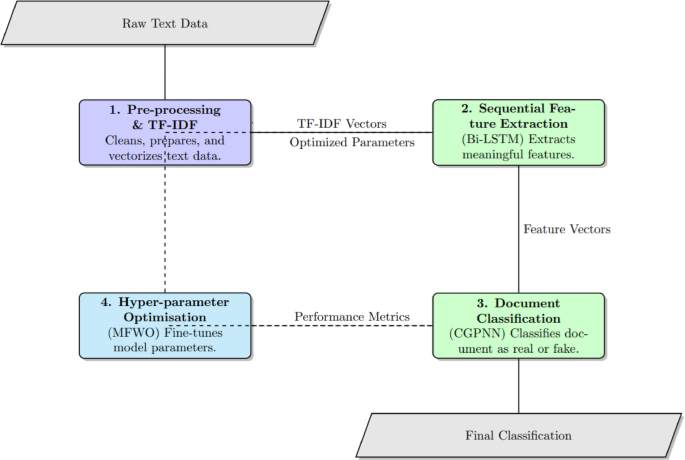
A sophisticated hybrid machine learning architecture has demonstrated remarkable effectiveness in detecting fake news across multiple datasets, according to new research published in Scientific Reports. The model, which combines convolutional Gaussian perceptron neural networks (CGPNN) with recurrent LSTM architecture and metaheuristic optimization, consistently outperformed existing approaches in comprehensive testing.
Researchers conducted the experiments using Python 3.8 with TensorFlow 2.6 and PyTorch 1.10, leveraging NVIDIA RTX 3090 GPUs, Intel Xeon processors, and 128GB RAM. The model training employed five-fold cross-validation with early stopping to prevent overfitting, using the ADAM optimizer with an initial learning rate of 0.001.
The model’s performance was evaluated through six complementary metrics: accuracy, precision, recall, F1-score, Jaccard Index, and Root Mean Square Error (RMSE). These metrics collectively assessed the model’s ability to correctly classify fake and real news across different dimensions of performance.
Confusion matrix analysis revealed balanced error distribution, with the model correctly classifying 12,544 instances of real news and 4,329 cases of fake news. Importantly, false positives and false negatives were evenly balanced at 1,885 cases each, indicating the model avoids bias toward either class despite dealing with imbalanced datasets.
When tested across four prominent datasets—ISOT, Fakeddit, BuzzFeedNews, and FakeNewsNet—the model demonstrated robust cross-domain capabilities. It achieved its highest performance on BuzzFeedNews (98% accuracy, 95% F1-score), while maintaining strong results on other datasets, with accuracy never falling below 92%.
An ablation study highlighted the critical role of each component in the hybrid architecture. The CGPNN component proved most vital, with its removal causing a 7.9% accuracy decrease. Other significant contributors included recurrent LSTM architecture (4.8% accuracy improvement over standard LSTM) and lexicon-based feature integration (5.5% accuracy enhancement).
Statistical significance tests confirmed that the performance improvements over benchmark approaches were not due to chance. The model significantly outperformed traditional methods like CNN and Decision Tree-Random Forest, with p-values well below the standard significance threshold of 0.05.
When compared directly with state-of-the-art methods on the ISOT dataset, the hybrid model achieved 92% accuracy and 90% F1-score, outperforming even advanced transformer-based models like DeBERTa (91.8% accuracy). Conventional techniques like CNN (78% accuracy) lagged significantly behind.
Cross-dataset evaluation revealed moderate performance reductions when applying models trained on one dataset to another, highlighting some domain-specific characteristics in fake news patterns. The smallest performance drop occurred between Fakeddit and FakeNewsNet, suggesting similarities in their content structure.
Attention map analysis uncovered distinctive patterns in how the model processes fake versus real news. Across all datasets, fake news consistently amplified negative sentiment (around 60% attention weight), while real news prioritized neutral sentiment (60% attention). Both categories allocated minimal attention to positive sentiment.
Compared to lightweight models like DistilBERT and FastText, the proposed architecture delivered superior performance but at the cost of larger size and slower inference times. The full model ranged from 240-250MB with inference times of 18-20ms per sample, compared to FastText’s 20-21MB size and 5-6ms inference time.
The model also demonstrated strong performance in non-political domains, outperforming baseline approaches in detecting health misinformation and celebrity hoaxes, confirming its versatility across different types of false information.
These findings represent a significant advancement in automated fake news detection, offering potential applications for social media platforms, news organizations, and fact-checking initiatives seeking to combat misinformation. The research underscores that hybrid approaches combining multiple neural network architectures with optimization techniques can substantially improve detection capabilities compared to single-model approaches.
Fact Checker
Verify the accuracy of this article using The Disinformation Commission analysis and real-time sources.

29 Comments
Exploration results look promising, but permitting will be the key risk.
Good point. Watching costs and grades closely.
Uranium names keep pushing higher—supply still tight into 2026.
Interesting update on Researchers Develop Hybrid Deep Learning Framework for Enhanced Fake News Detection. Curious how the grades will trend next quarter.
Good point. Watching costs and grades closely.
Good point. Watching costs and grades closely.
Nice to see insider buying—usually a good signal in this space.
Good point. Watching costs and grades closely.
Production mix shifting toward Fake Information might help margins if metals stay firm.
Good point. Watching costs and grades closely.
If AISC keeps dropping, this becomes investable for me.
Good point. Watching costs and grades closely.
Good point. Watching costs and grades closely.
Exploration results look promising, but permitting will be the key risk.
Good point. Watching costs and grades closely.
Good point. Watching costs and grades closely.
Exploration results look promising, but permitting will be the key risk.
Good point. Watching costs and grades closely.
Good point. Watching costs and grades closely.
The cost guidance is better than expected. If they deliver, the stock could rerate.
Good point. Watching costs and grades closely.
Good point. Watching costs and grades closely.
Exploration results look promising, but permitting will be the key risk.
If AISC keeps dropping, this becomes investable for me.
Good point. Watching costs and grades closely.
I like the balance sheet here—less leverage than peers.
If AISC keeps dropping, this becomes investable for me.
Good point. Watching costs and grades closely.
Good point. Watching costs and grades closely.