


Listen to the article
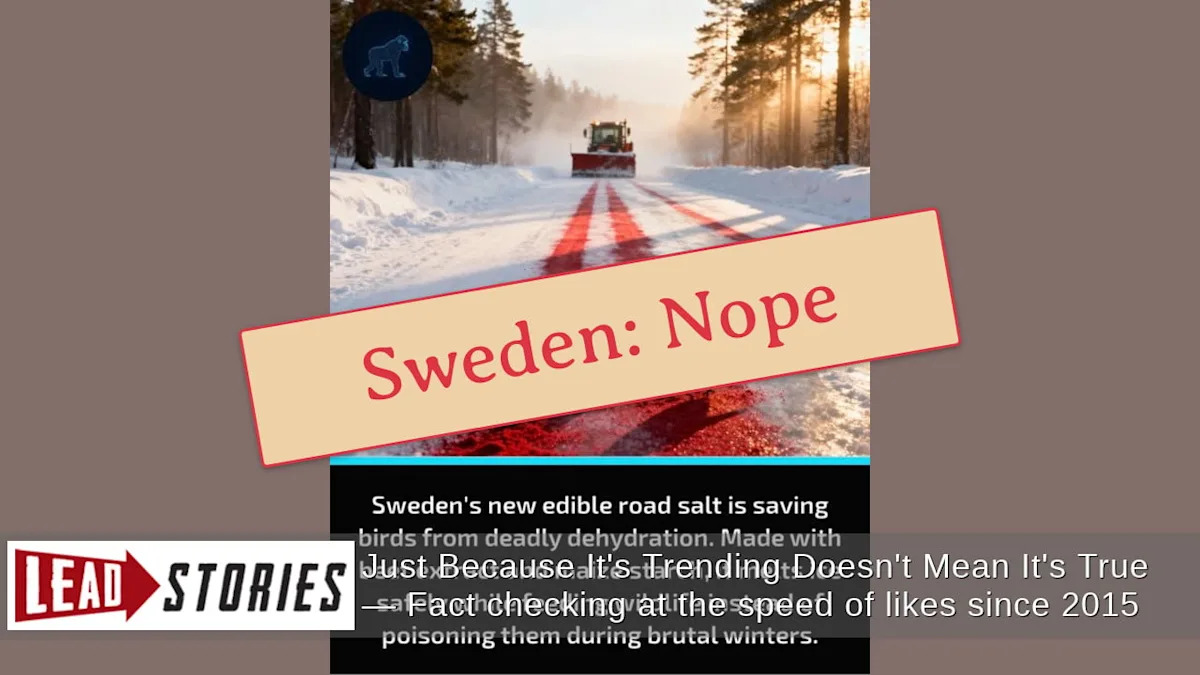
Sweden Denies Using Red Beet-Based De-Icing Solution on Roads
The Swedish Transport Administration has officially refuted viral claims that the country has adopted a red beet-and-starch-based de-icing solution on its roadways. The false narrative, which has been circulating widely on social media, suggested that Sweden had switched to this food-grade alternative to traditional road salt in order to prevent birds from suffering salt poisoning.
“Right now, false posts about methods for salting roads are being spread on social media. The idea is that we at the Swedish Transport Administration are using a new type of red-colored road salt. This is not true,” the agency stated clearly in the Q&A section of its official website.
The claim’s inherent logic is flawed from a wildlife safety perspective. Had such a program been implemented to make de-icing agents edible for birds, it would likely increase bird mortality by attracting them to dangerous roadways, potentially causing more bird deaths and creating additional traffic hazards for motorists.
Extensive searches across English and Swedish news publications reveal no credible reporting on any large-scale implementation of such a program. The misinformation appears to be a distortion of limited testing that occurred nearly two decades ago.
In 2003, Swedish public radio did report that transportation authorities planned to conduct tests exploring whether sugar could supplement or replace traditional road salt as a de-icing agent. However, even at that time, officials expressed doubt about whether wildlife would be attracted to the experimental compounds.
A follow-up report in spring 2006 indicated some preliminary success with alternative de-icing methods, but made no mention of any edible properties or intention to feed birds—a critical detail that undermines the current viral claim’s central premise.
The spread of this misinformation highlights the ongoing challenge of verifying environmental and infrastructure claims on social media. While many countries, including Sweden, continue to explore more environmentally sustainable winter road maintenance techniques, the specific claim about a nationwide switch to red, edible de-icing agents is demonstrably false.
Road salt usage remains a legitimate environmental concern in many northern countries. Traditional sodium chloride can contaminate groundwater, damage vegetation, corrode vehicles and infrastructure, and potentially harm wildlife. This has prompted ongoing research into alternatives worldwide.
Some municipalities in various countries have experimented with beet juice derivatives as additives to reduce the total amount of salt needed, as these natural compounds can improve the adherence of salt to road surfaces and extend its effective temperature range. However, these applications are typically used as supplements to traditional methods rather than wholesale replacements.
The Swedish Transport Administration continues to use conventional road salt as its primary winter road management strategy while researching more sustainable options. The agency maintains transparent communication about its methods on its official channels, making it relatively easy to verify or debunk claims about its operations.
Social media users are encouraged to verify claims with official sources before sharing potentially misleading information about public infrastructure and environmental initiatives.
Fact Checker
Verify the accuracy of this article using The Disinformation Commission analysis and real-time sources.

8 Comments
The transport authority’s clear explanation helps restore confidence in the integrity of Sweden’s road maintenance practices. Transparency is key when addressing these kinds of viral claims.
The logic behind the claim doesn’t seem to hold up from an ecological perspective. Attracting birds to roadways would likely do more harm than good. Kudos to the authorities for addressing this misinformation promptly.
Interesting fact check on the claim about Sweden using beet-based road salt. I’m glad the transport authority was quick to debunk this misleading narrative. It’s important to rely on official sources when it comes to these kinds of infrastructure claims.
It’s good to see a fact-based rebuttal of this beet-salt story. Relying on official sources is crucial when it comes to infrastructure and public safety claims.
Glad to see the Swedish agency quickly dispel this dubious claim. Fact-checking and official sources should always take precedence over unsubstantiated social media narratives.
This highlights the importance of verifying claims, especially around sensitive topics like environmental protection and wildlife safety. Kudos to the Swedish agency for the transparent response.
This is a good example of how official sources can effectively debunk misinformation. The Swedish agency’s swift action to address the false narrative is commendable.
This seems like another classic example of social media spreading unsubstantiated rumors. I appreciate the Swedish agency taking the time to clearly refute the false narrative and set the record straight.