


Listen to the article
Nigeria’s Information Ecosystem Under “Sustained Pressure” from Disinformation, Experts Warn
Nigeria faces an unprecedented threat to its democratic processes as misinformation and disinformation campaigns continue to evolve at alarming rates, experts warned Tuesday during a technical summit focused on enhancing journalists’ fact-checking capabilities.
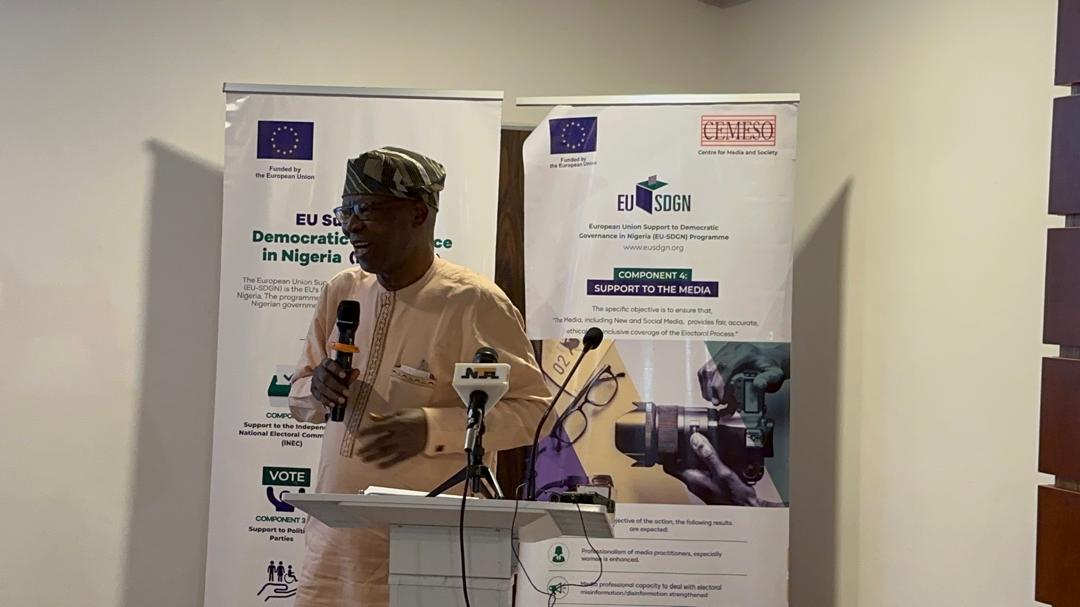
Akin Akingbule, executive director of the Centre for Media and Society (CEMESO), described Nigeria’s information landscape as being under “sustained pressure” with serious implications for democratic institutions and public trust.
“What makes this moment uniquely dangerous is not any single threat in isolation, but the unprecedented convergence of several crises arriving simultaneously,” Akingbule explained. “Artificial intelligence has industrialized the production of disinformation.”
The proliferation of AI-generated content presents particular challenges for Nigeria. According to Akingbule, deepfake content has grown globally by over 500 percent between 2019 and 2023, with Nigeria already experiencing significant consequences. During the 2023 elections, AI-generated videos falsely showed international celebrities endorsing presidential candidates, while voice cloning technology produced fabricated conversations between political leaders designed to incite unrest.
The impact has been tangible. Voter turnout in Nigeria’s 2023 elections fell to just 27 percent, a figure that Akingbule argues reflects not apathy but a democratic system where “fear, manipulation, and the deliberate suppression of specific communities have made participation feel futile or dangerous.”
CEMESO has put forward several recommendations to combat these threats, including the institutionalization of fact-checking as “essential democratic infrastructure,” the development of AI detection tools specifically built for Nigerian-language datasets, and completing the infrastructure necessary to deliver credible information to rural communities.
Lanre Arogundade, executive director of the International Press Centre (IPC), emphasized the rapidly evolving nature of the threat, noting that “AI manipulative tools are now being developed at speeds that exceed those with which American cruise missiles land in Iran, or Iranian hypersonic missiles deposit their munitions in Israel.”
The IPC and CEMESO are working together as facilitators for the European Union Support to Democratic Governance in Nigeria program, specifically focusing on strengthening media coverage of electoral processes. Fact-checking has been incorporated as a core element of this initiative.
Arogundade stressed that journalists should first apply basic “journalistic common sense” when evaluating potentially misleading information, regardless of whether it comes in audio or visual form.
The National Broadcasting Commission (NBC) also recognizes the severity of the threat. Stella Erhunmnse, representing the NBC’s director-general, described disinformation as a direct challenge to “national stability, public trust and democratic legitimacy.”
“From a regulatory standpoint, the NBC recognizes that the integrity of the information ecosystem is now as critical as the integrity of the electoral process itself,” Erhunmnse stated. “Where information is distorted, public perception is compromised. Where public perception is compromised, democratic outcomes are placed at risk.”
The NBC is advocating for fact-checking to be understood not as an optional activity but as a “core professional obligation” for journalists. Erhunmnse called for embedding fact-checking practices into newsroom culture, editorial workflows, and institutional priorities.
The summit concluded with the unveiling of an AI fact-checking guide, described as a practical toolkit designed for journalists and editors working under real-world constraints. Participants also emphasized the need for collaboration between journalists, civil society organizations, and government at all levels to combat disinformation effectively.
As Nigeria prepares for future electoral cycles, the battle against misinformation represents a critical front in protecting democratic processes and ensuring public discourse remains grounded in verifiable facts rather than manufactured narratives.
Fact Checker
Verify the accuracy of this article using The Disinformation Commission analysis and real-time sources.

8 Comments
Disinformation is a serious threat to democratic institutions worldwide. It’s crucial that stakeholders work together to enhance fact-checking capabilities and restore public trust.
Disinformation fueled by AI-generated content is a growing concern worldwide. Enhancing fact-checking capabilities and public awareness are critical to maintaining the integrity of democratic institutions.
Absolutely. The proliferation of deepfakes is a serious threat that requires a concerted, multifaceted response from various stakeholders.
Combating disinformation is a complex challenge, but it’s heartening to see experts and stakeholders in Nigeria coming together to address this threat to their democratic institutions.
The convergence of multiple crises, as described by the expert, creates a uniquely dangerous situation. Strengthening the information ecosystem and restoring public trust must be a top priority.
This is a concerning trend that extends beyond Nigeria. Protecting democratic institutions from the corrosive effects of disinformation should be a global priority.
The rise of AI-generated content is particularly worrying, as deepfakes can spread rapidly and erode faith in democratic processes. Robust fact-checking and public education are essential to combat this trend.
Agreed. The global increase in deepfakes by over 500% is alarming and requires a coordinated response from governments, tech companies, and the media.