


Listen to the article
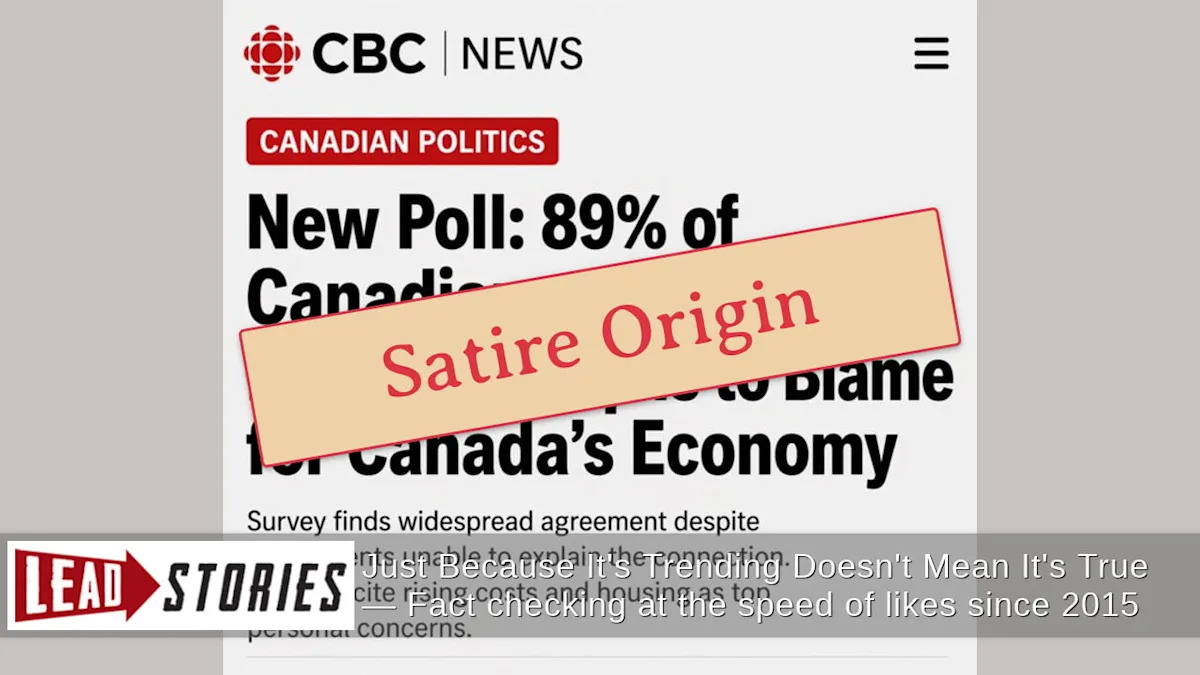
Canadian news consumers were misled last month by a fabricated CBC report claiming that an overwhelming majority of Canadians blame former U.S. President Donald Trump for Canada’s economic troubles. The image, which circulated widely on social media, was revealed to be satirical content later mistaken for genuine news.
The deceptive image first appeared on April 20 on X (formerly Twitter) from an account clearly labeled “SatireSquadHQ.” It featured what appeared to be a CBC news webpage with the headline “New Poll: 89% of Canadians Say Donald Trump Is to Blame for Canada’s Economy” alongside a subheading claiming Canadians couldn’t explain the supposed connection despite their conviction.
The fabricated story suggested that Canadians were blaming Trump for everyday economic challenges including “rising grocery prices to housing costs and general financial anxiety” despite being unable to articulate how the former U.S. president could be responsible for Canada’s domestic issues.
“It’s complicated,” a fictional respondent was quoted as saying. “But every time something feels off, he seems like a safe bet.”
The satirical nature of the post became less apparent when other social media users began sharing the image without noting its origins. One user who reposted the fabricated news commented, “There’s no nice way to say this. 89% of Canadians are really, really dumb and easily manipulated,” suggesting they had accepted the image as authentic.
Digital forensic analysis supports the conclusion that the image was artificially generated. Two independent AI detection tools – Hive Moderation and Sightengine – assessed the image with high confidence scores (86.1% and 89% respectively) as being created by generative AI technology rather than being a genuine screenshot.
Verification through CBC’s own website confirms no such poll or article exists in their archives. Similarly, a comprehensive search through Google News returns no results matching the purported reporting.
The incident highlights the growing challenge of distinguishing between genuine news content and fabricated material in today’s digital landscape. While the original post came from an account clearly labeled as satirical – with the creator later commenting, “The real story is how many people read this and nodded” – the image’s subsequent spread demonstrates how quickly context can be lost as content moves through social networks.
This type of misinformation is particularly concerning during periods of economic stress when public sentiment about financial hardship can be easily manipulated. The fictional poll played on real anxieties about Canada’s economic challenges, including inflation, housing affordability, and wage stagnation.
Media literacy experts point to this case as an example of how sophisticated AI tools can create convincing forgeries of trusted news sources. Even when content begins as clearly labeled satire, its journey through social media can strip away important contextual clues that help readers distinguish between fact and fiction.
The CBC, Canada’s national public broadcaster, has previously warned about the misuse of its branding in fabricated news content. Like many major news organizations, it continues to face challenges with impersonation as AI-generated content becomes more sophisticated and easier to produce.
For consumers of news, the incident serves as a reminder to verify information through official channels before accepting or sharing content, especially when it makes extraordinary claims about public opinion or political figures.
Fact Checker
Verify the accuracy of this article using The Disinformation Commission analysis and real-time sources.

9 Comments
I’m curious to know more about the motivations behind creating this kind of satirical content. Is it simply for attention, or is there a more insidious agenda at play?
Interesting fact check. It’s concerning how misinformation can spread so quickly online, even when labeled as satire. I’m glad the CBC didn’t actually release a misleading poll like that.
While it’s concerning to see false information spreading, I’m glad the CBC was able to quickly clarify that they did not actually release a poll like this. Fact-checking is so important these days.
This highlights the importance of verifying news sources and being cautious about blindly accepting social media posts as fact. I wonder how often these kinds of fabricated stories slip through the cracks.
It’s good to see the disinformation commission calling out this kind of misleading content. We need to be vigilant about separating truth from fiction, especially when it comes to complex economic issues.
This is a valuable lesson in media literacy. We should all strive to think critically about the information we consume and not quickly share or believe unverified claims, even if they align with our own views.
It’s disheartening to see how quickly misinformation can take hold, even when the source is clearly labeled as satirical. We need to be vigilant in our media consumption habits.
This is a good reminder that we should always verify the credibility of news sources, especially when it comes to hot-button political and economic issues. We can’t afford to let ourselves be misled.
I’m curious to know if there have been any efforts to address the root causes of these kinds of fabricated stories. Is it a matter of improving media literacy, or are there other factors at play?