


Listen to the article
In a dramatic development that has raised tensions across the Middle East, Iranian state-affiliated media claimed an attack on a sophisticated U.S. radar installation in Qatar, but verification remains elusive as misinformation spreads across social platforms.
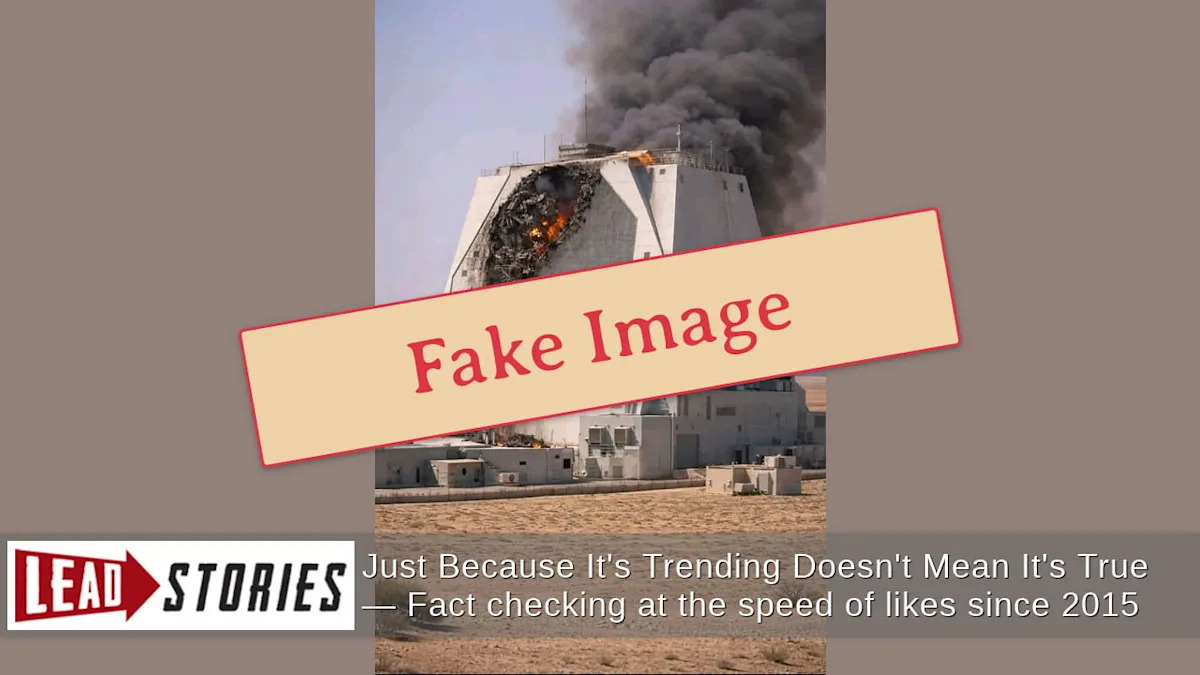
A viral image purporting to show damage to an American early warning radar system in Qatar has been definitively identified as fake. The image, circulated by the account @iranin_arabic on March 3, 2026, with the ominous caption “Unfortunately, this is just the beginning,” bears no resemblance to the actual facility when compared with satellite imagery.
The Islamic Revolutionary Guard Corps (IRGC) announced on February 28 through Tehran Times that “the American radar FPS-132, with a range of 5,000 kilometers, stationed in Qatar with unique equipment designed for tracking ballistic missiles, was completely destroyed.” However, as of March 3, neither U.S. nor Qatari officials have confirmed this claim, and no independent satellite imagery has verified any damage to the installation.
The radar system in question is formally designated as AN/FPS-132, following military classification protocol where “AN” indicates Army-Navy, “F” stands for Fixed, “P” denotes radar (Pulsed), and “S” signifies Search. The “132” refers to its being the 132nd design in this category.
The actual radar facility is located near Lehnaizeeba, Qatar, at coordinates 25°42’25.4″N 51°15’12.0″E, and is clearly visible on Google Maps. The installation represents a significant U.S. defense asset in the region, built under a $1.06 billion contract awarded to Raytheon Company in 2017.
The fraudulent image being circulated shows an octagonal antenna array, with only one array visible. In stark contrast, satellite imagery and official renderings of the actual facility reveal three circular antenna arrays integrated into a much larger rectangular building complex, complete with several auxiliary structures and paved access roads.
This alleged attack comes amid escalating tensions between Iran and Western allies in the region. The AN/FPS-132 radar system, also known as the Upgraded Early Warning Radar (UEWR), plays a crucial role in missile defense for U.S. and allied interests. With its reported 5,000-kilometer range capability, the system provides early detection of ballistic missile launches that could threaten military installations and civilian populations across multiple countries.
The Qatar-based radar represents one of several such installations positioned strategically around the world to provide the U.S. and its allies with comprehensive missile detection coverage. Similar systems operate in locations including Fylingdales in the United Kingdom, Thule Air Base in Greenland, and Clear Air Force Station in Alaska.
The timing of this claimed attack and subsequent misinformation campaign appears calculated to inflame regional tensions. Military analysts note that targeting early warning systems would typically precede larger military operations, as it could potentially blind defensive capabilities against subsequent missile or air attacks.
While investigating the veracity of the attack itself exceeds the scope of this report, the circulation of fake imagery highlights the complex information environment that surrounds military confrontations in the digital age. Sophisticated radar installations like the one in Qatar represent high-value targets in both physical and information warfare domains.
Defense experts caution that claims about attacks on critical military infrastructure should be approached with skepticism until independently verified, particularly when accompanied by unverified imagery that contradicts known details about the facilities in question.
As regional stakeholders await conclusive evidence about the radar’s status, the incident serves as a reminder of how quickly misinformation can spread during moments of geopolitical tension, potentially complicating diplomatic efforts to prevent further escalation.
Fact Checker
Verify the accuracy of this article using The Disinformation Commission analysis and real-time sources.
