


Listen to the article
False Claims of Three Days of Darkness Prediction by Saint Carlo Acutis Debunked
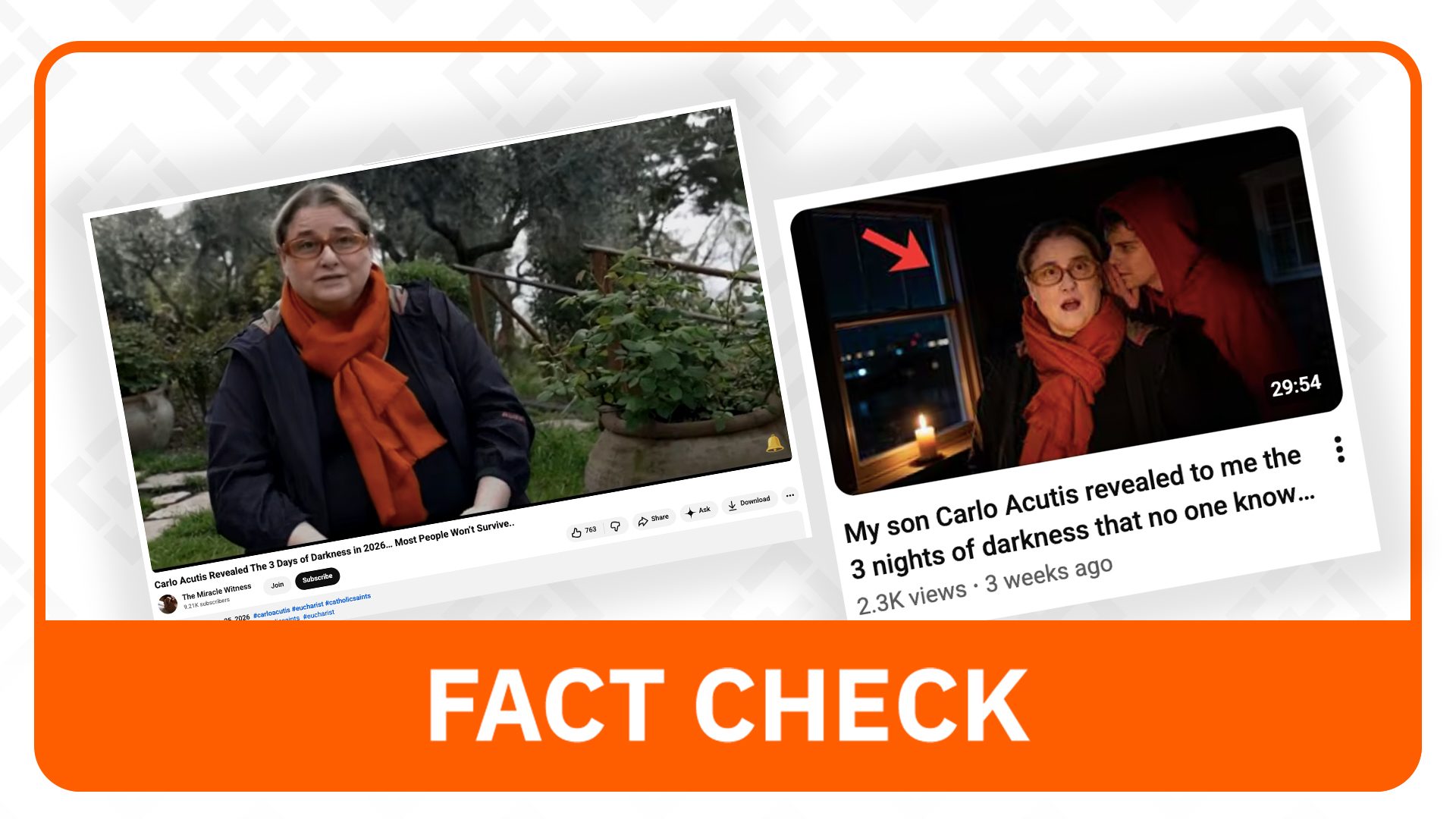
A misleading video claiming that Saint Carlo Acutis predicted “three days of darkness” to occur in 2026 has been circulating on YouTube and other social media platforms, garnering tens of thousands of views despite having no basis in fact, religious teachings, or credible sources.
The video, which has amassed over 27,000 views and hundreds of likes on YouTube, purportedly shows Antonia Salzano, mother of Saint Carlo Acutis, discussing her son’s prediction about an apocalyptic three-day period of darkness that would engulf the Earth, causing widespread chaos and numerous deaths. In the manipulated footage, Salzano appears to advise viewers to prepare by staying indoors, praying, and keeping religious items inside their homes during this period.
However, fact-checking reveals no evidence that Saint Carlo Acutis ever made such a prediction. No credible reports, statements, or religious documentation attribute any “three days of darkness” warning to the young saint.
Technical analysis of the video shows clear signs of manipulation. A reverse image search identified that the original footage came from a prayer video series featuring Salzano sharing memories of her son. In the misleading version, her mouth movements don’t synchronize with the audio, and her body and hand gestures appear repetitively throughout the recording. Analysis through DeCopy.ai indicates a “100% likelihood” that the video was created through a combination of human editing and artificial intelligence.
The concept of “three days of darkness” has historical roots dating back to the 18th and 19th centuries and has been attributed to various historical figures, including Blessed Anna Maria Taigi, an Italian member of the Secular Trinitarians. However, it’s important to note that this prophecy is not part of official Catholic Church teachings and does not appear in any Vatican-sanctioned documents.
Saint Carlo Acutis, often called the first “millennial saint,” was an Italian teenager who died at age 15 from acute promyelocytic leukemia. He was canonized on September 7, 2025, by Pope Leo XIV, recognized for his devotion to spreading biblical teachings through digital means.
Acutis’s path to sainthood was supported by at least two attributed miracles: the healing of a Brazilian boy from a rare pancreatic disorder and the recovery of a Costa Rican woman who had suffered severe head trauma in a bicycle accident. His canonization represents the Vatican’s effort to connect with younger generations of Catholics through a relatable modern figure.
This fabricated prediction follows a pattern of misinformation that exploits religious themes and figures to generate engagement online. Similar misleading religious content has been previously identified and debunked by fact-checkers.
The spread of such fabricated religious predictions highlights the continuing challenge of misinformation in online spaces, particularly content that leverages respected religious figures and apocalyptic themes to attract attention. Viewers are encouraged to verify religious claims through official Church sources and recognized religious authorities rather than relying on unverified social media content.
As digital manipulation tools become increasingly sophisticated, distinguishing between authentic and fabricated religious content becomes more challenging, making critical evaluation of sources more important than ever for people of faith and the general public alike.
Fact Checker
Verify the accuracy of this article using The Disinformation Commission analysis and real-time sources.

16 Comments
I’m glad the Disinformation Commission took the time to thoroughly investigate this case and provide a clear, evidence-based debunking. Spreading misinformation, even about religious topics, can have serious consequences and should be taken seriously.
Absolutely. It’s commendable that the Commission took the time to carefully analyze the video and uncover the manipulated nature of the content. Maintaining trust in religious and historical narratives requires diligent fact-checking and transparency.
This is a concerning example of how misinformation can spread quickly, especially when it involves topics that evoke strong emotions or beliefs. I’m grateful the Disinformation Commission investigated this case thoroughly and provided a clear debunking.
You’re right, it’s crucial that we approach claims about religious figures and prophecies with a critical eye and a commitment to verifying information. Fact-checking is essential to prevent the spread of harmful falsehoods, no matter the subject matter.
This is a timely reminder of the importance of critical thinking and fact-checking, even when it comes to religious topics. I’m glad the Disinformation Commission took the time to thoroughly investigate and debunk this misleading video.
Absolutely. Maintaining trust in religious and historical figures requires diligent verification of claims, no matter how compelling or emotionally resonant they may seem. Fact-based reporting is essential to prevent the spread of harmful misinformation.
I’m glad the Disinformation Commission took the time to thoroughly fact-check this video and expose the falsehoods. It’s important that we don’t spread unverified claims, even if they may seem compelling or intriguing at first glance.
Absolutely. Fact-checking is essential, especially when it comes to sensitive topics like religion and prophecies. We should always be wary of content that seems designed to provoke strong emotions or alarm.
It’s disheartening to see attempts to exploit religious beliefs and symbols for the sake of spreading misinformation. I commend the Disinformation Commission for taking the time to investigate this case and provide a comprehensive debunking.
I agree, it’s important that we remain vigilant and hold ourselves and others accountable when it comes to the responsible and accurate representation of religious and historical narratives. Fact-based reporting is crucial in these sensitive areas.
It’s disappointing to see such blatant attempts to misrepresent the views and teachings of Saint Carlo Acutis. Spreading misinformation, even about religious figures, can be very harmful. Verifying claims is crucial before sharing them online.
You’re right, we need to be vigilant in identifying and debunking manipulated content, no matter the subject. Relying on trusted, authoritative sources is the best way to ensure we’re getting accurate information.
This is a concerning case of misinformation and manipulation. It’s crucial to rely on verified, credible sources when it comes to religious figures and prophecies. Fact-checking is important to prevent the spread of false claims.
I agree, we should be very cautious about unsubstantiated predictions, especially those that could cause undue fear or panic. Fact-checking is essential to maintain trust in religious and historical narratives.
This is a good reminder to be cautious of videos or claims that seem to present insider information or predictions, especially when they involve religious figures. Verifying the source and authenticity of such content is crucial.
Yes, it’s important to maintain a critical eye and not simply accept sensational or dramatic claims at face value. Fact-checking and relying on reputable sources should be the standard when it comes to information about religious figures and prophecies.