


Listen to the article
Fact Check: No Evidence Trump Called Australian PM ‘Airbus’ on Social Media
Claims that former President Donald Trump referred to Australian Prime Minister Anthony Albanese as “Airbus” in a social media post have been determined to be false after a comprehensive review of Trump’s online activity.
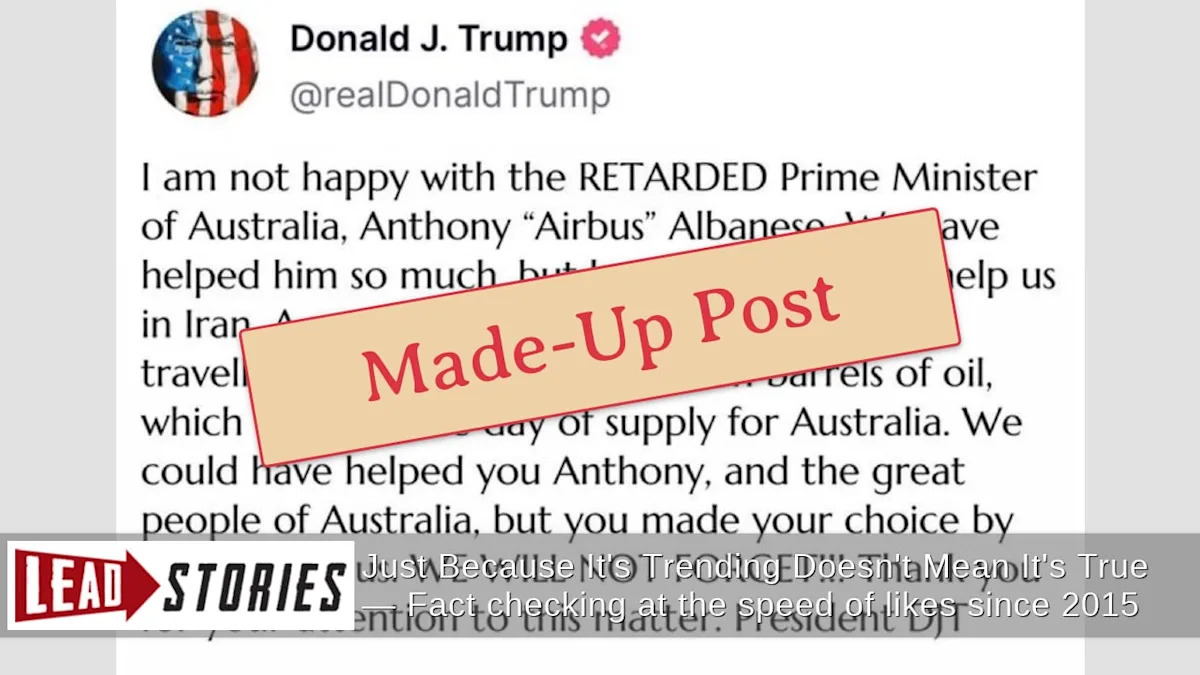
The allegation stemmed from an image shared on X (formerly Twitter) by user @JJKALE2 on April 17, 2026. The post featured what appeared to be a screenshot of a Trump Truth Social message alongside the quote from Henry Kissinger stating, “It may be dangerous to be America’s enemy, but to be America’s friend is fatal.”
In the purported Truth Social post, Trump allegedly wrote a scathing message criticizing the Australian Prime Minister, referring to him as “Anthony ‘Airbus’ Albanese” and calling him a “very sad little man.” The supposed post claimed Trump was unhappy with Albanese for not supporting the United States regarding Iran, while also mocking the Australian leader’s efforts to secure oil supplies for his country.
However, careful examination of Trump’s actual Truth Social account revealed no such post. A manual review of Trump’s recent communications found no mentions of “Airbus” in reference to the Australian Prime Minister. The only verified post mentioning Albanese dated back to March 9, 2026, and contained no derogatory nicknames or inflammatory language.
Media verification methods also raised significant red flags about the authenticity of the image. Notable typographical differences were evident between the fake post and genuine Truth Social communications. The most obvious discrepancy appeared in the font styling, particularly visible in the letter “J,” which displays distinct characteristics in legitimate Trump posts compared to the fabricated one.
Further supporting the conclusion that the post was fabricated, searches across major news platforms including Google News and Yahoo! News yielded no reports about Trump using the “Airbus” nickname. Given the diplomatic implications of such a statement from a former U.S. president toward the leader of a key ally, such a comment would almost certainly have generated significant media coverage had it been authentic.
The Australia-U.S. relationship has historically been one of the strongest and most stable alliances in the Pacific region. The two nations maintain robust defense cooperation through the ANZUS Treaty and collaborate extensively on intelligence matters as members of the Five Eyes alliance. Any genuine rift between leaders would likely trigger diplomatic responses and media analysis beyond isolated social media reports.
This incident highlights the ongoing challenge of misinformation in political discourse, particularly involving prominent world leaders. Fabricated social media posts can spread rapidly across platforms, potentially creating confusion about official positions and bilateral relationships. Media literacy experts consistently recommend verifying claims through multiple reliable sources before accepting screenshots at face value.
As digital manipulation tools become more sophisticated, distinguishing between authentic and fabricated content grows increasingly difficult. Typography analysis, as demonstrated in this case, remains one useful method for identifying potential forgeries in social media content.
The false claim about Trump’s “Airbus” comment serves as a reminder of the importance of critical evaluation of political content shared on social media platforms, especially when such content could impact international relations or public perception of diplomatic engagements between nations.
Fact Checker
Verify the accuracy of this article using The Disinformation Commission analysis and real-time sources.

6 Comments
This is clearly a fabricated post. Trump has a reputation for making controversial statements, but I don’t see any evidence he actually called the Australian PM an ‘Airbus’ on social media. Fact-checking is important to verify claims, especially when it comes to public figures.
I’m glad the Disinformation Commission took the time to thoroughly investigate this claim. In the age of social media, it’s all too easy for fabricated content to gain traction. Rigorous fact-checking is essential to maintain trust in public discourse.
It’s concerning to see false information being spread, especially about political leaders. I appreciate the diligence in fact-checking this purported Trump post. Maintaining accurate information is crucial, particularly on sensitive topics like international relations.
Agreed. Fact-checking helps counter the spread of misinformation, which can have real consequences. It’s important to verify claims, especially those involving prominent public figures.
While Trump is known for his unorthodox communication style, this alleged ‘Airbus’ post seems too outrageous to be real. I appreciate the journalists taking the time to verify the facts and set the record straight. Accurate reporting is crucial.
This is a good example of why we can’t always trust what we see on social media, even if it’s attributed to a well-known figure. The Disinformation Commission’s fact-checking process helps ensure the public has access to reliable information. Well done.