


Listen to the article
Military Leaders Dispute Claims of Nuclear Confrontation with President Trump
No evidence exists to support viral social media claims that Air Force General Dan Caine, chairman of the Joint Chiefs of Staff, stormed out of an emergency meeting after President Donald Trump allegedly suggested threatening Iran with nuclear weapons.
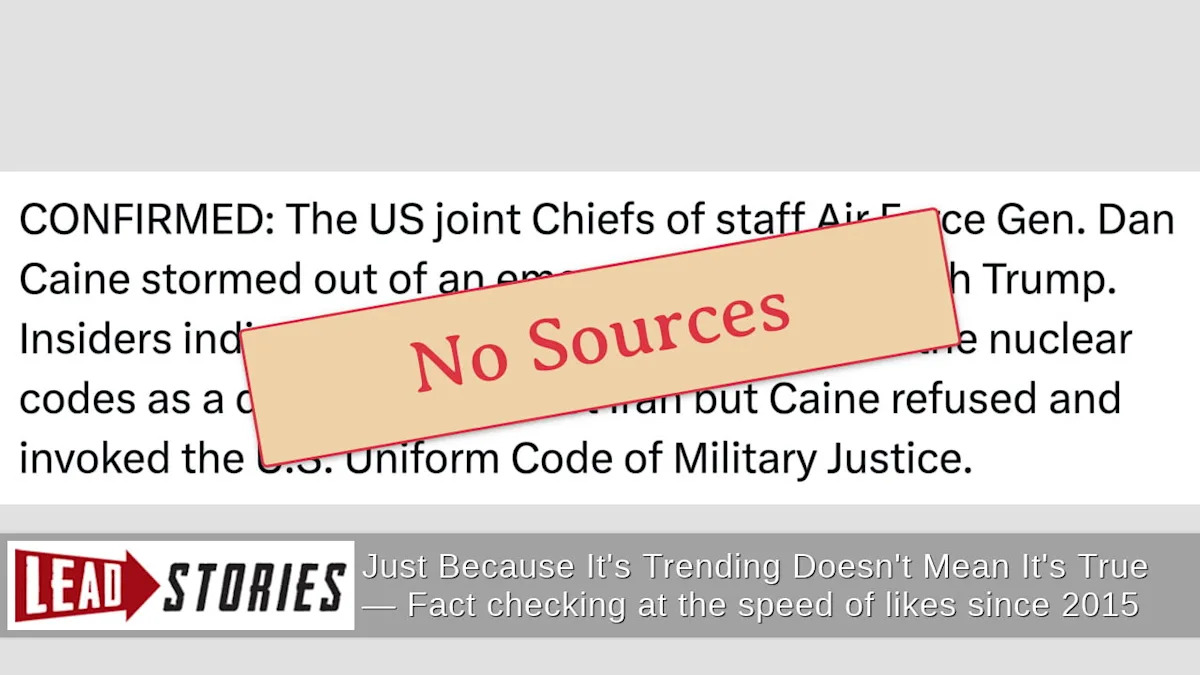
The unfounded allegation first appeared on X (formerly Twitter) on April 19, 2026, when user @JaokooMoses posted: “CONFIRMED: The US joint Chiefs of staff Air Force Gen. Dan Caine stormed out of an emergency meeting with Trump. Insiders indicate that Trump wanted to invoke the nuclear codes as a deterrence against Iran but Caine refused and invoked the U.S. Uniform Code of Military Justice.”
Despite the post’s definitive “CONFIRMED” label, extensive searches through major news databases and official statements reveal no credible reporting of such an incident. Had a dramatic confrontation between America’s top military officer and the president occurred over potential nuclear action, it would have triggered immediate, widespread coverage across mainstream media outlets.
Defense analysts note that such claims come during a period of heightened tensions between the United States and Iran, where military decision-making processes are under intense public scrutiny. Relations between the two nations have deteriorated significantly following the collapse of previous diplomatic agreements.
The Washington Post did publish an article on February 22, 2026, titled “Gen. Dan Caine Foresees Risks in Any Iran Attack Ordered by Trump,” which acknowledged differences in strategic assessment between military leadership and the administration. However, the reporting mentioned nothing resembling the dramatic scenario described in the viral social media posts.
“Military leaders always provide their candid assessment of operational risks,” explained Dr. Emma Richardson, a national security expert at Georgetown University. “But there are established protocols for these discussions that don’t typically involve dramatic exits or public displays of disagreement.”
The false claim appears designed to exploit genuine public interest in how military leaders interact with civilian authorities on matters of nuclear weapons policy. The U.S. nuclear command structure deliberately includes multiple stakeholders to ensure proper protocols are followed for any nuclear-related decisions.
Military historians point out that the reference to the Uniform Code of Military Justice (UCMJ) in the viral post reflects a common misunderstanding of military authority. While military officers swear an oath to the Constitution and can refuse unlawful orders, the UCMJ does not provide a mechanism for military leaders to overrule presidential directives through simply “invoking” it.
“The relationship between civilian leadership and military advisors is more nuanced than these sensationalized accounts suggest,” said retired Admiral James Stavridis in a recent interview unrelated to this specific claim. “Disagreements happen behind closed doors through established channels, not through dramatic confrontations.”
The claim about General Caine has since spread across various social media platforms, demonstrating how unverified information can quickly gain traction during periods of geopolitical tension.
The Pentagon has not officially commented on the viral posts, which is typical for obviously false claims that do not warrant formal rebuttal. Senior defense officials continue to focus on actual military planning regarding regional threats, rather than responding to social media speculation.
Military-civilian relations experts emphasize that while healthy debate occurs within national security deliberations, the system is designed to ensure professional military advice is delivered through appropriate channels while respecting civilian control of the armed forces as established in the Constitution.
As tensions with Iran remain a significant focus of U.S. foreign policy, analysts urge the public to rely on verified reporting from credible news organizations rather than unsubstantiated claims on social media platforms.
Fact Checker
Verify the accuracy of this article using The Disinformation Commission analysis and real-time sources.

9 Comments
This is a timely and important fact check on a sensitive national security issue. The lack of corroborating evidence from major news outlets suggests the social media claim is likely false. Maintaining an informed, fact-based public discourse is crucial, especially on matters of defense policy.
This fact check provides a thorough debunking of the viral claim about General Caine walking out of a meeting over the President’s comments on Iran. It’s important to rely on official and credible sources when it comes to sensitive national security issues like this.
Agreed, the lack of any mainstream media coverage on such a dramatic event is a clear sign the claim is unfounded. Fact-checking is crucial to counter the spread of misinformation, especially around defense and foreign policy.
This fact check highlights the importance of critical thinking and reliance on credible sources when evaluating claims, particularly those involving high-level government and military officials. The lack of mainstream media coverage on such an extraordinary event is a clear red flag.
The content snippet indicates a comprehensive review was conducted, and no credible evidence was found to support the viral social media claim. This kind of rigorous fact-checking on sensitive national security matters is commendable and helps maintain public trust.
Agreed. Verifying claims through official sources and major media outlets is crucial, especially on issues that could impact military readiness and foreign relations. Fact-checking is an important safeguard against the spread of misinformation.
The content snippet highlights the key points – that extensive searches found no credible evidence to support the viral social media claim. It’s good to see the Disinformation Commission taking the time to thoroughly investigate and debunk this kind of unsubstantiated rumor.
Absolutely. Fact-checking efforts like this help maintain public trust in our institutions and leaders, even during periods of heightened political tensions. Verifying claims before amplifying them is critical.
Appreciate the thorough investigation into this claim. Distinguishing truth from fiction is essential, particularly when it comes to potential confrontations between senior military officials and the president. Fact-checking efforts help counter the spread of misinformation on critical issues.