


Listen to the article
A recent wave of social media posts is circulating misleading information about Kentucky’s upcoming primary election, falsely claiming that unaffiliated voters can exploit a “loophole” to participate in either party’s contest.
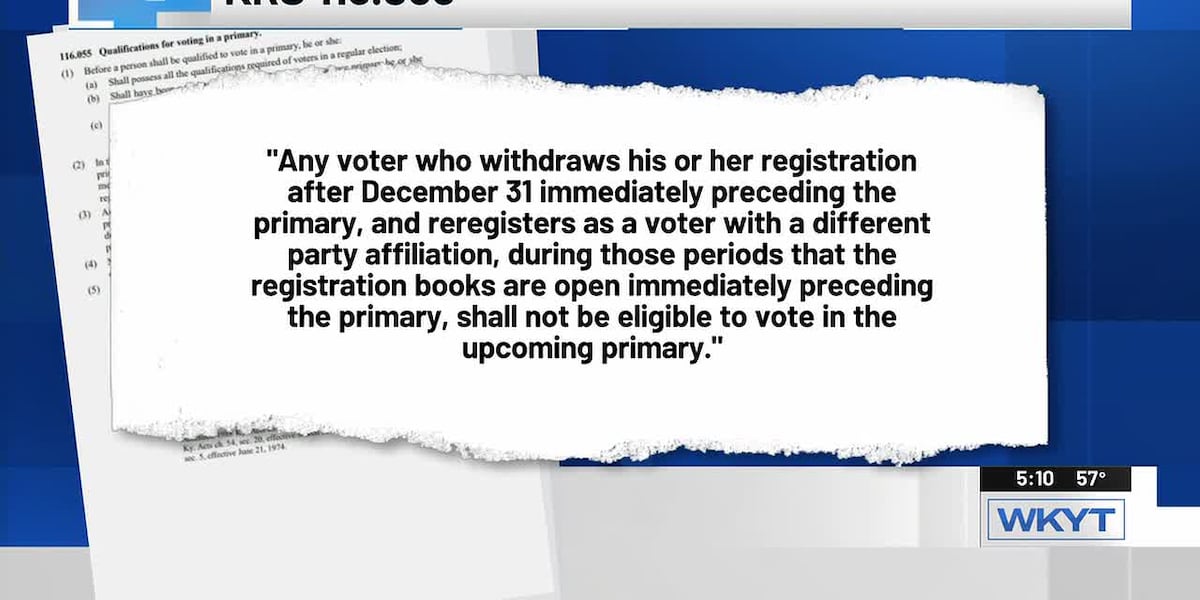
Election officials have swiftly debunked these claims, confirming that Kentucky’s closed primary system permits only registered party members to vote in their respective party’s primary. The Commonwealth’s longstanding election rules require voters to be registered with a political party by December 31 of the previous year to participate in that party’s primary election.
“Kentucky law is very clear on this matter,” said a spokesperson from the Kentucky State Board of Elections. “Only voters who were registered with a party by the December deadline can vote in that party’s primary. There is no mechanism or loophole that allows last-minute party switching or unaffiliated voter participation.”
The misinformation appears to have gained traction primarily on TikTok and Facebook, where users have been claiming that independent voters could arrive at polling stations and request a ballot for either party. Some posts even suggested that election workers would be required to provide such ballots upon request, regardless of the voter’s registered affiliation.
Kentucky operates under a closed primary system, one of the more restrictive primary election formats used across the United States. In this system, only voters who have formally registered with a political party may participate in that party’s nominating contest. This differs significantly from open primaries in states like Michigan or Wisconsin, where voters can choose which party’s ballot to take regardless of their registration status.
The Commonwealth’s voter registration deadline for the upcoming primary passed months ago, with no provisions for same-day registration or party affiliation changes. According to state records, approximately 46 percent of Kentucky’s 3.4 million registered voters are Democrats, 45 percent are Republicans, and the remaining 9 percent are registered as independent or with third parties.
Election integrity experts note that such misinformation could potentially cause confusion at polling stations and create unnecessary complications for election workers already managing complex voting procedures.
“These kinds of viral claims can lead to real problems on election day,” explained Dr. Martha Johnson, a political scientist at the University of Louisville. “When voters show up with incorrect expectations about their voting rights, it can lead to frustration, longer lines, and in some cases, confrontations with poll workers who are simply following the law.”
The primary elections in Kentucky are particularly consequential this year, with several competitive races on the ballot including congressional seats and numerous state legislative positions. Political analysts view the Kentucky primaries as potential indicators of voter sentiment heading into the general election.
County clerks across the state have been working to clarify the rules in response to the misinformation. Several county election offices have issued statements on their websites and social media accounts reiterating the closed primary rules and directing voters to check their registration status through the state’s official voter information portal.
The spread of election misinformation remains a persistent challenge for officials nationwide. A recent study by the Brennan Center for Justice found that false claims about election procedures increased by 73% in the months preceding primary elections compared to previous electoral cycles.
State officials encourage voters with questions about their eligibility or the voting process to contact their county clerk’s office or visit the Kentucky State Board of Elections website for accurate information. They also remind eligible voters that while they cannot change party affiliation for the upcoming primary, all registered voters regardless of affiliation will be able to participate in the general election in November.
“The integrity of our elections depends on voters having accurate information,” the state election board spokesperson added. “We want to ensure every eligible voter can participate within the framework of Kentucky’s election laws.”
Fact Checker
Verify the accuracy of this article using The Disinformation Commission analysis and real-time sources.

8 Comments
Interesting to see the role of social media in spreading this type of misinformation. It’s a reminder that we all need to be vigilant about verifying claims, especially around elections. Kudos to the election board for swiftly debunking these false narratives.
Agree, social media can be a breeding ground for election-related falsehoods. Voters should always check authoritative sources like state election boards to get the facts.
This is an important fact check on Kentucky’s closed primary system. It’s crucial that voters understand the rules and don’t fall for misleading claims about “loopholes” that don’t actually exist. Responsible election reporting like this helps ensure the integrity of the democratic process.
Absolutely. Transparency and accurate information from election officials are vital to upholding the fairness and legitimacy of our elections.
As an investor in mining and energy equities, I’m curious to see how this kind of election issue could potentially impact commodity markets and related stocks. While it may not have a direct effect, the broader political climate is always something to monitor.
Good point. Even if this specific issue doesn’t directly affect the mining/energy sectors, the overall political landscape can definitely influence investor sentiment and market dynamics in those areas.
While the details of Kentucky’s primary rules may not be directly relevant to the mining/energy space, this type of fact-checking is important for upholding democratic norms and processes more broadly. Kudos to the journalists for shining a light on these misleading claims.
This highlights the importance of having clear, well-established election rules that are consistently applied. Attempts to exploit perceived “loopholes” undermine the democratic process and must be shut down. Glad to see Kentucky taking a strong stance on this.