


Listen to the article
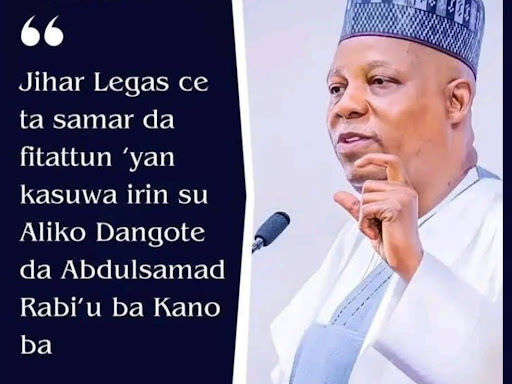
Nigeria’s Vice President Kashim Shettima has found himself at the center of a social media controversy after remarks he made during the Invest Lagos Summit 3.0 were widely circulated and debated online. The claim, which spread rapidly in Hausa language on various platforms and discussion groups, alleged that Shettima denied the Kano State origins of two of Nigeria’s most prominent business moguls.
During his address at the investment summit, Shettima made statements praising Lagos State’s role as Nigeria’s economic powerhouse. In his speech, he declared that “Lagos donated President Tinubu to Africa, it was Lagos that donated to Africa its richest man, not Kano. Aliko Dangote is a Lagos man.” He also referenced Abdul Samad Rabiu, chairman of BUA Group, suggesting that the business leader similarly emerged from the Lagos business environment.
The comments sparked immediate debate across social media platforms, particularly among northern Nigerians who were quick to point out the well-documented origins of both businessmen. Aliko Dangote, Africa’s richest person, was born on April 10, 1957, in Kano State. He comes from the prominent Dantata business family, which has deep roots in the ancient commercial city. Dangote built his business empire through strategic investments in cement, sugar, flour, oil and gas, and manufacturing sectors.
Abdul Samad Rabiu, founder of BUA Group, was also born and raised in Kano State. He established BUA International Limited in 1988 and expanded it into a major conglomerate with interests in cement, sugar, flour milling, steel, and infrastructure development. Both men represent the entrepreneurial legacy that Kano State has historically cultivated as a major trading center in West Africa.
However, a closer examination of Shettima’s full remarks reveals a more nuanced message than what circulated on social media. The Vice President was not disputing the ancestral origins of either businessman. Instead, he was emphasizing Lagos State’s role as the platform where these entrepreneurs scaled their operations and built continental business empires.
Indeed, while both Dangote and Rabiu trace their roots to Kano, many of their largest industrial investments are based in Lagos. The Dangote Group operates major facilities in Lagos, including the massive Dangote Refinery and sugar refinery. Similarly, BUA Group has developed significant industrial investments across Nigeria, with substantial operations in Lagos.
During the same speech, Shettima used similar examples to illustrate his broader point about Lagos as a melting pot of Nigerian talent and ambition. He cited Festus Keyamo, the Minister of Aviation and Aerospace Development, noting that Keyamo identifies Lagos as home despite hailing from Ughelli in Delta State. The Vice President also referenced Taiwo Oyedele, chairman of the Presidential Committee on Fiscal Policy and Tax Reforms, highlighting his close association with Lagos despite his Ondo State roots.
In a lighter moment, Shettima jokingly remarked that Imo State Governor Hope Uzodimma made his fortune in Lagos before reconnecting with his home state. These examples formed part of a deliberate narrative showcasing Lagos as Nigeria’s commercial nerve center where diverse Nigerians converge to build successful careers and enterprises.
The Vice President further praised President Bola Ahmed Tinubu for laying the political and developmental foundation that shaped modern Lagos governance and economic continuity. He highlighted that several of Africa’s leading startup companies and unicorns are headquartered in the state, reinforcing its position as the continent’s premier business destination.
The controversy reflects common misunderstandings that arise from colloquial expressions in Nigerian social culture. Terms like “Lagos man” or “Lagos boy” are frequently used informally to describe individuals strongly associated with Lagos through residence, business activities, or lifestyle rather than indicating their ancestral origin. This cultural context was largely lost in the online circulation of Shettima’s remarks.
Lagos State continues to serve as Nigeria’s undisputed commercial capital, hosting the headquarters of most major corporations and serving as the primary gateway for foreign investment into West Africa. The state’s gross domestic product alone rivals that of several African countries, underscoring its economic significance.
After reviewing the full context of the Vice President’s remarks, fact-checkers at PRNigeria concluded that while Shettima did make the statements attributed to him, the claim that he denied Dangote and Rabiu’s Kano origins is misleading. His comments were intended to emphasize Lagos’ role as an economic incubator rather than to dispute the businessmen’s well-known heritage. The verdict on the viral claim was determined to be misleading, highlighting the importance of contextual understanding in an era of rapid information sharing.
Fact Checker
Verify the accuracy of this article using The Disinformation Commission analysis and real-time sources.

6 Comments
Uranium names keep pushing higher—supply still tight into 2026.
Nice to see insider buying—usually a good signal in this space.
Good point. Watching costs and grades closely.
Uranium names keep pushing higher—supply still tight into 2026.
I like the balance sheet here—less leverage than peers.
Silver leverage is strong here; beta cuts both ways though.