


Listen to the article
The Twitter post that shocked parents and educators alike was entirely fabricated, according to a thorough investigation that tracked the short-lived account’s history. The inflammatory tweet, which recently resurfaced on social media, was created by a fake account designed to provoke outrage rather than represent an actual teacher’s views.
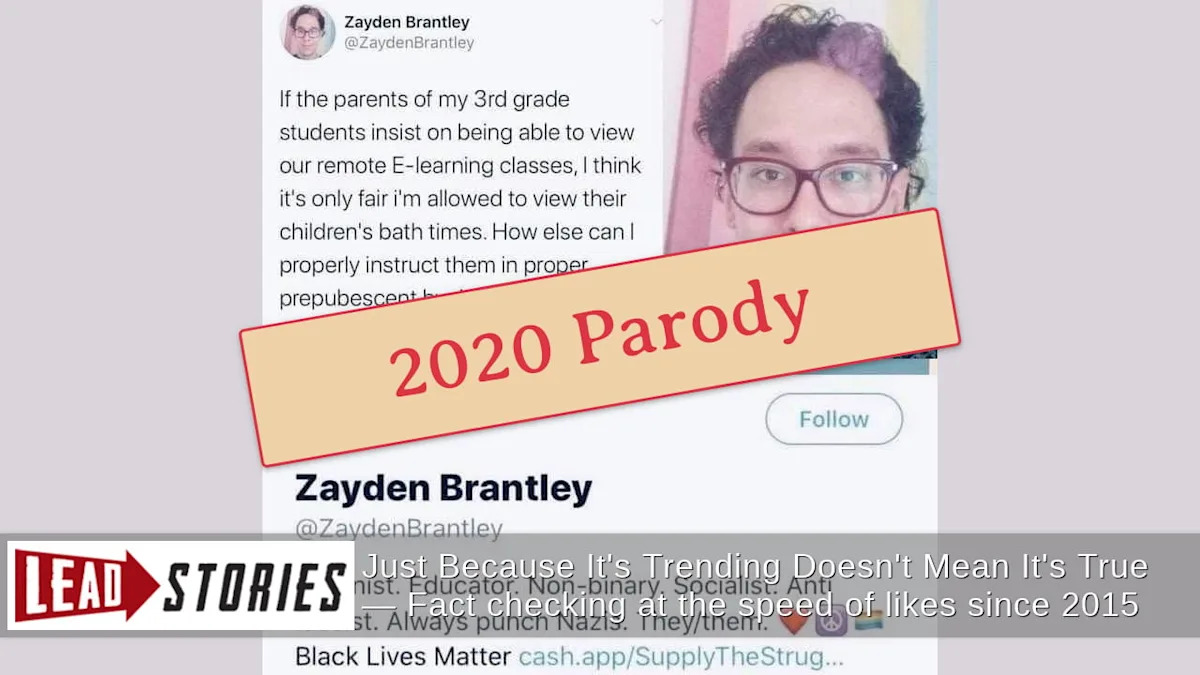
The controversial screenshot, which began circulating again on May 6 when user @HazelAppleyard shared it with the caption “Please be satire please be satire,” showed an alleged post from a Twitter account under the name “Zayden Brantley.” In the fabricated tweet, “Brantley” suggested that if parents insisted on viewing remote learning sessions during the pandemic, teachers should be allowed to watch children’s bath times to “properly instruct them in prepubescent hygiene.”
The account’s profile claimed to represent a “Feminist. Educator. Non-binary. Socialist. Anti fascist” who used they/them pronouns and supported Black Lives Matter, including a cash app link for donations.
Digital forensics revealed the @ZaydenBrantley Twitter account no longer exists. Attempts to access the account redirect to a standard “This account doesn’t exist” message. The Internet Archive contains a snapshot from September 2, 2020, confirming the account did briefly exist, but was deleted shortly afterward on September 3, 2020.
The timing is significant as the account appeared during a particularly contentious period in American education, when schools nationwide were transitioning to remote learning due to COVID-19 restrictions. Parents’ concerns about online education supervision collided with teachers’ privacy and autonomy, creating fertile ground for inflammatory content designed to intensify these tensions.
Further investigation into the account’s posting history, documented through screenshots preserved on platforms like iFunny, revealed a pattern of deliberately provocative content. Another tweet from August 25, 2020, made outrageous claims about instructing fourth graders in “erotic massage” and reading inappropriate material – content so obviously inflammatory that it points to deliberate trolling rather than genuine educational discussion.
A separate August 9, 2020 post solicited donations supposedly for sex workers through the same cash app link mentioned in the profile, further suggesting the account was created to generate outrage while potentially collecting money under false pretenses.
No evidence exists that Zayden Brantley was ever a real person or educator. Reverse image searches of the profile picture yielded minimal results, with the only significant match being a YouTube thumbnail from a 2023 video titled “The Self Admitted Child Predators of Twitter are Disgusting.” Notably, the video itself never mentions the name Zayden Brantley, suggesting the image may have been appropriated from elsewhere.
Social media archives indicate the account was active for only a brief period in August and early September 2020 before being removed, likely due to user reports for violating platform policies. Facebook comments from September 3, 2020, document the moment users noticed the account’s disappearance, with one person noting: “oh wow! looks like I saw it one hour ago and it was there… must have been a lot of people who reported his posts.”
This incident highlights the persistent challenge of “sockpuppet” accounts – fake personas created specifically to provoke emotional responses and spread misinformation on social media platforms. Such accounts often target divisive topics like education, gender identity, and politics to maximize engagement through outrage.
The resurgence of this four-year-old fabricated content demonstrates how inflammatory social media posts can continue circulating long after they’ve been debunked, particularly when they align with existing cultural tensions or political narratives.
Fact Checker
Verify the accuracy of this article using The Disinformation Commission analysis and real-time sources.

9 Comments
This fabricated Twitter profile seems designed to provoke outrage rather than represent legitimate views. I’m glad the account was promptly deleted in 2020 before it could spread more misinformation.
It’s concerning that someone would create a fake social media persona to push inflammatory rhetoric, especially when it comes to sensitive topics involving children. We need to be vigilant about verifying information online.
Agreed. Spreading false narratives, even as a prank, can have real-world consequences. I’m glad the authorities were able to identify and remove this fake account before it gained traction.
While I appreciate the desire to combat fascism and support important causes, creating a fictional persona to do so is counterproductive and risks undermining genuine activism. Honesty and transparency should be the priority.
It’s disheartening to see how easily misinformation can spread online, even when the underlying account is quickly identified as fake. We must continue to emphasize the importance of critical thinking and fact-checking in the digital age.
While the idea of a non-binary, socialist, anti-fascist educator may resonate with some, fabricating a persona to represent those views is counterproductive and undermines legitimate efforts to promote diversity and inclusion.
I’m curious to know more about the motivations behind creating this fake account. Was it simply a misguided attempt at satire, or something more sinister? Regardless, the spread of disinformation is a serious concern that requires ongoing attention.
This is a concerning example of how social media can be weaponized to spread misinformation and sow division. I’m glad the facts have been established, but vigilance is still needed to prevent similar incidents.
Absolutely. Fact-checking and calling out fabricated content is crucial, especially when it involves sensitive issues. We must remain diligent in order to maintain trust and productive discourse online.