


Listen to the article
Fake Social Media Account of Tumbler Ridge Shooter Dupes Nonprofit and Spreads Misinformation
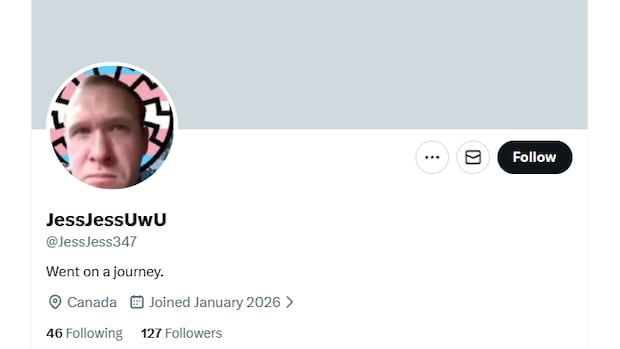
A fraudulent social media account impersonating the Tumbler Ridge mass shooter briefly fooled a prominent nonprofit organization and spread false information about the tragedy that claimed eight lives in northeastern British Columbia this week.
The X (formerly Twitter) profile featured numerous racist, white supremacist, and antisemitic posts with a username and display name that matched those on a YouTube channel belonging to the actual shooter, 18-year-old Jesse Van Rootselaar, who was identified by RCMP. Police reported that the shooter died by suicide after killing eight people and seriously injuring two others on Tuesday.
The New York-based Anti-Defamation League (ADL) initially cited the fake X profile in a report published Wednesday, claiming the shooter had an interest in “gore, guns, and white supremacy.” However, the account was later determined to be someone impersonating the shooter, prompting the ADL to issue a correction on Thursday.
“Upon further investigation, that X account has been found not credible,” the ADL stated in its correction, removing “white supremacy” from the report’s headline.
Disinformation experts warn that such deception can have serious consequences beyond the immediate tragedy.
“We often take the information that we see and we allow it to enter into some preconceived notions we have about others without us actually knowing if the information is accurate,” said Valérie Kindarji, a visiting researcher at The Montreal Centre for International Studies who specializes in the impacts of disinformation on democracies.
The posts on the fake X account included graphic videos showing violence against Black people, AI-generated content depicting abuse of a Muslim woman, and a white supremacist training video captioned, “The 2nd civil war is coming.”
Evidence of the deception emerged when users noticed some posts from the account displayed a different username (@HisuiPapist), suggesting the account owner had changed the name to match the YouTube channel in an apparent impersonation attempt. The fraudulent account was suspended by X late Wednesday afternoon for violating platform policies against glorifying violence and impersonation.
Later that night, a new account using the same @HisuiPapist handle bragged about fooling the ADL, posting: “THE ADL THOUGHT MY ACCOUNT WAS REAL LMAO.”
The ruse became possible after internet users found the Facebook page belonging to the shooter’s mother, Jennifer Strang (legally named Jennifer Jacobs), who was among those killed. In a 2021 post, Strang had publicly shared Van Rootselaar’s YouTube channel, noting her son “doesn’t go on much other social media.” The authentic YouTube account was taken down by the platform within a day of the shooting.
“We have this conception of disinformation that it’s usually done by these shadowy actors with strategic goals. But sometimes, the reality is so banal. It’s just a troll,” said Kindarji.
Esli Chan, a senior research fellow at the Centre for Media, Technology and Democracy’s Media Ecosystem Observatory, noted that people should be “wary” of false information created by those seeking to monetize views or attract attention by “intentionally trying to be controversial.”
“A lot of the information out there isn’t being distributed out of goodwill. It’s being distributed because people want a degree of attention online,” said Chan, who is also a doctoral candidate at McGill University.
The incident had wider repercussions. A Canadian Jewish News article based on the ADL’s initial report was subsequently removed, while a Jerusalem Post piece was updated to lead with the ADL’s retraction.
The misidentification problem extended beyond the fake X account. In the hours following the shooting, a transgender Ontario woman was falsely identified as the suspect. Her photo went viral and was picked up by several news outlets, including Radio-Canada, which later removed the photo and issued a correction. The woman’s mother told Agence France-Presse that her daughter was “devastated” and afraid to go outside after being misidentified.
According to Chan, the rush to amplify unverified claims about the shooter to support political narratives is “particularly dangerous in this scenario when we have a historically marginalized community being implicated.”
A 2018 MIT study found that falsehoods were “70 percent more likely to be retweeted” than factual information, with false news traveling about six times faster than truth.
Kindarji encourages people to “take a beat and wait” for verified, official information. “The reason why information trickles slowly from institutions, from news organizations, from police… is because they have processes in place to validate and to check the information before publicizing it. There are no incentives for people online to do the same.”
As of Thursday night, the new impersonator account remained active on X, boasting that it made over half a million people “believe Jesse Strang was a nazi.”
Fact Checker
Verify the accuracy of this article using The Disinformation Commission analysis and real-time sources.

10 Comments
Impersonating the shooter and spreading hateful content is a despicable act. I’m glad the authorities and fact-checkers were able to expose this hoax, but it’s worrying how easily disinformation can gain traction, especially around sensitive topics like this.
This is a disturbing case of someone trying to capitalize on a tragic event through disinformation. I’m relieved the ADL was able to identify and retract the false claims, but it highlights the ongoing challenges of managing misinformation online.
This is a disturbing example of how online misinformation can distort the facts around tragic events. While I’m relieved the ADL retracted their initial claims, it’s concerning that these hoaxes are becoming more prevalent. We need to find solutions to limit the spread of deception.
Shocking that someone would create a fake social media account to spread disinformation about this tragic shooting. It’s good the ADL corrected the record quickly, but this highlights the need for greater online accountability and fact-checking.
It’s good to see the ADL correct the record on this fake social media account. Exploiting tragedies for disinformation is a despicable act, and we need to find better ways to combat these types of hoaxes in the future.
It’s reprehensible that someone would create a fake social media account to exploit and distort the details of this terrible shooting. I hope the real perpetrator faces justice, and that measures are taken to prevent such hoaxes from spreading in the future.
I agree, these types of hoaxes can cause a lot of harm and undermine public trust. Rigorous fact-checking is crucial to counter misinformation, especially around tragic events.
This is a disturbing case of misinformation exploiting a tragic event. While the fake account was debunked, it’s concerning how quickly false narratives can spread these days. We need better ways to identify and limit the impact of such hoaxes.
Impersonating the shooter and spreading hateful content is absolutely abhorrent. I’m glad the authorities and fact-checkers were able to expose this hoax, but it’s worrying how quickly misinformation can spread, especially around sensitive topics like this.
Tragic that this shooting happened, and now it’s compounded by the spread of false information. While I’m glad the ADL corrected the record, it’s troubling that these kinds of hoaxes are becoming more common. We need better ways to combat online deception.