


Listen to the article
Americans Feel Economic Strain from Iran War as Inflation Reaches Three-Year High
Americans are feeling the economic impact of the ongoing conflict in Iran every time they fill up at the gas station, as inflation surged to its highest level in nearly three years, according to economic data released Thursday. However, some of the negative effects are currently being offset by substantial tax refunds and a surge in business investment driven by artificial intelligence technologies.
The Commerce Department reported that the Personal Consumption Expenditures price index—the Federal Reserve’s preferred inflation gauge—rose 0.7% from February to March and 3.5% year-over-year, marking the largest annual increase since May 2023.
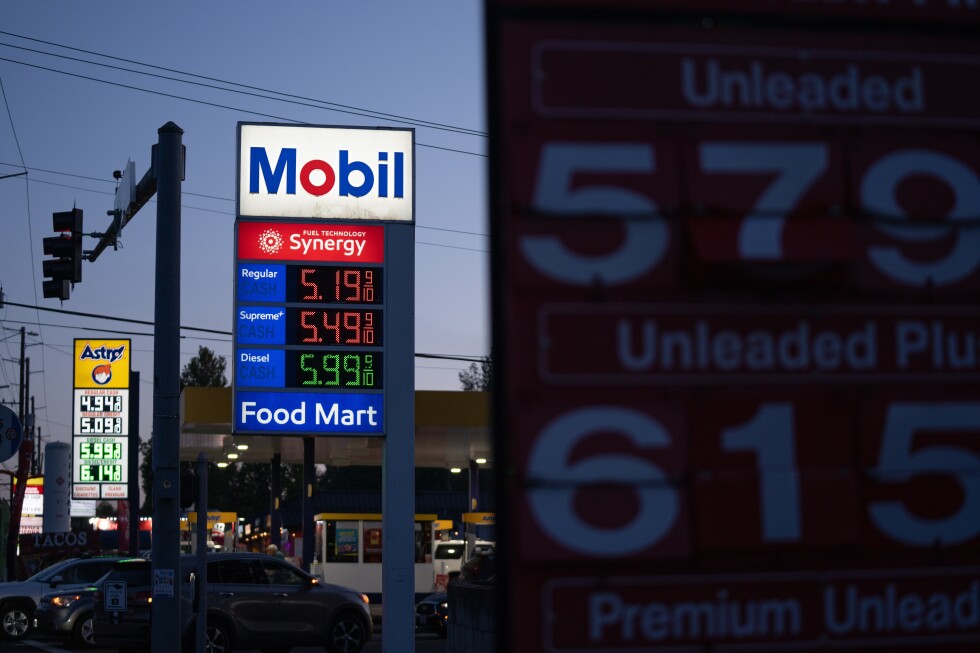
The primary driver behind this inflation spike is clear: gasoline prices soared 21% in March alone after Iran responded to U.S. and Israeli attacks by closing the Strait of Hormuz, creating what analysts describe as the biggest disruption to global oil supplies in history. The average price for a gallon of regular gasoline has continued climbing, jumping another 7 cents overnight to $4.30—significantly higher than the $3.18 recorded at the same time last year. Gas prices have now set new multi-year highs for three consecutive days.
“Rising tax refunds were outpacing the increased burden of gasoline spending two to one in March and most of April,” noted Michael Pearce, chief U.S. economist at Oxford Economics. “With tax refund season winding down and gas prices still climbing, the hit to consumer spending will become more evident from May.”
Despite these inflationary pressures, the U.S. economy maintained steady growth in the first quarter of the year. The Commerce Department reported that gross domestic product expanded at a 2% annual pace from January through March. While this figure fell short of economists’ expectations, it represents a significant improvement from the meager 0.5% growth recorded in the final quarter of 2025, when a 43-day federal government shutdown reduced economic output by more than a percentage point.
A key bright spot in the economic data is the surge in business investment, excluding housing, which jumped 10.4% in the first quarter—the largest increase in nearly three years. This investment boom is largely attributable to rapid development and implementation of artificial intelligence technologies across various industries.
Consumer spending, which accounts for approximately 70% of U.S. economic activity, grew at a modest 1.6% annual rate in the first quarter. Americans benefited from substantial tax refunds resulting from President Donald Trump’s 2025 tax cuts, providing a temporary boost to spending power despite rising prices.
However, economists warn that this consumer spending buffer may soon disappear. As households allocate more of their budgets to gasoline, they will likely cut back on other goods and services, potentially slowing overall economic growth. Joe Brusuelas, chief economist at tax and advisory firm RSM, has already downgraded his forecast for U.S. economic growth this year to 1.7% from his earlier projection of 2.4%.
“A year that was set to benefit from tail winds associated with a large tax cut and boom in artificial intelligence-led investment has been partially derailed by the impact of what as of today is an adverse and growing supply shock caused by the war in Iran,” Brusuelas explained. “Unfortunately, war and the supply shock that ensued has altered the probable growth path this year.”
The simultaneous threats of rising inflation and slowing economic growth have created a dilemma for the Federal Reserve and other central banks worldwide. They face the difficult choice of either cutting interest rates to stimulate economic growth or maintaining higher rates to combat inflation.
For now, major central banks are adopting a wait-and-see approach. The Bank of England recently maintained its main interest rate at 3.75% and hinted at potential future increases as policymakers assess the war’s economic impact. Similarly, the Federal Reserve, Bank of Japan, and European Central Bank have all opted to keep rates unchanged while they monitor the economic fallout from the conflict.
The U.S. labor market remains a source of stability amid these economic challenges. The Labor Department reported that unemployment benefit applications—a proxy for layoffs—fell last week to their lowest level in more than 50 years, indicating that American workers continue to enjoy considerable job security.
However, the employment landscape shows some concerning trends. While companies are reluctant to lay off existing workers, they’re also hesitant to hire. Job growth last year was the weakest outside a recession since 2002, and 2026 has shown inconsistent patterns—strong hiring in January (160,000 new jobs) and March (178,000) contrasted with significant job losses in February (133,000).
Economists describe this as a “no-hire, no-fire” scenario that particularly disadvantages young job seekers entering the market. Additionally, there are growing concerns that artificial intelligence technologies may be eliminating entry-level positions, further complicating the employment outlook for new workers.
Fact Checker
Verify the accuracy of this article using The Disinformation Commission analysis and real-time sources.

14 Comments
High gas prices are undoubtedly a major strain on American families, so it’s good to see that factors like tax refunds and AI investment are providing some offset. However, the overall inflationary pressure is still a significant concern that will require close monitoring.
The surge in inflation is certainly worrying, but the offsetting effects of tax refunds and AI investment are an interesting development. It will be important to monitor how these dynamics play out over the coming months and their broader implications for the US economy.
Given the volatility in the energy markets, it’s not surprising to see inflation hit a 3-year high. The tax refunds and AI investment seem to be providing some cushioning, but high gas prices remain a significant burden for many Americans.
Interesting to see the impact of the Iran conflict rippling through the US economy. It’s good to hear that tax refunds and AI investments are providing some offset, but high gas prices are still squeezing consumers hard.
I agree, the high gas prices must be very frustrating for American families. Hopefully the situation in the Middle East can be resolved soon to provide some relief.
The economic impact of the Iran conflict is clearly being felt, but it’s encouraging to see the US economy demonstrating some resilience through tax refunds and the AI boom. Curious to see how these dynamics evolve in the coming months as the geopolitical situation continues to unfold.
Absolutely, the interplay between the geopolitical tensions, energy prices, and emerging tech sectors will be crucial to watch. It’s a complex situation, but the economic diversification seems to be providing some much-needed cushioning.
The Iran conflict and its impact on global oil supplies is a significant challenge, but it’s encouraging to see the US economy showing some resilience. The AI boom and tax refunds provide a helpful counterbalance, though high gas prices will remain a burden for many.
Agreed, the AI investment is a bright spot that could help cushion the blow from the Iran-driven energy disruption. Curious to see if policymakers can find ways to further support this emerging tech sector.
The surge in inflation is certainly concerning, especially with the disruption to global oil supplies. However, it’s encouraging that the economic pain is being partially offset by factors like AI investment. Curious to see how this plays out in the coming months.
Yes, the AI boom provides an interesting counterbalance to the oil-driven inflation. It will be important to monitor how these opposing forces shape the overall economic picture going forward.
The economic impacts of the Iran conflict are real, but it’s good to see that the US economy has some resilience in the face of these challenges. The AI boom is an especially encouraging sign, though high gas prices will continue to be a concern.
Absolutely, the AI investment is a bright spot amidst the economic headwinds. Hopefully policymakers can find ways to further support innovation and growth in this sector.
While the high gas prices are undoubtedly a burden, it’s heartening to see that the US economy has some buffers in the form of tax refunds and AI investment. These factors seem to be offsetting some of the negative impacts of the Iran conflict, though inflationary pressures remain a concern.