


Listen to the article
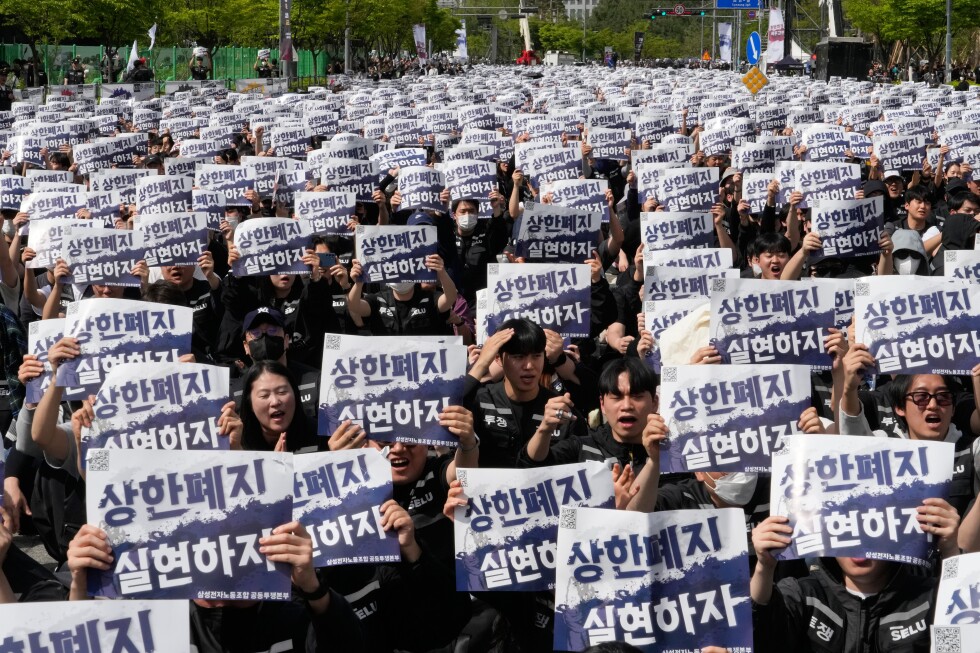
Thousands of Samsung workers took to the streets at the tech giant’s sprawling chip complex in Pyeongtaek, South Korea on Thursday, demanding higher bonuses as the company reaps substantial profits from the artificial intelligence boom.
The demonstration, which union officials claim drew about 40,000 members, saw protesters waving banners and shouting slogans like “make compensation transparent and remove maximum limits on bonuses!” The rally took place under heavy police surveillance, highlighting the growing tension between Samsung’s management and its workforce.
This labor action comes at a pivotal moment for South Korea’s semiconductor industry. Just hours before the protest, SK Hynix, Samsung’s primary domestic competitor, announced record-breaking quarterly results. The chipmaker reported all-time high revenue and operating profit for the January-March quarter, directly attributing this success to surging global investment in data centers and AI infrastructure that has dramatically increased demand for memory chips.
The timing is significant as Samsung itself recently forecast first-quarter operating profits of 57.2 trillion won ($38.6 billion), outpacing SK Hynix’s 37.6 trillion won ($25.4 billion). Together, these two South Korean tech giants produce approximately two-thirds of the world’s memory chips, putting them at the forefront of the AI revolution currently transforming the technology landscape.
Samsung’s union, representing approximately 74,000 workers, claims the company has failed to share its financial success adequately with employees. According to union representatives, management’s proposal to offer bonuses in restricted stock has been rejected, with workers instead pushing for the removal of bonus caps altogether.
“We won’t stop this fight until our fair demands are met,” declared union leader Choi Seung-ho, addressing the crowd from atop a crane-mounted structure.
The stakes are high for both sides. The union has threatened an 18-day walkout beginning May 21 if negotiations fail to produce an acceptable agreement. Union officials estimate such action could cost Samsung more than 1 trillion won ($676 million) daily in lost production—a potentially devastating blow amid fierce global competition in the semiconductor market.
This labor dispute occurs against a complex backdrop for the global chip industry. While demand for AI-capable semiconductors has created unprecedented opportunities, geopolitical tensions have introduced new challenges. The ongoing conflict in the Middle East has disrupted supplies of critical materials like helium and bromine that are essential to chipmaking processes, while simultaneously driving up energy costs.
SK Hynix appears better positioned to weather these supply chain disruptions. During a Thursday conference call, Chief Financial Officer Woo Hyun Kim reassured investors that the company has been diversifying its sourcing of critical materials beyond the Middle East and maintains sufficient inventory to continue production without significant interruption.
For Samsung, the labor dispute adds another layer of complexity to its operations at a time when maintaining production capacity is crucial. The company’s more diverse business portfolio, which includes smartphones and consumer electronics in addition to semiconductors, provides some insulation against sector-specific challenges but also creates additional operational pressures.
Industry analysts suggest this confrontation between Samsung and its workforce could represent a turning point in South Korea’s traditionally management-friendly labor environment, particularly within its globally dominant technology sector. As AI continues to drive record profits for chip manufacturers, employees are increasingly demanding their share of the windfall.
The outcome of this dispute will likely influence labor relations throughout South Korea’s technology industry as companies balance the need to remain competitive globally while addressing growing demands from their domestic workforce for greater compensation during this period of extraordinary profitability.
Fact Checker
Verify the accuracy of this article using The Disinformation Commission analysis and real-time sources.

14 Comments
It’s understandable that Samsung workers want a bigger share of the company’s AI-driven profits. But Samsung also has to balance worker demands against maintaining its global leadership in semiconductors. This will be a delicate balancing act.
Exactly. Samsung has to keep both its workers and shareholders happy, which is no easy feat in such a cutthroat industry. They’ll need to get creative in their negotiations.
The AI boom has been hugely profitable for Samsung, so the workers’ demands for more transparent compensation and higher bonuses seem justified. But Samsung will have to weigh that against the need to stay competitive globally.
Absolutely. Samsung is in a tough spot, needing to keep employees happy while also protecting its bottom line. Careful negotiation will be key to avoiding a damaging strike.
The Samsung workers have a point – their company is raking in huge profits, so they deserve a fair slice of that success. But Samsung also has to protect its market position, so this will be a tough negotiation.
Agreed. Samsung will need to find a compromise that appeases the workers without jeopardizing its ability to invest and stay competitive in the long run.
The Samsung protest highlights the tricky position semiconductor companies are in – needing to keep workers satisfied while also preserving their competitive edge. Careful compromise will be key to avoiding a damaging labor dispute.
Well put. Samsung has to tread a fine line here. Workers deserve a fair share, but the company also can’t afford to lose its technological lead. Finding the right balance will be crucial.
This labor action highlights the challenges facing South Korea’s semiconductor industry. With sky-high profits, workers want a bigger share, but companies have to balance that against maintaining their technological edge. It’s a delicate balancing act.
Well said. The semiconductor industry is fiercely competitive globally, so Samsung will have to tread carefully to keep both workers and shareholders satisfied.
This is a challenging situation for Samsung. The workers have a valid case for higher pay given the company’s record profits. But Samsung also has to protect its global market position in semiconductors, which is highly competitive. Striking the right compromise will be tough.
Absolutely. Samsung is in a difficult spot, needing to keep both its workforce and shareholders satisfied. They’ll have to get creative to find a solution that works for everyone.
Interesting to see Samsung workers protesting for higher pay. With the company posting record profits, it’s understandable they want a bigger slice of the pie. However, labor tensions could impact productivity if not handled carefully.
You raise a good point. Samsung will need to strike a balance between keeping workers satisfied and maintaining its competitive edge in the semiconductor market.