


Listen to the article
Asian Markets Retreat After Brief Rally as Iran Tensions Push Oil Above $100
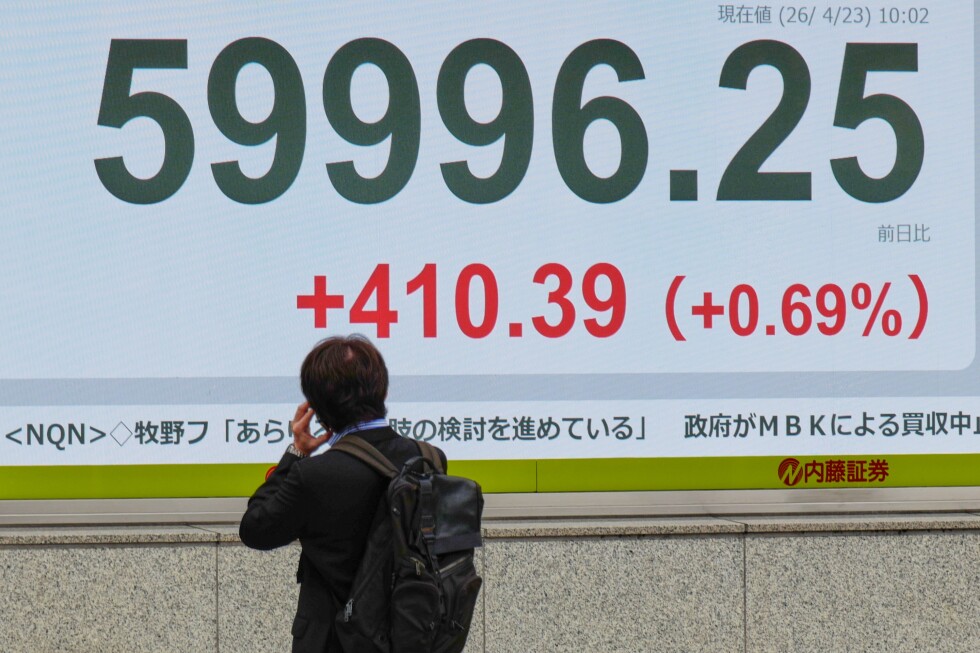
Asian stock markets pulled back on Thursday following a short-lived rally that briefly pushed Japan’s Nikkei 225 index above the 60,000 mark for the first time in history. Meanwhile, oil prices climbed above $100 a barrel as investors responded to deteriorating prospects for diplomatic resolution of the Iran conflict.
The Nikkei 225 ultimately closed down 0.8% at 59,140.23 after touching an intraday high of 60,013.98. South Korea’s Kospi managed to finish 0.9% higher at 6,475.81, supported by government data showing better-than-expected annual economic growth of 1.7% in the first quarter. The robust performance was largely driven by strong exports, particularly semiconductor chips used in artificial intelligence applications.
Elsewhere in the region, Hong Kong’s Hang Seng index shed 1% to close at 25,901.38, while mainland China’s Shanghai Composite declined 0.3% to 4,093.25. Australia’s S&P/ASX 200 fell 0.6% to 8,793.40, and Taiwan’s Taiex dropped 0.4%. India’s Sensex demonstrated the steepest decline, falling 1%.
The retreat comes despite U.S. markets reaching record highs the previous day, with the S&P 500 jumping 1% to 7,137.90, the Dow Jones Industrial Average climbing 0.7% to 49,490.03, and the Nasdaq composite gaining 1.6% to 24,657.57. Strong corporate earnings reports from companies including GE Vernova, Boeing, and Philip Morris International had buoyed Wall Street sentiment.
However, escalating tensions in the Middle East have overshadowed positive economic developments. The eight-week-old Iran war has reached a critical point, with peace talks stalling despite U.S. President Donald Trump’s extension of a ceasefire. Uncertainty around when or whether negotiations will resume has heightened market anxiety.
The situation deteriorated further when Iran fired on three ships in the Strait of Hormuz on Wednesday, with Iran’s Revolutionary Guard seizing two vessels. This action came in response to the U.S. imposing a sea blockade of Iranian ports last week. President Trump has indicated the blockade will continue, further dimming prospects for de-escalation.
These developments have significant implications for global energy markets, as the Strait of Hormuz serves as a critical chokepoint through which approximately one-fifth of the world’s oil typically passes. With maritime traffic largely halted through the strait, oil prices have surged dramatically.
Brent crude, the international benchmark, rose 1.4% to $103.34 per barrel early Thursday, while U.S. benchmark crude increased 1.5% to $94.35 per barrel. These prices represent a substantial jump from pre-conflict levels, when Brent crude traded around $70 per barrel in late February.
“As hopes for a resolution between the U.S. and Iran fade and peace talks stall, the oil market is having to reprice expectations,” noted ING Bank strategists Warren Patterson and Ewa Manthey. “If no progress is made, the market will become increasingly numb to the noise and headlines that have dictated price action recently.”
The energy shock has reverberated across global markets, affecting everything from transportation costs to manufacturing. For oil-importing nations across Asia, the sustained price increase threatens to fuel inflation and pressure economic growth.
In currency markets, the U.S. dollar rose slightly against the Japanese yen, trading at 159.66 yen compared to Wednesday’s 159.48 yen. The euro weakened marginally to $1.1701 from $1.1705.
Precious metals markets also saw declines, with gold prices dropping 0.5% to $4,728.60 per ounce and silver prices falling 2.6% to $75.95 an ounce, as investors recalibrated risk assessments amid the evolving geopolitical situation.
Analysts suggest that market volatility is likely to persist in the near term as investors continue to monitor both corporate earnings reports and developments in the Iran conflict, which has emerged as a significant wild card for global economic prospects.
Fact Checker
Verify the accuracy of this article using The Disinformation Commission analysis and real-time sources.

12 Comments
India’s Sensex taking the steepest hit is noteworthy. As a major consumer of oil and commodities, the country’s markets seem particularly sensitive to global price swings and geopolitical tensions. Will this dent the growth momentum in India?
That’s a fair point. India’s economy has been one of the brighter spots globally, but high energy and commodity prices pose a clear headwind. Policymakers will need to carefully navigate these external pressures.
Interesting to see oil prices spike above $100 due to the Iran tensions. Definitely a tricky geopolitical situation that could impact energy markets and broader equities.
Absolutely, the Iran situation is a major wildcard that investors will be closely watching. The surge in oil prices could start to put pressure on markets if it persists.
It’s interesting to see the divergent performance across the Asian markets, with some holding up better than others. This underscores the importance of regional differences and domestic factors in driving equity returns.
The resilience of the semiconductor industry is an encouraging sign, but the broader market retreat suggests lingering concerns about the economic outlook. Investors will need to closely watch for any further shifts in the geopolitical landscape.
Absolutely, the interplay between geopolitics, commodities, and the macroeconomic environment will be crucial in determining the direction of equity markets in the near term.
The surge in oil prices above $100 is a significant development that could have far-reaching implications. It will be important to monitor how central banks and policymakers respond to address the potential inflationary pressures.
The resilience of the semiconductor sector is encouraging, with strong chip demand for AI applications helping to offset some of the broader Asian market declines. Is this a sign that the chip shortage may be easing?
That’s a good question. The semiconductor industry has shown remarkable adaptability throughout the supply chain challenges. The robust Korean export data suggests the demand outlook remains positive.
The retreat in Asian stocks despite the Wall Street rally highlights the unique dynamics in play. Investors seem increasingly focused on the impact of global inflation and supply chain issues on corporate earnings and economic growth.
Absolutely, the global macroeconomic landscape is becoming more complex, with different regions facing distinct challenges. Navigating these cross-currents will be critical for investors in the months ahead.