


Listen to the article
Iran’s AI-Powered “Lego-ganda”: The New Frontier of Information Warfare
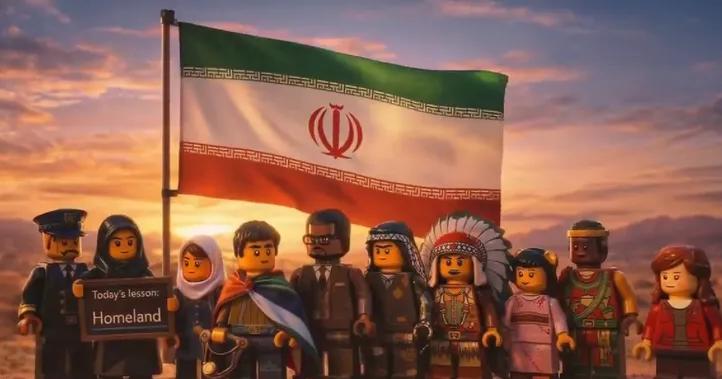
In a significant shift from traditional propaganda methods, Iran has embraced sophisticated “asymmetric” information warfare tactics, with AI-generated Lego animations emerging as a powerful new tool in its arsenal. These colorful, toy-like videos—which have gained global attention in recent weeks—represent a calculated strategy that treats digital content production with the same importance as military operations.
The animations, produced by a group calling itself “Explosive Media,” utilize Western songs to craft narratives depicting the supposed political, military, and moral defeat of the United States. Iranian media outlets sympathetic to the government claim these videos have successfully challenged what they term the “global media empire’s control over the narrative.”
The reach of these animations has extended far beyond Iran’s borders. At the recent Coachella music festival in the United States, The Strokes’ lead singer referenced them during a performance, saying: “I wanted to come with my laptop and show one of the Iranian Lego videos… They have more facts than local news. But they’re deleting them, YouTube, the government, whoever.”
Behind the seemingly playful plastic visuals lies a sophisticated system of artificial intelligence and coordinated distribution designed to shift conflict from physical battlefields to digital screens worldwide.
The Wall Street Journal has dubbed this phenomenon “Lego-ganda”—political and military messaging delivered through Lego-style visuals. While not entirely unprecedented (China employed similar imagery during COVID-19, and Russia used related techniques during Moldovan elections), the scale of Iran’s current campaign is remarkable.
Unlike conventional state propaganda, these videos aren’t produced by official broadcasters. Instead, they come from seemingly independent groups that adopt styles dramatically different from traditional government content while still promoting symbols of Iranian victory and legitimacy. “Explosive Media” maintains a rapid production schedule, releasing at least two videos weekly.
Researchers like Michael Kosciewicz describe this approach as “Slopaganda”—a combination of “slop” (cheap, mass-produced AI content) and propaganda. The strategy involves quickly producing inexpensive content tailored to audience preferences, ensuring rapid dissemination across social media platforms.
Rather than creating entirely new narratives, these videos primarily amplify existing divisions within American society. Darren Linvill, director of the Media Forensics Hub at Clemson University, notes that Iran has evolved beyond previous media strategies to focus on exploiting internal American grievances. Political analyst Alex Goldenberg suggests Iran’s information strategy centers on identifying and widening “fault lines” in American political discourse.
The use of childlike visuals to convey violent or politically charged messages has alarmed many experts. Lucas Olejnik from King’s College London told the Wall Street Journal: “The familiar aesthetics lower the audience’s guard at the exact moment the political message is delivered.” Daniel Butler, a political science professor, argues that Lego imagery makes war and suffering appear “less graphic” and “more shareable,” transforming horrific realities into the visual language of childhood play.
Critics contend this amounts to “sanitizing violence,” where scenes of destruction and death are rendered as plastic blocks, diminishing the perceived value of human life. Chicago Archbishop Cardinal Blase Cupich has expressed concern that such content contributes to “cheapening the value of human life.”
The emergence of artificial intelligence has created two distinct layers in this information war. The first aims to establish legitimacy in global public opinion. The second focuses on “information saturation”—flooding media channels with multiple, conflicting AI-generated versions of events to create doubt around every narrative. When audiences become overwhelmed by contradictory content, they may dismiss even authentic evidence as potentially fake.
This pattern was evident during what Iranian sources called the “12-day war,” described by the Hozin Institute as the first widespread use of deepfakes in military conflict. Networks linked to Iran produced fake videos showing missile strikes on Tel Aviv and Israeli aircraft being shot down, garnering over 100 million views across platforms. Similar tactics reappeared during the subsequent “40-day war,” with falsified videos amplified by Russian and Chinese state media.
“Explosive Media” claims to be a continuation of a group known as L.O.S.E.R., which began operating early in the conflict with a video titled “Narrative of Conquest.” After YouTube removed their content, the group announced itself on X (formerly Twitter) on February 27, describing themselves as “independent Iranian AI content production” creators “breaking the media silence.”
In an interview with The New Yorker, a member of “Explosive Media” claimed independence from the Iranian government, stating their videos aim to counter Western media narratives. They described their team as young people between 19 and 25 years old who use AI to produce two-minute videos within 24 hours.
Despite YouTube’s attempts to shut down their channels, the distribution of this content follows a sophisticated pattern. Intelligence platform Graphika found that videos posted to “Explosive Media’s” Telegram channel are quickly reshared on X by Tasnim News Agency and Russia’s RT, artificially boosting their reach through coordinated posting by thousands of accounts.
Interestingly, the Lego format has begun to work against the Iranian regime as well. Critics have adopted the same visual style to tell opposing narratives, including videos depicting Iranian officials confronting public backlash and being forced to flee—suggesting that in the digital battlefield of information warfare, no tactical advantage remains exclusive for long.
Fact Checker
Verify the accuracy of this article using The Disinformation Commission analysis and real-time sources.

7 Comments
The global reach of these Iranian Lego videos is quite remarkable. I’d like to understand more about their broader cultural impact, especially on younger audiences.
Interesting use of Lego animations for propaganda! I’m curious to learn more about how these videos are crafted and their potential impact on young audiences.
These Lego propaganda videos seem to be a novel approach to spreading disinformation. I’d be interested to know more about the technical capabilities behind their production.
The claim that these Lego animations have ‘more facts than local news’ is quite bold. I wonder if there’s any objective evidence to support the accuracy of their content.
While the visual appeal of Lego animations may capture attention, we must be cautious about accepting the narratives they present as truthful. Critical analysis is essential.
While the aesthetics of Lego animations are engaging, I’m skeptical of their use for political messaging. It’s important to be critical of the narratives they aim to convey.
The use of AI-generated Lego animations for information warfare is a concerning trend. I wonder about the ethical implications of such tactics targeting vulnerable populations.