


Listen to the article
The robotics pioneer who helped unleash the Roomba vacuum is now betting that you might one day replace your beloved dog or cat with a plush robot that follows you around your home and adapts to your daily habits.
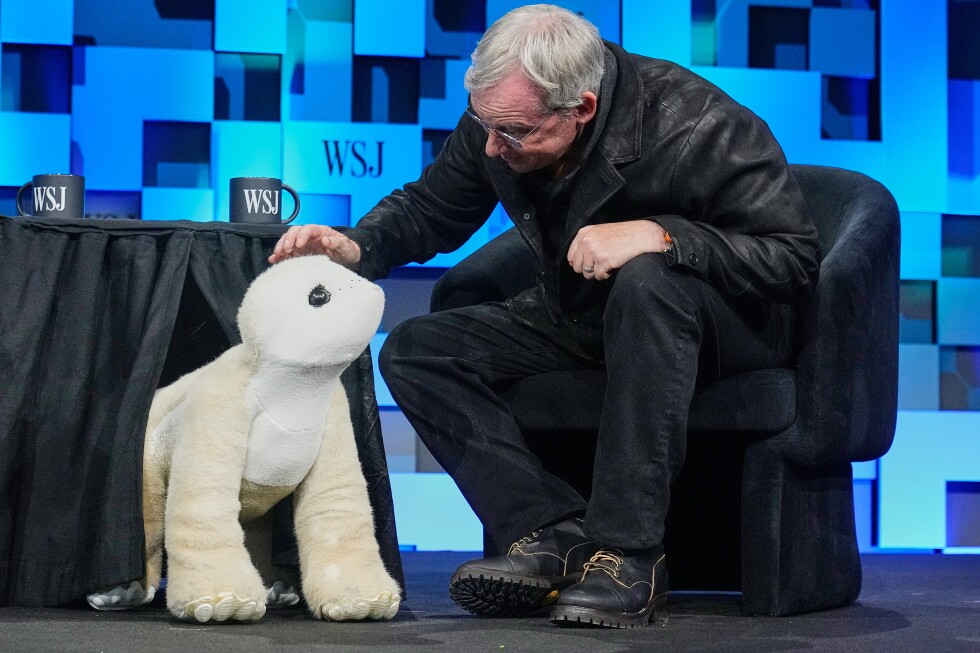
Colin Angle, former longtime CEO of iRobot, unveiled a four-legged prototype called the Familiar on Monday. The robot resembles a bulldog-sized creature with doe-like eyes and bear cub ears and paws. It greets people by extending into a stretch that invites patting of its touch-sensitive fake fur.
“We chose a form factor that’s not a human, not a dog, not a cat, because we wanted to steer away from all of those preconceptions,” explained Angle, who now leads the startup Familiar Machines & Magic.
This lifelike machine, powered by the latest artificial intelligence technology, marks a significant advancement from when Angle co-founded iRobot in 1990 or when he launched the first Roomba in 2002. While not the first attempt to create a robotic pet – Sony introduced its plastic robotic dog Aibo in the late 1990s and revamped it in 2018 – Angle believes the Familiar achieves something unprecedented.
“The challenge is to make something that’s not a watch-me toy,” Angle told The Associated Press. “This is about having something that you want to hug, you want to pet. When it’s happy, that makes you happy. And it is large enough or mobile enough to follow you to the kitchen or drag you off the couch and take a walk.”
The robot communicates through animal-like sounds rather than speech. However, it features audio input “ears” and an AI system that understands and learns from verbal commands. Leveraging recent advances in generative AI similar to those powering ChatGPT, the Familiar can adapt its behavior as it learns from interactions with people around it.
“I couldn’t have done this six months ago,” Angle noted, highlighting the rapid pace of AI development that has made such sophisticated companion robots possible.
Angle led iRobot for 25 years, during which the Roomba became the first widely adopted home robot. He stepped down as CEO and chairman earlier this year after Amazon abandoned its plan to acquire the Massachusetts-based company, which had been struggling amid intense competition, particularly from Chinese manufacturers.
Familiar Machines, based in Woburn, Massachusetts, remained in “stealth” mode until this week when Angle demonstrated one of his prototypes at The Wall Street Journal’s Future of Everything conference in New York.
While no timeline has been announced for when consumers might be able to purchase a Familiar, Angle identified retired people as a key target demographic. “Not because people suddenly stop enjoying pets, but the fear and obligation of caring for them are such that people are very reluctant to get new pets at older ages,” he explained.
The name “Familiar” draws on deep folkloric roots, referring to animal companions associated with witches, wizards, and similar concepts in fantasy literature such as Philip Pullman’s “His Dark Materials” novels. “It’s an archaic, ancient word,” Angle said, noting that he was surprised to find he could trademark it.
Angle has assembled an impressive team of robotics advisors, including Marc Raibert, founder of Boston Dynamics (creator of the four-legged Spot robot), and Cynthia Breazeal, inventor of the social robot Kismet and the tabletop speaker robot Jibo. Many team members previously worked together at the Massachusetts Institute of Technology and share a skepticism toward the current trend of humanoid robots that, while impressive in appearance, have limited practical utility.
Maja Matarić, a computer science professor at the University of Southern California who co-founded the field of socially assistive robotics 25 years ago, serves as another advisor. Upon first seeing Angle’s prototype, she “immediately got down on the ground near it and had to hug it and pet it, then started to play with it to see what it would do.”
Matarić emphasized that the robot’s adorable rather than creepy appearance is crucial to its appeal. Decades of research have shown that robots that are “cute, personalized and vulnerable” are more appealing than alternatives. She suggested the Familiar could be particularly valuable in nursing homes or for providing emotional support in mental health contexts.
Recent advances in AI have also expanded the potential impact of such robots. “Before generative AI, robots could not readily understand what people were saying,” Matarić noted, underlining how technological progress has made more natural human-robot interactions possible.
Fact Checker
Verify the accuracy of this article using The Disinformation Commission analysis and real-time sources.

7 Comments
The Familiar looks like a unique take on a robotic pet. I’m skeptical about whether it can truly replicate the companionship and emotional connection of a real animal, but the AI capabilities are impressive.
It will be interesting to see if this robot can gain widespread adoption or if there are limitations that prevent it from becoming a true substitute for a live pet.
This is an intriguing development in the world of robotics and home automation. I’m curious to learn more about the AI technology powering the Familiar and how it might evolve over time.
While I’m fascinated by the engineering behind the Familiar, I worry that it could have unintended consequences for human-animal relationships and the mental health benefits of pet ownership. Cautious optimism is warranted.
Interesting concept from the Roomba pioneer. I’m curious to see how this AI-powered pet robot performs and how it compares to traditional pets. The touch-sensitive fur sounds like an intriguing feature.
I wonder how the AI will adapt to individual household habits and personalities. Could be a good companion for those unable to care for a live pet.
I appreciate the goal of creating a robotic pet that isn’t just a novelty toy. The AI-powered adaptability seems promising, but I have concerns about the ethical implications of replacing live pets with machines.