


Listen to the article
Romania’s Pro-European Coalition Collapses as Prime Minister Loses Confidence Vote
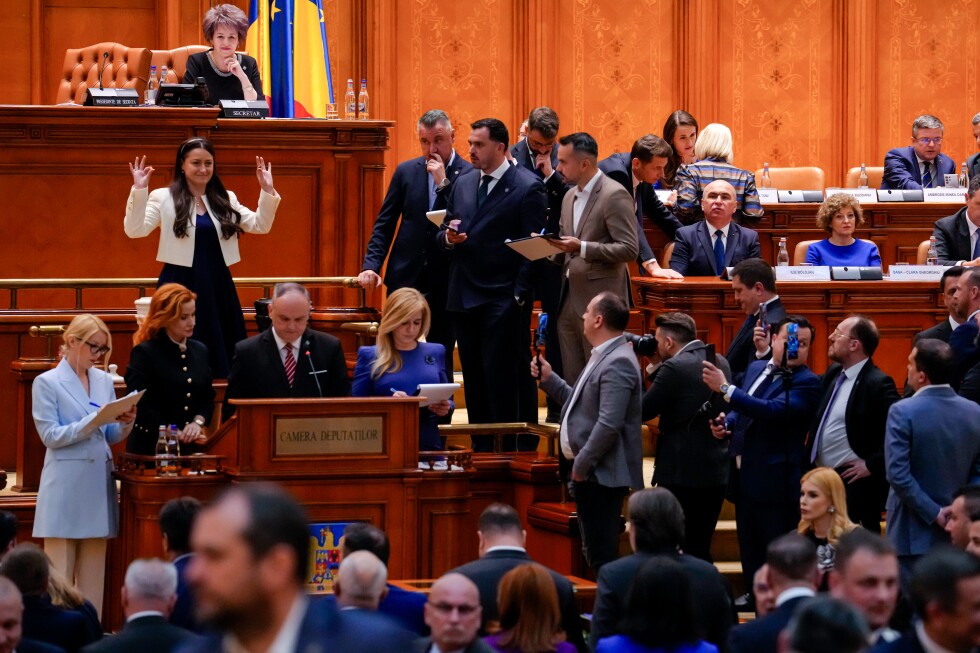
Romania plunged deeper into political uncertainty Tuesday as Prime Minister Ilie Bolojan’s government collapsed following a decisive no-confidence vote in Parliament, further destabilizing one of the European Union’s eastern members.
Lawmakers voted 281-4 to remove Bolojan, who had been in office for less than a year. His administration had aimed to resolve Romania’s ongoing political turmoil and economic challenges but ultimately fell victim to coalition fractures.
The motion was jointly submitted by the Social Democratic Party (PSD), which recently withdrew from the governing coalition, and the nationalist opposition Alliance for the Unity of Romanians (AUR) party. Members of Bolojan’s National Liberal Party (PNL) and remaining coalition partners abstained from the vote.
Romanian President Nicusor Dan called for calm following the government’s collapse. “While it is not a happy moment, it is a democratic decision by Parliament,” Dan said, reassuring citizens that consultations to form a new government are already underway. “We will have a new government within a reasonable time. I exclude the scenario of early elections and emphasize that at the end of these procedures, we will have a pro-Western government.”
The political instability compounds Romania’s existing challenges. The country has been grappling with one of the highest budget deficits in the European Union, persistent inflation, and a technical recession. These economic troubles follow the controversial annulment of a presidential election in December 2024, which sparked widespread public discontent.
When Bolojan’s coalition took power last June, reducing the budget deficit was declared a top priority. However, the PSD frequently clashed with the prime minister over his proposed austerity measures, which included tax increases, freezes on public-sector wages and pensions, and cuts to government spending and administrative positions.
In the days leading up to the vote, the PSD accused Bolojan of failing to implement meaningful reforms during his 10-month tenure and claimed Romania needed leadership “capable of collaboration.” Defending his record before Parliament, Bolojan argued that his fiscal policies, though difficult, had been necessary to “regain the trust of the markets in the Romanian government.”
“I assumed the position of prime minister, being aware that it comes with enormous pressure and that I would not receive applause from the citizens,” Bolojan said. “But I chose to do what was urgent and necessary for our country.” He described the no-confidence motion as “cynical and artificial,” suggesting it was written by people disconnected from the daily realities of governance.
PSD president Sorin Grindeanu has called for Bolojan to appoint an interim prime minister while consultations take place. “I would like us to quickly find a solution together with the other parties and move forward,” Grindeanu stated. “All options are open.”
The political path forward remains unclear. Dan Motreanu, secretary-general of Bolojan’s PNL, challenged the PSD and AUR to step up, writing on social media that they “have a duty to take over the government, to come up with a prime minister candidate and a clear program.” He accused both parties of “playing political theater” and warned that “any signal of political chaos” would harm Romania’s economy and citizens.
Forming a new government presents significant challenges. The PSD would be essential to creating any pro-European parliamentary majority but has previously ruled out governing alongside the nationalist AUR. George Simion, AUR’s leader, capitalized on public frustration, claiming voters had “supported and wanted water, food, energy” but instead “received taxes, war and poverty.”
Cristian Andrei, a political consultant based in Bucharest, predicted a prolonged stalemate. “No one has a majority or a coalition, and it will take the president weeks to find such a majority and name a new prime minister, prolonging the indecision,” he said.
Andrei outlined two difficult scenarios: either reforming the existing coalition without Bolojan or establishing a minority government led by PSD with support from populist parties. “A PSD-AUR official Cabinet is not a possibility today because the president will not endorse it,” he added.
The prime ministerial position was originally scheduled to rotate from Bolojan to a PSD premier in 2027 as part of a power-sharing agreement. Romania’s next general election is scheduled for 2028.
Fact Checker
Verify the accuracy of this article using The Disinformation Commission analysis and real-time sources.

7 Comments
This sounds like a complex political situation in Romania. The collapse of the governing coalition and the prime minister’s ouster via no-confidence vote points to deep divisions. I’m curious to see what policy direction the next government will take and how they’ll address the country’s economic troubles.
Agreed, the political instability in Romania is concerning. I hope the new government can provide some much-needed stability and focus on addressing the economic challenges facing the country.
Interesting to see the political turmoil in Romania. It’s always concerning when a government collapses like this, but I’m glad to hear the president is calling for calm and a swift transition to a new government. Let’s hope they can resolve the country’s economic challenges soon.
Romania seems to be going through a rough patch politically. The prime minister’s removal via no-confidence vote suggests significant tensions within the governing coalition. I’ll be interested to see if the next government can restore some stability and get the economy back on track.
Yes, the political turmoil in Romania is concerning. Hopefully the next government will be able to provide more consistent leadership and focus on resolving the country’s economic issues.
The collapse of the Romanian government is certainly an important development. I’m curious to see how the political landscape shifts and what the new government’s priorities will be. Hopefully they can restore stability and get the economy moving in a positive direction.
This is a significant political event in Romania. The no-confidence vote that toppled the prime minister points to deep divisions within the governing coalition. I’ll be watching closely to see how the next government approaches the country’s economic challenges and whether they can bring more stability to the political situation.