


Listen to the article
Hundreds of Thousands Stranded as Governments Race to Evacuate Citizens from Middle East
Explosions in the sky woke Cory McKane on Saturday, turning a quick visit to Dubai before a friend’s wedding in India into a tense, multi-day search for a way out of the United Arab Emirates as conflict between Israel, the United States and Iran intensified.
With few options, McKane and his friends eventually drove a rental car to the Oman border, where taxi drivers were charging up to $650 to take people to Muscat International Airport. The journey took 10 hours but paid off: McKane secured a last-minute flight to India, arriving Wednesday exhausted but relieved.
His story reflects the plight of hundreds of thousands of travelers stranded across the Middle East after Israel and the United States attacked Iran on Saturday and Iran retaliated against Gulf states and Israel. With much of the region’s airspace closed and airstrikes intensifying, governments worldwide are scrambling to bring their citizens home.
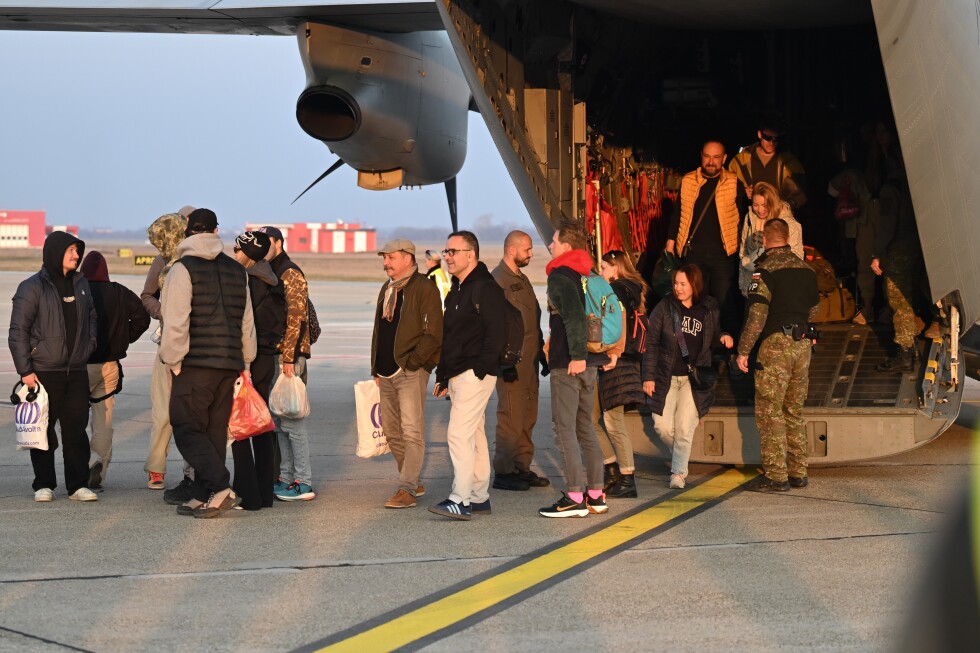
Officials have chartered jets or deployed military aircraft, routing stranded travelers through Oman, Egypt and Saudi Arabia — key exit points where planes could still operate safely.
A plane carrying French citizens from Oman and then Egypt landed in Paris early Wednesday, the first of several expected repatriation flights organized by France. Italy evacuated a group of students from Dubai, while more than 200 people from 16 countries departed Iran by land through neighboring Turkmenistan despite that country’s strict visa policies.
Even as evacuation efforts gain momentum, many travelers face the difficult choice of waiting for government assistance or trying to secure increasingly scarce commercial flights.
According to aviation analytics firm Cirium, more than 23,000 of the roughly 44,000 flights scheduled to fly to or from the Middle East between the start of the conflict and Thursday have been canceled. Flight-tracking service FlightAware reported more than 2,400 flight cancellations worldwide on Wednesday, down from about 3,150 on Monday.
Recovery Flights Underway
France estimates about 400,000 of its citizens are in parts of the Middle East affected by the conflict, either as residents or travelers.
Eleonore Caroit, the minister responsible for French nationals abroad, said about 100 seats on the country’s first evacuation flight were reserved for vulnerable passengers, including families with children, older people and those with medical conditions. Two more flights were scheduled Wednesday — a military aircraft carrying 180 French citizens from Abu Dhabi and a charter bringing 205 people from Israel.
The U.S. State Department reports 18,000 Americans have returned safely, including 8,500 on Tuesday. President Donald Trump’s spokeswoman Karolyn Leavitt pushed back Wednesday against criticism that the administration had not done enough to help Americans leave.
“We will help every single American who wants to come home if they’re making that request of the State Department,” she said, adding that a department hotline message advising callers not to rely on U.S. government assistance had been corrected.
Mexican President Claudia Sheinbaum said nearly 280 citizens had been evacuated, while around 15,000 people have left Israel through land crossings into Jordan and Egypt. Israel’s Ministry of Tourism is operating buses to transport tourists to the southern border with Egypt.
Britain announced a charter flight would depart Oman late Wednesday to bring back some of the thousands of U.K. nationals in the Gulf. The U.K. Foreign Office said more than 130,000 British nationals in the Middle East had registered with the government since Saturday, though officials noted not all are seeking to leave.
Ireland’s foreign minister said Emirates airline would operate a flight from Dubai to Dublin on Wednesday, with a charter flight also planned to evacuate 280 people from Oman in the coming days. Officials estimate 22,000 to 23,000 Irish citizens are currently in the Middle East.
Norway has deployed an “emergency team” to Dubai to reinforce embassy staff assisting about 1,500 Norwegians registered in the city.
Regional Impact Extends Globally
On Indonesia’s resort island of Bali, about 6,000 people are stranded after their flights to Dubai, Abu Dhabi and Doha were canceled. Many are tourists from Europe or the U.S. who had planned to connect through those Middle Eastern hubs.
South Africa’s Foreign Ministry urged citizens to take advantage of limited commercial flights after putting its own evacuation plans on hold due to airspace closures.
Airspace restrictions remain in place across most of the Middle East, according to flight-tracking service Flightradar24. Iran, Iraq, Qatar, Bahrain, Kuwait and Syria have announced their no-fly zones will last until at least early next week.
The United Arab Emirates’ airspace is partially closed, while Saudi Arabia continues to restrict routes near its border with Iraq and along the Persian Gulf. Israel is preparing for a phased reopening that would allow incoming flights carrying returning citizens starting early Thursday. Jordan has lifted its previous nighttime flight ban, restoring 24-hour operations.
The aviation notices governing these closures allow authorities to modify restrictions on short notice depending on security conditions, creating a volatile situation for airline schedules as the conflict continues.
Some commercial airlines have resumed limited service, but seats are filling quickly. British Airways reported that its flights scheduled to depart Muscat through Saturday were fully booked, while Etihad Airways and Emirates, based in Abu Dhabi and Dubai, said their commercial flights remained suspended due to regional airspace closures, although both airlines operated a small number of repatriation and cargo flights.
For travelers like Fabio Falasca, a 28-year-old entrepreneur from Rome stranded in Dubai, the ordeal has been harrowing. After spending Saturday night sleeping in an underground parking lot, he eventually secured passage on a bus to Oman where he could catch a flight back to Italy.
“I can’t wait to get home and not be afraid of what’s outside,” Falasca said. “My only thought is to get home.”
Fact Checker
Verify the accuracy of this article using The Disinformation Commission analysis and real-time sources.

8 Comments
This is a very concerning situation, with so many travelers stranded due to the escalating tensions in the Middle East. I hope the repatriation efforts are successful in safely returning everyone home.
The logistics of these large-scale repatriation efforts must be incredibly complex. I’m curious to learn more about the coordination between different countries and airlines to manage the evacuation of citizens from this volatile region.
Yes, the coordination required is surely immense. Governments will need to work closely with airlines and other transport providers to efficiently route people through the limited safe exit points.
This is a stark reminder of the unpredictability and volatility of the geopolitical landscape in the Middle East. My thoughts are with the travelers anxiously awaiting safe passage home.
This situation highlights the importance of travel insurance and having contingency plans when visiting high-risk regions. I hope the affected travelers are able to get home safely, despite the disruptions.
It’s heartbreaking to hear about the plight of these travelers, having their trips disrupted and facing such difficulties getting home. Kudos to the governments working to facilitate these emergency evacuation flights.
The escalating tensions in the Middle East are deeply concerning, and my heart goes out to all the travelers caught in the crossfire. I’m glad to see governments taking action to repatriate their citizens.
Agreed, the safety and wellbeing of the stranded travelers must be the top priority right now. Let’s hope the repatriation efforts continue smoothly.