


Listen to the article
Brazilian Cultural Institute Brings “Fake News” Exhibition to PUCRS University
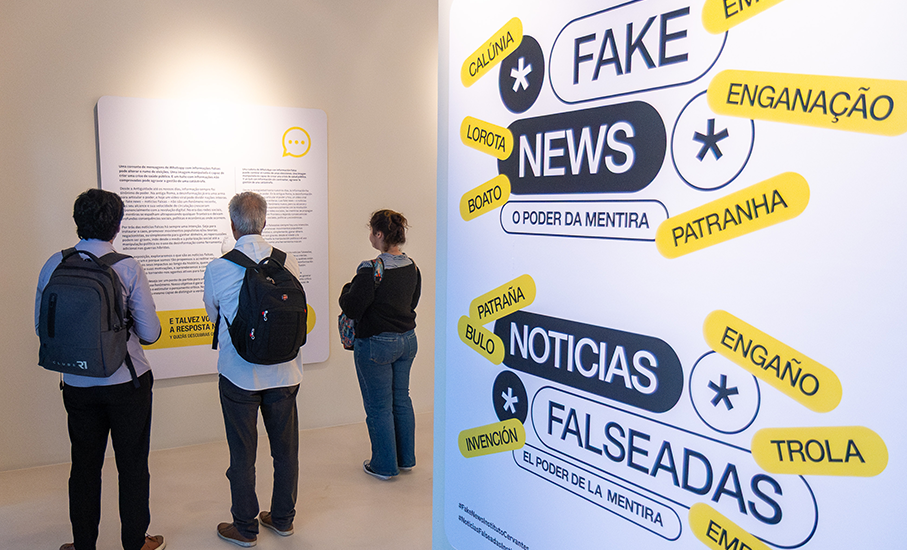
The Instituto Cervantes, in collaboration with PUCRS Culture, is bringing the educational exhibition “Fake News – The Power of Lies” to Porto Alegre. The exhibition, which has previously toured major cities including Brasília, Rio de Janeiro, New York, and São Paulo, will open on April 15th at the Central Library Brother José Otão on the PUCRS campus.
Developed by Spanish creative agency Prodigioso Volcán, the exhibition takes a critical look at misinformation, exploring how fake news functions, why people believe it, and strategies to combat its spread. The display will be available to the public free of charge until May 16th, with viewing hours Monday through Friday from 7:35 AM to 10:35 PM, and Saturdays from 9:00 AM to 2:40 PM.
To complement the exhibition’s opening, a roundtable discussion will take place on April 15th at 7:15 PM in the Living 360° Auditorium. The panel will feature Álvaro Sánchez from Prodigioso Volcán, alongside professors and researchers Gabriela Bailas and Luana Chinazzo. Registration for this discussion is free and open to the public through the organizers’ website.
“In a time when misinformation spreads faster than ever before, understanding the mechanics behind fake news has become essential,” said a representative from Instituto Cervantes. The exhibition offers visitors an interactive opportunity to assess their own vulnerability to misinformation and test their ability to distinguish truth from lies.
The exhibition highlights that while fake news is not a modern phenomenon – having been used as a tool of manipulation since ancient Rome – digital technology has dramatically amplified its reach and impact. In today’s hyper-connected world, false information transcends geographical boundaries with unprecedented speed, causing significant societal, political, and economic damage.
Experts note that fake news typically serves specific purposes: creating social chaos, reinforcing populist rhetoric, promoting conspiracy theories, or generating financial gain through clickbait. The consequences can be far-reaching, from stoking public fear and deepening political polarization to undermining electoral processes and even functioning as a form of hybrid warfare.
The roundtable will bring together diverse perspectives on the phenomenon. Álvaro Medina Sánchez, who leads strategic projects at Prodigioso Volcán, brings expertise in new narratives and artificial intelligence in journalism. Gabriela Bailas, who holds a PhD in Theoretical Particle Physics, will offer insights from her work as a science communicator. Luana Chinazzo, a researcher with a dual doctorate in Social Communication and Sociology, specializes in studying disinformation and social media during sociopolitical crises.
This exhibition comes at a critical moment when Brazil, like many countries worldwide, grapples with the challenges of misinformation. Recent studies have shown growing concern about the impact of fake news on democratic processes, public health initiatives, and social cohesion across Latin America.
The initiative represents part of a broader effort by educational and cultural institutions to promote media literacy and critical thinking skills among the general public. By bringing this exhibition to a university setting, organizers hope to engage both students and the wider community in conversations about responsible information consumption in the digital age.
Visitors are encouraged to approach the exhibition with an open mind and consider how their own information habits might be influenced by the psychological and technological factors that enable fake news to flourish in contemporary society.
Fact Checker
Verify the accuracy of this article using The Disinformation Commission analysis and real-time sources.

9 Comments
This exhibition on misinformation sounds like a timely and important initiative. Understanding how fake news spreads and strategies to combat it is crucial in today’s information landscape.
In a time of heightened concern over the spread of misinformation, initiatives like this are sorely needed. Kudos to PUCRS for hosting this important exhibition.
Agreed, this is a valuable educational opportunity. Hopefully it inspires more universities to follow suit.
The exhibition’s focus on exploring why people believe misinformation is particularly interesting. Understanding the psychology behind it could lead to more effective solutions.
Curious to see what strategies and insights the exhibition offers for combating the proliferation of fake news. Addressing this challenge is crucial for an informed public.
The roundtable discussion with experts from the exhibition’s creator and local professors is an excellent way to foster dialogue and deeper engagement on this topic.
Public accessibility is also key – making this exhibition free and open to all is commendable.
Bringing this educational exhibit to a university setting is a smart move. Students are often at the forefront of navigating online information, so equipping them with critical thinking skills is invaluable.
Agreed. Proactive efforts to address misinformation at the academic level can have far-reaching impacts.