


Listen to the article
Thousands of New York City building workers have voted to authorize a potential strike, setting the stage for what could be the first such work stoppage in 35 years. The strike would affect an estimated 1.5 million residents across the city if contract negotiations fail to produce an agreement before the current contract expires at midnight on Monday.
Members of the 32BJ Service Employees International Union (SEIU), which represents approximately 34,000 doorpersons, superintendents, porters, and other residential building workers, are locked in contentious negotiations with building owners over health care benefits, pension plans, and wage increases.
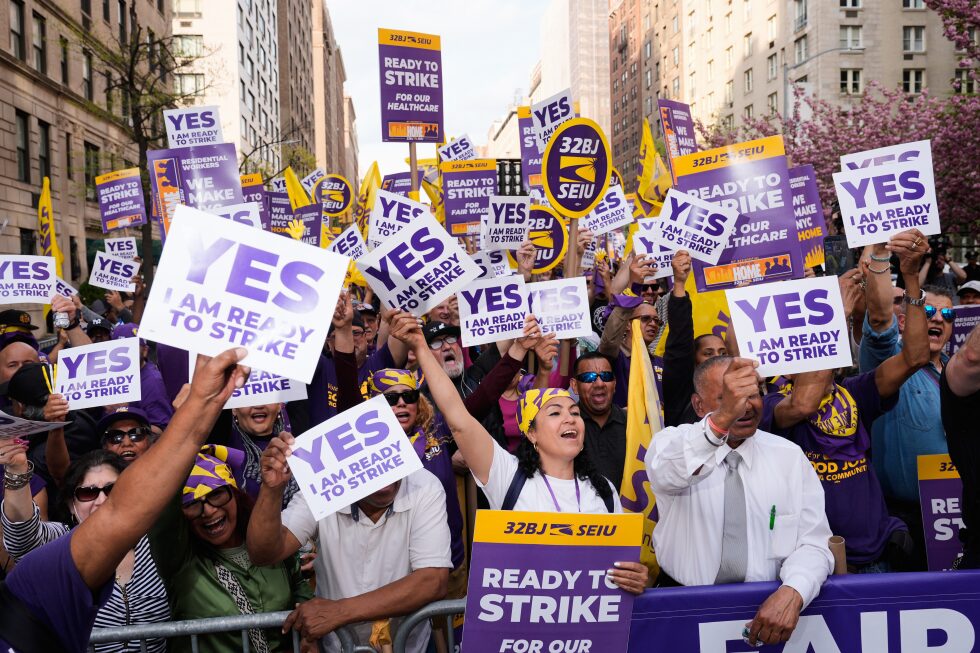
At a massive rally that stretched for four blocks along Manhattan’s Park Avenue on Wednesday, workers held cards declaring their readiness to strike as colleagues watched from their posts at nearby buildings. The demonstration highlighted the growing tension between workers who maintain some of New York’s most valuable real estate and the property owners who employ them.
“We try to take care of everyone,” said Adam Cintron, a 39-year-old doorperson who attended the rally. While hoping to avoid a strike, Cintron expressed concern about keeping pace with the city’s steep cost of living on the industry’s average salary of about $62,000 for doorpersons.
The standoff centers on several key issues. Building owners, represented by the Realty Advisory Board on Labor Relations, want workers to begin paying health insurance premiums—a benefit workers currently receive at no cost. Owners have also proposed creating a new, lower-paying job classification for future hires, which the union strongly opposes.
Meanwhile, the union is advocating for increased pension benefits and higher wages, though specific wage proposals have not yet been made public. Union President Manny Pastreich emphasized that workers face rising costs, particularly housing expenses, which he pointedly noted benefit “the very same building owners who say they have to come after our health care to make ends meet.”
Howard Rothschild, President of the Realty Advisory Board, countered that building owners face mounting expenses of their own, including the potential impact of Mayor Zohran Mamdani’s proposed rent freeze on the city’s approximately one million rent-stabilized apartments. Rothschild called for a contract that “supports a viable path forward” and warned that “without meaningful movement to address costs… the long-term sustainability of the industry and its workforce is at risk.”
The building owners have noted that most American workers contribute to their health insurance premiums, unlike these building service employees who currently receive full coverage. But workers like Percy Jackson, a porter in Brooklyn’s East New York neighborhood who has been in the industry for 23 years, consider these benefits essential to their livelihoods.
“With everything going up in New York… if we had to pay, actually, into our medical, it wouldn’t work,” Jackson explained.
The potential strike would have far-reaching implications across New York City’s residential landscape. Building residents could suddenly find themselves responsible for tasks typically handled by building staff: staffing entry doors, sorting packages, cleaning common areas, removing trash, and maintaining building security.
The role of building service workers has evolved significantly in recent years. Doorpersons, often traditionally pictured as white-gloved figures at ornate entrances, now manage the explosion of package and food deliveries that surged during the pandemic. They assist residents with mobility challenges, provide security in buildings with hundreds of occupants, and often handle cleaning and maintenance tasks.
Superintendents oversee critical building operations and repairs, particularly challenging in New York’s aging housing stock, where many buildings are more than a century old.
In anticipation of a possible strike, some building managers have already advised residents to postpone renovations, moves, and major deliveries, and to minimize visitors until a resolution is reached.
Mayor Mamdani joined Wednesday’s rally, expressing support for the workers who “maintain multimillion-dollar apartments, and yet, when they get home, struggle to understand how they can make rent on the first of the month.”
The last strike by these workers occurred in 1991 and lasted 12 days. While the union has authorized strikes in the years since, they have typically reached agreements before work stoppages occurred. As Monday’s deadline approaches, both sides face increasing pressure to find common ground that addresses the economic realities of both workers and building owners in one of America’s most expensive housing markets.
Fact Checker
Verify the accuracy of this article using The Disinformation Commission analysis and real-time sources.

22 Comments
A potential strike by NYC building workers would be very impactful. I’ll be watching to see if the two sides can reach an agreement that addresses the workers’ needs without causing major disruptions.
This is a delicate balance, as both the workers and residents have valid interests at stake. Compromise and cooperation will be essential to avoid a difficult work stoppage.
A potential strike by NYC building workers highlights the ongoing tensions around compensation and benefits in the real estate industry. I hope both sides can reach an agreement that works for everyone.
Residential building services are vital to the city, so a work stoppage could be very disruptive. I’ll be following this story to see how the negotiations play out.
It’s interesting to see NYC building workers consider striking over contract negotiations. Maintaining quality of life for both workers and residents will be crucial if a strike goes forward.
I hope the two sides can find a compromise that addresses the workers’ concerns around benefits and wages without significantly disrupting building services for residents.
This is a complex issue with valid concerns on both sides. Building workers deserve fair compensation, but property owners also face cost pressures. I’ll be interested to see how the negotiations progress.
A work stoppage would disrupt essential services for many NYC residents. I hope the two sides can find common ground to avoid that scenario.
This is a complex issue with valid concerns on both sides. Building workers deserve fair wages and benefits, but owners also need to control costs. I hope they can find a compromise.
A strike would be very inconvenient for residents, so I hope cooler heads prevail and the two sides can reach an agreement before the contract expires.
This could be a significant labor dispute in NYC. Residential building workers provide essential services, so a strike would likely impact many people. I’m curious to see how the negotiations progress.
Building owners will need to balance the needs of their workforce with maintaining affordable housing. Finding the right solution will be challenging but important for the city.
This is an important labor dispute that could have significant impacts on NYC residents. I’m curious to see if the building owners and union can come to an agreement that addresses the workers’ concerns.
A strike would be very inconvenient, so I hope the two sides can find a solution that works for everyone involved. Maintaining essential building services is crucial for the city.
The tensions between NYC building workers and property owners seem to reflect broader challenges around labor, housing, and urban development. I hope they can find a solution that works for everyone involved.
A strike would be very inconvenient for residents, so I’m glad the workers are trying to avoid that if possible. Hopefully the negotiations result in a fair contract for all.
The potential strike by NYC building workers is a complex issue with valid concerns on both sides. I’ll be following this story to see if the two parties can reach a fair compromise.
A work stoppage would be very disruptive, so I hope the negotiations lead to an agreement that addresses the workers’ needs without significantly impacting residents.
The potential strike by NYC building workers highlights the ongoing challenges around labor rights and urban development. I’ll be following this story closely to see if a resolution can be reached.
Finding the right balance between worker needs and resident impact will be crucial. I hope both sides can compromise to avoid a disruptive work stoppage.
It’s always concerning when essential workers consider striking, as it can significantly disrupt daily life. I’m curious to see if the building owners and union can find common ground.
This dispute highlights the challenges of maintaining a livable city for both workers and residents. Hopefully the negotiation process leads to a fair resolution.