


Listen to the article
Chinese Automakers Showcase Cutting-Edge Technologies at Beijing Auto Show
China’s automotive industry is asserting its global leadership in innovation as manufacturers unveil their latest electric vehicles and technologies at the Beijing Auto Show. The biennial event, which opened to media on Friday and runs until May 3, features more than 1,450 vehicles, including 181 global debuts, highlighting China’s growing dominance in automotive technology.
Industry analysts note that Chinese manufacturers are now setting the pace for technological advancement in electric vehicles and batteries, areas where foreign brands once held uncontested leadership. This shift represents a significant evolution in the global automotive landscape, with Chinese innovation increasingly driving industry standards.
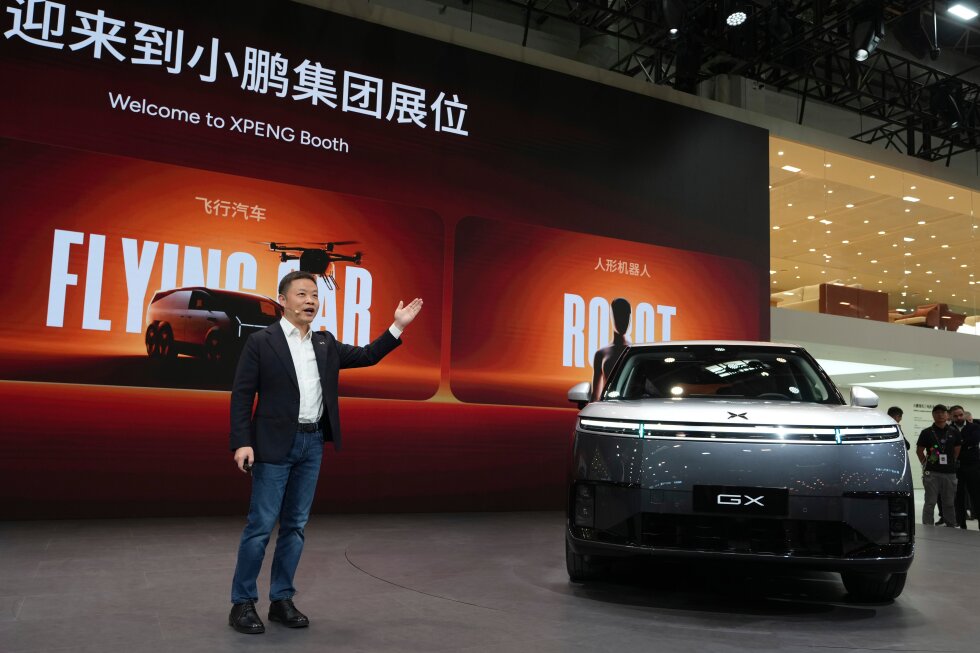
XPeng, a prominent Chinese EV maker, drew large crowds with its new GX model, a six-seater SUV featuring foldable third-row seats that can lie completely flat. During a presentation, founder and CEO He Xiaopeng emphasized the vehicle’s advanced safety systems, including intelligent driving capabilities that can detect if a driver falls asleep or becomes unwell, automatically pulling over and alerting emergency services.
BYD, another leading Chinese manufacturer, showcased its next-generation “blade” EV battery, which can achieve a near-full charge in just nine minutes. The company also demonstrated charging capabilities in extreme conditions, operating at temperatures as low as minus 30 degrees Celsius. These advancements directly address consumer concerns about charging times and cold-weather performance that have historically limited EV adoption.
Meanwhile, Yijing, a joint venture between Dongfeng Motor Corporation and technology giant Huawei, presented its flagship X9 SUV. According to Chairman Wang Junjun, the model features a next-generation Qiankun intelligent driving system and Huawei’s new HarmonyOS cockpit and operating system, reflecting the increasing integration between China’s tech and automotive sectors.
Battery technology also took center stage as CATL, China’s battery manufacturing giant, unveiled an updated version of its “Shenxing” battery that can charge from 10% to 98% in approximately six-and-a-half minutes. This advancement significantly narrows the convenience gap between electric and traditional fuel vehicles.
“It just reinforces that the Chinese — whether in EVs, batteries, intelligent driving — are setting the pace for all these important sectors,” said Tu Le, managing director of consultancy Sino Auto Insights, noting the “speed and aggressiveness of advancement” among Chinese automakers.
Chris Liu, senior analyst at research group Omdia, added: “China has become one of the fastest-moving markets for deploying and iterating new vehicle technologies, giving consumers early access to some of the most advanced features.”
This technological progress comes as China has become the world’s largest car exporter, leveraging cost advantages from its massive scale and benefiting from years of government subsidies that helped manufacturers rapidly scale up and accelerate innovation cycles. However, the domestic market faces challenges, with government EV subsidies scaling back and intense price wars pressuring manufacturers.
Domestic passenger car sales in China dropped 23% in the first quarter of 2024 compared to the previous year, with approximately 4 million vehicles sold. However, exports surged 63% to nearly 2 million vehicles as Chinese manufacturers gained market share in Europe, Southeast Asia, and Latin America. Omdia forecasts China’s passenger vehicle exports will grow by around 14% year-on-year by 2026.
The hypercompetitive Chinese market has driven vehicle prices down by approximately 20% over the past two years, according to consultancy AlixPartners, creating additional pressure on manufacturers’ margins in the domestic market.
While many of the advanced technologies showcased at the auto show may not immediately appear in export models due to regulatory and safety requirements in overseas markets, Liu suggests they signal “capabilities that can be refined and adapted for global markets over time.”
Foreign automakers are attempting to regain ground in China, with Volkswagen Group announcing plans to incorporate “agentic” AI into its vehicles for the Chinese market. The German automaker also unveiled new EV models, including the UNYX 09 electric sedan co-developed with XPeng. However, Andreas Radics, managing director at Berylls by AlixPartners, believes that while foreign brands may “stabilize” their market share, regaining their former dominance is “not realistic.”
Chinese manufacturers are increasingly shifting from exporting finished vehicles to establishing production facilities overseas, with factories in countries like Hungary and Turkey helping to increase international supply and avoid potential trade barriers. According to AlixPartners, Chinese carmakers are projected to almost triple their overseas production to 3.4 million vehicles by 2030, up from 1.2 million last year, signaling a strategic shift in their global expansion approach.
Fact Checker
Verify the accuracy of this article using The Disinformation Commission analysis and real-time sources.

11 Comments
It’s impressive that Chinese brands are now outpacing global leaders in areas like electric vehicles and autonomous tech. This signals a major shift in the industry’s center of gravity.
I’m curious to learn more about the intelligent driving features that can detect driver impairment. Safety should be the top priority as these autonomous capabilities evolve.
Good point. Having fail-safes to ensure driver attentiveness and intervene if needed is crucial for building public trust in self-driving tech.
The foldable third-row seats in the XPeng GX sound like a clever design feature that enhances the vehicle’s versatility. It will be interesting to see how Chinese EV models compare to global competitors on practicality.
Absolutely, functionality and user-friendliness are just as important as cutting-edge technology when it comes to mass-market appeal.
China’s automotive industry is clearly upping its game. I wonder how this will impact the competitive landscape for legacy automakers in the years ahead.
Good question. The rapid pace of innovation coming out of China could force traditional players to rethink their strategies to stay relevant.
Kudos to the Chinese automakers for raising the bar on safety features like the intelligent driver monitoring system. This type of proactive approach is crucial as autonomous capabilities advance.
Exciting to see Chinese automakers pushing the boundaries of innovation in EVs and safety tech. This competition will surely drive the whole industry forward.
Agreed, the rapid advancement in Chinese EV capabilities is quite remarkable. Consumers worldwide will benefit from these innovations.
The sheer scale of new model debuts at the Beijing Auto Show underscores China’s ambition to dominate the future of mobility. Consumers worldwide will be the ultimate beneficiaries of this innovation race.