


Listen to the article
Hawai’i’s aquarium fishing industry faces a critical turning point as lawmakers advance legislation that would permanently ban the practice, while state officials simultaneously develop rules that could revive limited harvesting off the Kona Coast.
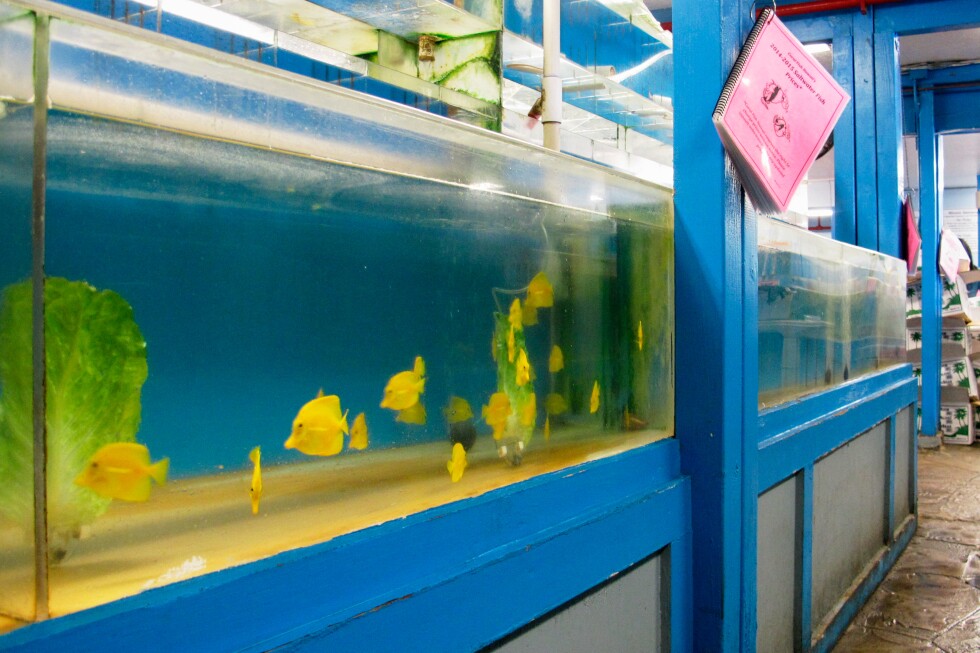
For Kekoa Alip, a 46-year-old Hawai’i Island resident, memories of abundant yellow tang fish—or lau’īpala—swimming along the Kona Coast remain vivid despite their diminished numbers today.
“You could see the waves roll with lau’īpala,” said Alip, who once lived near the Hawai’i Ocean Sciences and Technology Park. “From childhood to my early adulthood, there were totally visual effects of the yellow tang in the reef.”
The controversial practice of collecting tropical fish for aquariums has been on hold statewide since 2017 following various legal challenges. Now, Hawai’i stands at a crossroads with two competing paths forward.
The state House recently passed HB 2101 with a 43-8 vote, advancing legislation that would permanently ban aquarium fish collection off the Big Island. The bill now faces consideration in the Senate, where its referral to four committees suggests a potentially tougher path ahead.
Meanwhile, state aquatic resource managers are developing rules that would allow seven permit holders to collect more than 200,000 yellow tang and other species annually from Big Island reefs. These proposed quotas closely mirror recommendations from an environmental review prepared by the pet trade industry five years ago—a similarity that has alarmed conservation advocates.
The stakes are high. Hawai’i’s reef fish are prized commodities in the global aquarium trade, which represents a multibillion-dollar industry worldwide according to Ron Tubbs, a former collector who operated off O’ahu for decades until court rulings halted the practice in 2021.
The industry continues to wield significant influence in the debate. Records show that the Pet Advocacy Network—the nation’s leading pet trade group—recently enlisted prominent lobbyist Blake Oshiro and his firm, Capitol Consultants Hawai’i, to represent its interests as the legislative battle intensifies.
Local support for the ban appears strong. The Hawai’i County Council unanimously endorsed the prohibition in January, voting 9-0 to urge state lawmakers to end commercial aquarium harvesting.
The controversy has also created space for alternative business models. The Biota Group, led by CEO Carsten Buschkühle and local manager James Gorke, has been developing captive breeding operations for Hawai’i’s reef fish species at Hawai’i Pacific University’s Waimānalo campus. The company testified that an aquarium harvest ban would encourage further investment in its aquaculture efforts.
“Aquaculture allows Hawaiian reefs to stay stocked with marine life while still allowing the iconic animals as ambassadors to educate the world about Hawaii’s reefs,” the group stated in testimony, though it also warned of “significant risk and financial loss” to the aquaculture sector if wild harvesting resumes.
The aquarium fishing industry has fluctuated over decades. Between 1975 and 2017, the number of commercial collectors ranged from just eight in 1982 to a peak of 54 in 1996, according to the state Aquatic Resources Division. By 2020, before statewide environmental court rulings halted the practice, 41 active collectors were operating.
Tubbs described the economics of the trade, noting that collectors could sell fish like kole—a dark bristletooth tang with gold-ringed eyes—to mainland wholesalers for about $20 each. These fish would then be marked up to around $40 for pet stores, which would sell them to consumers for approximately $60.
Alip himself briefly participated in the industry as a teenager, harvesting yellow tang with his cousin before growing concerned about dwindling fish populations. “We chose kuleana over cash,” Alip said, using the Hawaiian term for responsibility. “It’s an export trade. Never heard of anyone wanting locally, the fish. And that was concerning to me even back then.”
The debate extends beyond simple fish counts to deeper questions about the meaning of sustainability. While collectors point to studies showing rapid repopulation of certain species, marine scientist Alohi Nakachi argues that traditional Hawaiian knowledge and community observations must be considered alongside scientific data.
“It’s holistic. It’s not just the fish,” Nakachi explained. “It’s how the limu will affect the fish that affect the coral reefs. They’re all in this integrated, connected system.”
The issue continues in the courts as well. The Hawai’i Island Aquarium Fishers Association sued in 2024 to force state agencies to issue commercial licenses, arguing they fulfilled environmental review requirements established in earlier court decisions.
Public hearings on the state’s proposal to reopen limited aquarium fishing are scheduled for late March and early April, while the legislative ban awaits Senate committee hearings. Whatever the outcome, the decisions made in coming months will significantly impact Hawai’i’s marine resources and the communities that depend on them for generations to come.
Fact Checker
Verify the accuracy of this article using The Disinformation Commission analysis and real-time sources.

8 Comments
As an outsider, I’m curious to learn more about the history and cultural significance of the aquarium trade in Hawaii. Understanding the full context will be important in shaping equitable policies.
Lawmakers have a difficult choice ahead. A permanent ban could devastate the aquarium trade, but limited, sustainable harvesting might be a viable compromise. I’m curious to see how the Senate deliberations unfold on this critical issue.
This is a complex issue with valid arguments on both sides. Preserving Hawaii’s marine ecosystems is crucial, but the livelihoods of aquarium traders also need to be considered. I hope lawmakers can find a balanced solution that protects the environment while supporting sustainable economic activity.
Agreed, finding the right balance will be challenging but essential. Ongoing dialogue and compromise from all stakeholders will be key to reaching a fair outcome.
The decline in yellow tang populations is concerning. As a longtime resident, I can understand the nostalgia and sense of loss expressed. Any legislative changes should be based on rigorous scientific data to ensure the right long-term decisions are made.
That’s a good point. Sound data and ecological assessments should drive the policy. Emotional appeals alone won’t lead to the best outcome for Hawaii’s marine life.
It’s heartening to see the state taking this issue seriously and exploring multiple paths forward. Protecting Hawaii’s natural wonders should be the top priority, but the economic impacts on local communities also warrant careful consideration.
Absolutely. Finding the right balance between environmental preservation and economic realities is the ultimate challenge here. I hope all sides can approach this constructively.