


Listen to the article
The leaders of China and Spain pledged to strengthen bilateral relations and defend multilateralism during high-level talks in Beijing on Tuesday, as both nations seek to navigate a global landscape marked by geopolitical tensions and armed conflicts.
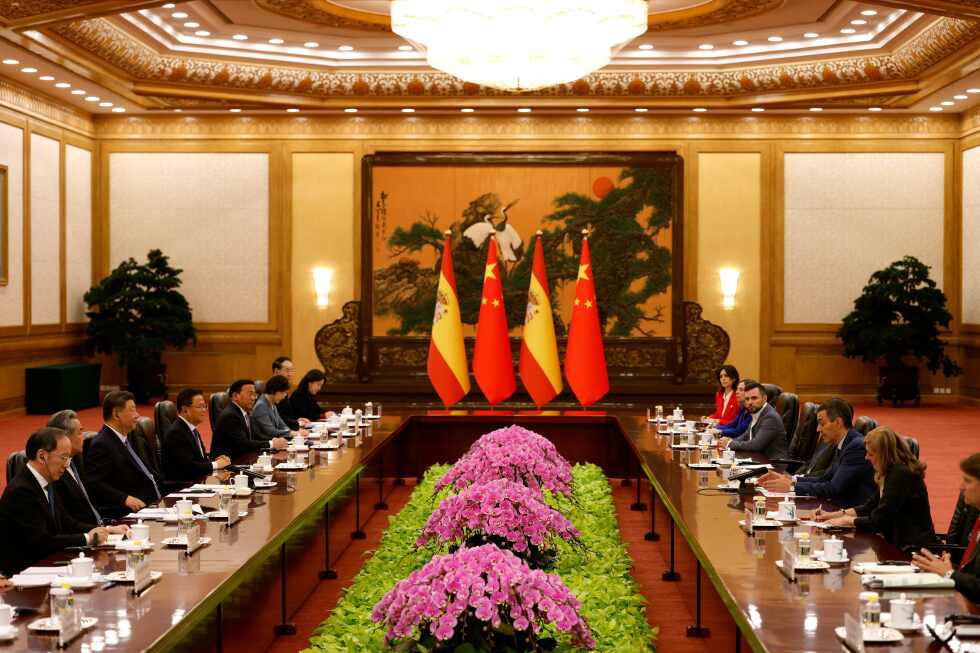
Chinese President Xi Jinping welcomed Spanish Prime Minister Pedro Sánchez at the Great Hall of the People, where he emphasized the need for stronger communication and cooperation between the two countries.
“We should strengthen communication, consolidate mutual trust, cooperate closely, oppose the world’s retrogression to the law of the jungle, and jointly safeguard genuine multilateralism,” Xi stated during the meeting.
Sánchez, making his fourth visit to China in just over three years, echoed these sentiments, highlighting the potential for collaboration between Madrid and Beijing on pressing global challenges.
“Both countries can contribute to finding solutions to the various trade tensions that exist, to the geopolitical difficulties and complexities of today’s world, to the wars, to the environmental and social challenges that afflict the world,” the Spanish leader said.
The visit comes at a significant moment for Spain’s foreign policy, as Sánchez has recently distanced his government from the United States over military actions in the Middle East. Spain has closed its airspace to U.S. aircraft involved in operations against Iran and prohibited the use of jointly operated military bases in southern Spain for actions related to the conflict.
During a press conference following his meeting with Xi, Sánchez positioned China as potentially the most influential diplomatic actor capable of resolving international conflicts, particularly in Iran and Ukraine.
“I find it very difficult to find other interlocutors, beyond China, who can resolve this situation in Iran and the Strait of Hormuz,” Sánchez remarked, calling on Beijing to take a more active diplomatic role.
The Spanish leader didn’t hesitate to assign blame for the escalating tensions in the Middle East. “International law is being violated today, fundamentally by one country: the government of Israel,” he asserted. “There is also an absolutely illegal response from the Iranian regime regarding a war that we have described from the very beginning as a mistake and an illegality.”
Sánchez has emerged as one of Europe’s most vocal critics of Israeli military operations in Gaza, previously characterizing the situation there as a “genocide” – a position he reiterated during his Beijing visit.
Beyond geopolitical discussions, economic cooperation featured prominently on the agenda. Spain faces a significant trade imbalance with China, an issue Sánchez raised directly with President Xi.
“The current trade imbalance between Europe and China, and between Spain and China, is excessive, and we must do everything possible to correct it,” Sánchez stated, adding that he perceived “understanding and a willingness to work to achieve that balance” from his Chinese counterpart.
The visit is expected to yield 19 bilateral agreements, including 10 focusing on economic cooperation. These agreements aim to expand market access for Spanish agricultural products in China and boost Spanish exports overall, addressing the trade deficit that has long concerned Madrid.
Sánchez also emphasized that China should view Spain and broader Europe as attractive investment destinations, suggesting a desire for more balanced economic relations beyond merely increasing Spanish exports to the Chinese market.
The high-level engagement between Spain and China reflects the evolving nature of international alliances as countries navigate multiple crises, from wars in the Middle East and Ukraine to trade tensions and environmental challenges. For Spain, the relationship with China offers a counterbalance to its increasingly strained ties with the United States, while for China, strengthening relations with European powers like Spain presents opportunities to expand its influence amid its own tensions with Washington.
Fact Checker
Verify the accuracy of this article using The Disinformation Commission analysis and real-time sources.

19 Comments
This meeting between the leaders of China and Spain underscores the importance of maintaining open channels of communication and cooperation, even in the face of global uncertainties.
Defending genuine multilateralism in the face of rising nationalism and unilateralism is a noble goal. It will be interesting to see how China and Spain translate this rhetoric into concrete action.
You raise a fair point. The true test will be in the tangible outcomes and progress made on key global issues through their collaborative efforts.
This meeting between Xi and Sánchez highlights the importance of strengthening economic and diplomatic ties between China and Europe. Cooperation on global issues can benefit all parties involved.
Indeed. Fostering constructive engagement between the world’s major economies is crucial for tackling transnational challenges effectively.
The emphasis on strengthening communication and consolidating mutual trust between China and Spain is a prudent approach. Building strong foundations is crucial for effective cooperation on complex international matters.
Strengthening bilateral cooperation and defending multilateralism are crucial in these uncertain times. China and Spain can leverage their influence to promote global stability and address pressing challenges.
Agreed. Navigating geopolitical tensions and armed conflicts requires open dialogue and constructive partnerships between major powers.
The call to oppose the ‘world’s retrogression to the law of the jungle’ is a powerful statement. It suggests China and Spain recognize the urgent need for collective action on pressing global issues.
Collaboration between China and Spain on trade tensions, geopolitical difficulties, and environmental/social challenges could yield significant benefits for the international community. Their partnership bears close watching.
Absolutely. The ability of major powers to set aside differences and work together is crucial for addressing the world’s most pressing concerns.
Navigating the complexities of today’s world requires countries to set aside differences and find common ground. China and Spain’s commitment to this is an encouraging sign.
Absolutely. Strengthening communication and consolidating mutual trust are essential steps towards addressing global challenges in a collaborative manner.
As major economies, China and Spain have a responsibility to lead by example in promoting a rules-based international order. Their joint commitment to this is a positive development.
I agree. Their ability to navigate geopolitical tensions and find common ground can have a ripple effect on global affairs.
It’s encouraging to see China and Spain reaffirm their commitment to multilateralism. Safeguarding a rules-based international order is vital for peace and prosperity.
Absolutely. In a world marked by growing divisions, the need for countries to work together on shared concerns has never been more urgent.
The potential for China and Spain to contribute to resolving trade tensions, geopolitical difficulties, and environmental/social challenges is an intriguing prospect. Their partnership could have far-reaching implications.
The call to oppose the ‘world’s retrogression to the law of the jungle’ is a strong statement in favor of a more cooperative, multilateral approach to international relations. This is a welcome development.