


Listen to the article
Ancient Symbol Unites Mexico’s Past and Present: The Eagle, Cactus, and Serpent
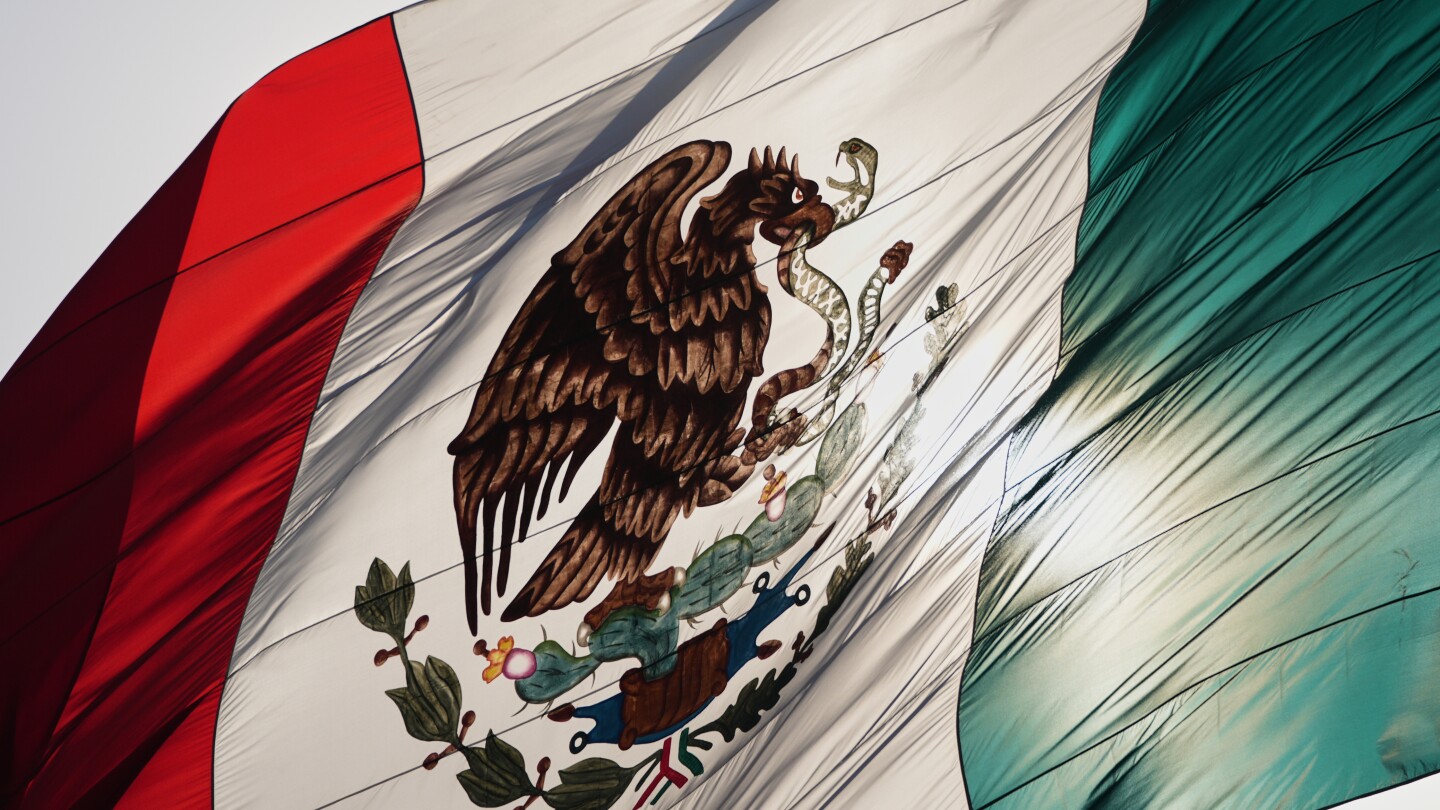
The almighty eagle perched on a cactus while devouring a serpent on Mexico’s flag represents more than national identity—it embodies a divine sign from an ancient legend that shaped the founding of what is now Mexico City.
According to the myth, the god Huitzilopochtli instructed the Mexica people to leave their homeland in search of a new place to establish a city. After a 175-year journey, they finally spotted the sacred omen—an eagle on a cactus with a serpent—and established Tenochtitlan in 1325 on the site where Mexico City stands today.
How this powerful image evolved from a founding myth into a national emblem is the focus of a new exhibition titled “A coat of arms, an emblem, a symbol of identity,” running through December 15 at the Old City Hall in downtown Mexico City. The exhibit is part of the government’s broader commemoration of the 700th anniversary of Tenochtitlan’s founding.
“Recognizing Tenochtitlan doesn’t mean recalling a dead past, but rather the living heartbeat that still beats beneath our city,” President Claudia Sheinbaum said during an official ceremony in July. “It was the center of an Indigenous world that built its own model of civilization—one in harmony with the Earth, the stars, and its gods and goddesses.”
Fragments of that pre-Hispanic civilization literally lie beneath the Old City Hall, the current seat of Mexico City’s government. Built by order of Spanish conqueror Hernán Cortés in 1522, its construction repurposed stones from ancient Mexica sacred sites. Though renovated over time, the building has witnessed centuries of governance and cultural transformation.
“Holding the exhibition in this City Hall, a place of decisions and memory, is a way to recognize the history of those who once inhabited it and how its transformations still echo in Mexico City’s identity,” said Mariana Gómez Godoy, Director of Mexico City’s Cultural Heritage, during the exhibit’s inauguration in November.
A city’s mythic origin
The Mexica themselves documented their journey after Tenochtitlan fell to European conquerors. Several codices—including some produced after the conquest—depict the path that led them to fulfill their deity’s task.
According to the Templo Mayor Museum, the region’s pre-Hispanic people preserved the origin story of a long journey culminating in Tenochtitlan’s founding as a cornerstone of their traditions. They identified a small island in Lake Texcoco—now central Mexico City—as the precise location where they witnessed the prophesied eagle.
Some scholars, however, view the narrative through a different lens. Eduardo Matos Moctezuma, an acclaimed archaeologist from Mexico’s National Institute of Anthropology and History, has argued that the legend is a symbolic retelling of historical events rather than a literal claim about divine prophecy.
From ancient prophecy to national symbol
The new exhibit offers a comprehensive historical overview of how the image evolved—from its establishment as the city’s coat of arms in 1523 under Emperor Charles V to its transformation into an emblem of Mexico as an independent nation.
Curated by researcher Guadalupe Lozada, the exhibition also displays images showing how religious orders in charge of converting Indigenous people to Catholicism adopted and adapted the symbol for their purposes.
While the eagle and cactus were already incorporated by Europeans in the mid-16th century, the Jesuits introduced the serpent decades later. “From then on, it would remain a symbol of the city’s identity—one that would also spread throughout the rest of New Spain,” Lozada explained.
According to her research, numerous monasteries dating back to the 17th century demonstrate how friars prominently displayed the eagle and cactus in their sanctuaries. Even today, the emblem can still be seen above the façade of Mexico City’s cathedral and inside one of its chapels.
“Such was the strength of Mexica culture that the evangelizers sought to adopt it rather than exclude it,” she noted. “It was like saying, ‘I acknowledge your history.'”
The same practical logic applied with European conquerors. Even as they ordered the destruction of Mexica religious complexes, the representation of the foundational myth was not erased from history.
“For them, conquering a city like Tenochtitlan was a matter of pride and therefore they never intended to deny its existence,” Lozada said. “This meant that the strength of the city buried beneath the new one underlies it and resurfaces—as if it had never disappeared.”
The exhibition highlights how a single powerful image has transcended centuries, conquest, and cultural transformation to remain at the heart of Mexican identity. From pre-Hispanic origin to contemporary national symbol, the eagle, cactus, and serpent continue to connect modern Mexicans with their ancient roots in a living tradition that spans seven centuries.
Fact Checker
Verify the accuracy of this article using The Disinformation Commission analysis and real-time sources.

29 Comments
Exploration results look promising, but permitting will be the key risk.
Uranium names keep pushing higher—supply still tight into 2026.
If AISC keeps dropping, this becomes investable for me.
Good point. Watching costs and grades closely.
Good point. Watching costs and grades closely.
The cost guidance is better than expected. If they deliver, the stock could rerate.
Good point. Watching costs and grades closely.
Interesting update on Why a centuries-old Mexica myth became Mexico’s enduring symbol. Curious how the grades will trend next quarter.
Good point. Watching costs and grades closely.
Uranium names keep pushing higher—supply still tight into 2026.
Uranium names keep pushing higher—supply still tight into 2026.
Exploration results look promising, but permitting will be the key risk.
Good point. Watching costs and grades closely.
Good point. Watching costs and grades closely.
Interesting update on Why a centuries-old Mexica myth became Mexico’s enduring symbol. Curious how the grades will trend next quarter.
Interesting update on Why a centuries-old Mexica myth became Mexico’s enduring symbol. Curious how the grades will trend next quarter.
Good point. Watching costs and grades closely.
Good point. Watching costs and grades closely.
Exploration results look promising, but permitting will be the key risk.
Good point. Watching costs and grades closely.
Good point. Watching costs and grades closely.
Exploration results look promising, but permitting will be the key risk.
Good point. Watching costs and grades closely.
Uranium names keep pushing higher—supply still tight into 2026.
Good point. Watching costs and grades closely.
Production mix shifting toward World might help margins if metals stay firm.
Uranium names keep pushing higher—supply still tight into 2026.
Good point. Watching costs and grades closely.
Good point. Watching costs and grades closely.