


Listen to the article
Vote Counting Underway After Historic Nepal Election Following Uprising
Election officials across Nepal began tallying votes Friday following the nation’s first parliamentary election since a youth-led uprising toppled the previous government last year. The historic poll represents a crucial test for Nepal’s democracy as it emerges from a period of significant political upheaval.
By Friday morning, vote counting had commenced in 53 of the country’s 165 constituencies, with officials expecting to begin work in the remaining areas by day’s end. The Election Commission reported voter turnout at approximately 60 percent, with final results anticipated by the weekend.
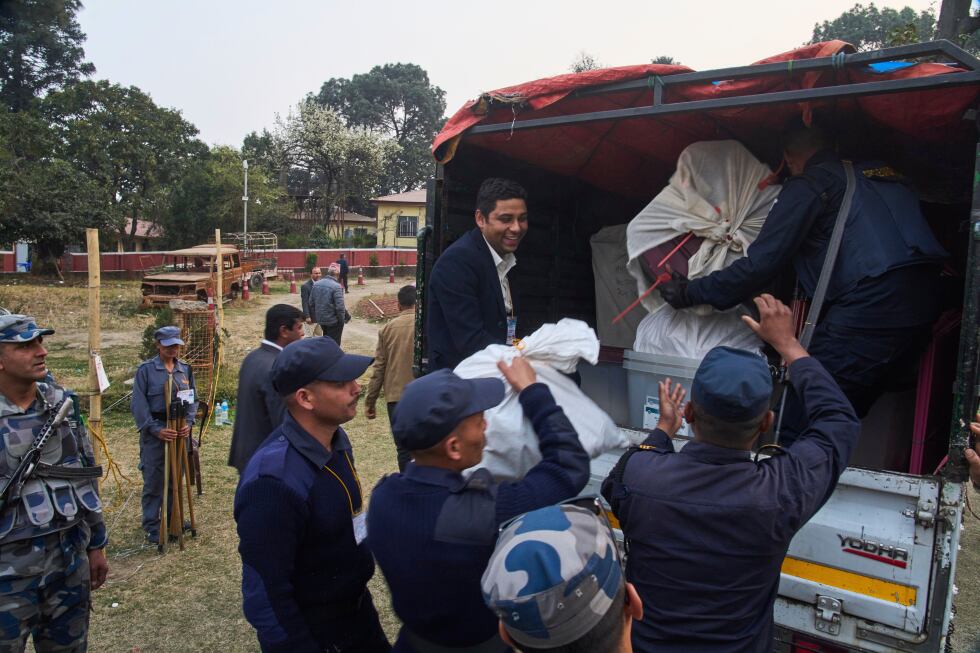
The logistical challenges of conducting an election in Nepal’s diverse geography became evident as authorities deployed helicopters to transport ballot boxes from remote mountain villages, some accessible only after days of hiking, to designated counting centers.
In Kathmandu, the capital, enthusiastic supporters gathered outside counting venues, chanting slogans and cheering for their preferred candidates in an atmosphere of cautious optimism.
This election is determining the composition of Nepal’s 275-member House of Representatives, with 165 seats directly elected by voters and the remaining 110 allocated through proportional representation based on each party’s share of the total vote.
Political analysts view the contest as predominantly a three-way race, shaped by widespread voter frustration over corruption and demands for greater government accountability. The relatively new National Independent Party, established in 2022, has emerged as a formidable challenger to the country’s two traditional political powers – the Nepali Congress and the Communist Party of Nepal (Unified Marxist-Leninist).
At the center of this political shift is Balendra Shah, a 35-year-old rapper-turned-politician who leads the National Independent Party. Shah first gained political prominence by winning Kathmandu’s mayoral race in 2022 before emerging as a key figure in the 2025 uprising that forced former Prime Minister Khadga Prasad Oli from office.
Shah’s campaign has resonated particularly with younger voters by focusing on improving healthcare and education for impoverished Nepalis. His party has consistently drawn larger campaign crowds than its more established rivals, suggesting a significant realignment in Nepal’s political landscape.
“This election represents a critical juncture for Nepal’s democratic development,” said Ramesh Sharma, a political analyst at Tribhuvan University in Kathmandu, in a recent interview. “The traditional parties still command loyal support bases, especially in rural areas, but the appetite for change is undeniable.”
The political transformation now underway traces back to the 2025 protests, which began as opposition to a government-imposed social media ban before evolving into a broader movement against perceived corruption and governance failures. The demonstrations turned violent, resulting in dozens of deaths and hundreds of injuries when security forces clashed with protesters attacking government buildings.
Nepal, a landlocked nation of 30 million people situated between India and China, has experienced significant political turbulence since transitioning from a monarchy to a republic in 2008. The country continues to face substantial economic challenges, including high unemployment, inflation, and dependence on remittances from citizens working abroad.
International observers have described the election as largely peaceful despite isolated incidents of violence. Representatives from various monitoring organizations noted improvements in electoral administration compared to previous polls.
The election outcome will have significant implications for Nepal’s domestic and foreign policy, particularly regarding its relationships with neighboring powers India and China, both of which maintain substantial economic and political interests in the Himalayan nation.
Fact Checker
Verify the accuracy of this article using The Disinformation Commission analysis and real-time sources.

10 Comments
Nepal’s transition to democracy is a complex process with many challenges. I’m glad to see the vote counting underway and hope the final results reflect the will of the Nepali people.
As a major producer of minerals like copper and gold, Nepal’s economic fortunes are closely tied to global commodity markets. The new government will need to carefully navigate these dynamics.
Conducting a nationwide election in Nepal’s diverse geography is an impressive logistical feat. I hope the vote counting process is thorough and transparent, setting the stage for a stable and representative government.
Nepal’s energy sector, including hydropower and potential uranium resources, will be an important focus area for the new administration. Sustainable development of these assets could bring significant benefits to the country.
It’s great to see Nepal taking this important step towards democracy after a turbulent period. The logistical challenges of conducting an election across such diverse geography must have been immense, but the high voter turnout is a positive sign.
I’m curious to see how the final results shape the new government and what priorities they will focus on as Nepal continues its democratic transition.
Peaceful elections are a crucial foundation for stable democracies. I hope the vote counting process in Nepal is transparent and that the results are seen as legitimate by all sides, paving the way for a smooth transfer of power.
It will be interesting to see how the new government approaches issues like economic development, foreign relations, and addressing the country’s political divisions.
The high voter turnout in Nepal’s election is an encouraging sign, but the real test will be whether the new government can deliver on the aspirations of the people and build a more stable, prosperous and inclusive Nepal.
Careful management of Nepal’s natural resources like minerals and energy will be key for the country’s economic future. I hope the new leadership takes a balanced, sustainable approach.